
 I visited a friend in Ithaca recently and we hit a couple of wineries on the southeast shore of Seneca Lake before we hiked up Watkins Glen (pictured at right). Our timing was great: we were swamped by heavy showers during the wine tasting, but the skies parted before our hike, just as we'd hoped.
The Finger Lakes is of course known for its riesling, but it's tougher to ripen reds adequately in this climate, and whatever the effects global warming might have, the region is still subject to periods of bitter cold in the winter and hot, humid conditions in the summer. Nevertheless, the two wineries we hit both focus on reds.
Up first was Shalestone Vineyards, who proclaim that "red is all we do." Despite their specialty, I was distinctly underwhelmed, as their entire lineup — from the cabernets to the merlot to the pinot to the meritage — tasted exactly the same: simple yet vague, with the barrel influences overcoming whatever terroir / varietal expression there might have been. The one exception was their Synergy blend that's 50% syrah; it was so short that it tasted like nothing at all.
Our experience at Damiani Wine Cellars was considerably better. I'd tasted their 2006 Meritage previously, thanks to a generous gift from my friend, and I'd admired its balance, its Loire-like weight, its lightly spiced minerality, and the way it hadn't been knocked up by oak or overextracted. During the tasting here I walked around the winemaking facility and saw that Damiani do use new French oak, but the oak doesn't overwhelm any of the wines. I was particularly pleased with the pinot noir, as every one in the lineup, from the $8 2006 (simple yet tasty) to the $32 2007 Reserve (more substance and complexity), drank as true pinot, with the light weight and refreshing, savory/sweet cherry aromas I look for. Interestingly, Damiani claims that their vineyard includes limestone as well as slate, which likely helps matters (or does for the reds; I found their semi-dry riesling dull).
As an aside, I received a press sample of the 2007 Heron Hill Blaufrankish Reserve from the Keuka Lake area back in July. Matured for 18 months in mostly Hungarian oak (70% new) and described by the winery as "opulent" and "hedonistic," I found that it announces itself on the palate with a blast of brisk, orangey acidity, sweet-tart flavors of pomegranate and mulberry, and a hint of white pepper and minerals. These elements are integrated, yet somehow they sing the same high note; even over three nights of tasting the wine felt one-dimensional rather than complex, and its thin orange-and-mulberry acidity seems to overrule the other characteristics. This wasn't an off bottle, but it seems strange that others seem to have had a different wine than I experienced.
Anyway, the rest of my Finger Lakes trip was pretty cool. We hiked in dramatic shale gorges, waved at Carl Sagan's house from afar, and had a couple of low-stress and delicious meals at the Pourhouse in Trumansburg, where I discovered the excellent Southern Tier IPA. Cheers to Ithaca!
Saturday, October 24, 2009
Reds in the Finger Lakes
Monday, October 19, 2009
Green Shoots?

To celebrate a good friend's newfound employment, we opened a bottle of Egly-Ouriet Champagne Brut "Les Vignes de Vrigny" 1er Cru, which is 100% pinot meunier from 40 year old vines — quite unusual. This is a joy to drink, a wine of real cut and verve. It's autolytic, with aromas of toasted hazelnuts and salted crackers (not the bread or brioche found in many Champagnes), but I also smell yellow flowers, chalk, and pears. It's beautiful, creamy, and long, with the racy acidity driving red fruits down the sides of the tongue with lovely cut and precision. The mousse is full, fine, and alive. This spent 40 months on the lees and was disgorged November 2008, so likely there's a lot of fruit from 2004 in here.
Going way downscale, I recently bought a terrific bottle of the 2004 Agricole Vallone Salice Salentino Vereto Riserva for just $11. Wine in Chicago seems to be more expensive than everywhere else on the planet (among other things, we have the highest sales tax in the nation), so you can probably find this for less. This medium-bodied wine shows bright cherry fruit, solid acidity, and some zingy pepper notes that showed great with pizza. The 10% of the blend that's malvasia nera is used to soften the wine; the other 90% is negroamaro. It's nice to find an affordable, everyday wine with real character and life.
Wednesday, October 7, 2009
Malvasia From the Piedmont

Malvasia bianco (there are red sheep in the malvasia family) is known to travel inland and north somewhat. For example, Lopez de Heredia uses a small proportion of malvasia in their white Riojas, and it's found to some small degree in central Italy. The Oxford Companion to Wine even says that "The finest dry white varietal Malvasia is made in Friuli," and it's certainly news to me that any malvasia is grown there.
Casalone claims that their Monemvasia is produced from grapes initially imported from the Greek village of Monemvasia by the Venetians in the 13th century. This sounds more like marketing than literal truth to me, but this non-DOC, non-vintage (but surely young) wine sure tastes like a malvasia grown in the sandy soils of Monferrato. For one thing, it's all peachy and aromatic like a larger-framed (if less creamy) arneis. For another thing, it has a certain subtle je ne sais musk that's totally crisp and and is clean and dry on the finish.
This works well with a variety of raw and cooked vegetables and would probably be great with prosciutto and cantaloupe.
Sunday, October 4, 2009
Griffin or Jackalope?
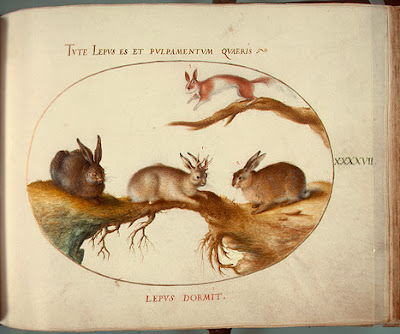 What's the difference between a "white pinot noir" and a rosé of pinot noir? It's a difficult question to answer, given that many labeled as white have a pinkish hue and even perform like rosé, and the techniques for making such wines are manifold. And some wineries may simply want to avoid the term rosé for marketing purposes.
The amount of maceration time may be a good place to start. If the juice was macerated with the skins for a few hours, then it's probably a rosé. If the juice was separated as quickly from the skins as possible during pressing, then it's probably safe to call it a white, regardless of its final color.
Of course, I'm not a winemaker and I've surely oversimplified the matter, so anyone who wants to clarify (or complexify) matters should weigh in.
On the other hand, I am a wine drinker, and I can tell you I've never had a rosé of pinot noir that resembled the 2005 Dirler Pinot Noir Cepage Pinot Noir. I cannot find any information about how, exactly, this wine was made, but Dirler is my favorite Alsatian producer* and if they make it, I'll buy it. Still, I was taken aback by this wine's distinctiveness.
It's the color of rose petal-macerated cantaloupe drippings, quite lighter in color than most rosés, and its nose really sets it apart; it reminds me of the more delicate style of skin contact whites such as those made by Paolo Bea. I smell apple skins, dried strawberries, freshly sliced oranges, and fresh tarragon. It's beautifully complex on the palate, with an extremely subtle earthiness that haunts the red fruit, musk melon, apple, herb, and Xmas spice flavors. And if that weren't enough, the Cepage Pinot Noir has a mouthcoating viscosity that's practically weightless, and the finish is fresh, perfectly balanced, subtly mineral, and very, very long.
I wish I knew more about how this wine was made. But if more knowledge would enhance my awe, I'm more than happy to just have the awe.
* Caveat that I've really only tasted from a handful of Alsatian producers
Wednesday, August 26, 2009
Stems and Seeds Again
 Ain't talking 'bout no reefer, I'm talking about the 2007 Luca Ferraris Grignolino d'Asti. What an interesting wine — what with all the seeds that are apparently present in the grignolino grape, this is a tannic little number. Yet the Ferraris is delicate and stony like a Moulin-à-Vent. And then yet again, there's very little fruit here. There are suggestions of orange and cherry, but only suggestions.
The nose is quiet and mysterious, showing mere hints of bitter greens and underbrush; wines that come from sandy soils are often well-perfumed, but not this one. It's sure forceful on the palate, though. The acidity is strong yet fine, and there's a distinctive stemmy bite. The stemminess is in fact its calling card. The lovely tannins are reminiscent of raisins, both slightly sweet and slightly bitter. Again, echoes of fruit, not the direct experience. Still, the wine is nicely balanced and so expressive that I hardly miss the fruit.
Ferraris (who makes a terrific ruchè, by the way) recommends this with light, non-fatty fare. For me, this worked well with a basic homemade pizza. I should also mention that my experience with this wine was exactly — and I mean exactly — the same on night two as it was on night one. No better, but definitely no worse. Unless it was imbued with some sort of magical anti-oxidation mojo, I'll chalk it up to the acid structure and toothsome tannins.
Sunday, August 16, 2009
Zinfandel Unbound
 As if to prove that California wines can be, should be, and sometimes actually are complete, I am enjoying the 2003 Caparone Zinfandel. A mucklet of sediment splats onto my countertop when I pop the cork, and as I pour I see that the wine suggests fall, a pale rose petal color that foreshadows brown. It even smells slightly autumnal, like a redwood forest on the coast, an aroma that plays well with the smell of fresh red berries, cherry medicine, tar, wood smoke, and black pepper. As I breathe it in I think of a potlatch in a plank house, which in turns makes me think I should have paired this wine with smoked salmon rather than grilled pepper steak, although that was a nice match.
Too many zinfandels founder on the shoals of thinness on the starboard side and, more often, cloying obsequiousness on the port side (pun intended). The Caparone quietly, effortlessly, sails up the middle of the strait. It serves up nice cherry fruit, bright acidity, brown earth, good presence and depth at midpalate, and solid structure. As with the (even better) Caparone aglianico it's not complex but it is complete, nicely priced in the mid-teens, and at 13.3% abv plays well with food. Even more importantly, it's comfortable in its own skin; it is not tamed; it is unbound.


 Posts
Posts


