
I have decided that 2011 is going to be a great year. And to get the year kicked off, I'm going to fete this exuberant little number that I admittedly drank a few months ago but which would have been great over the last weekend. It's a wine that seemingly shouldn't be what it is, and is definitely what it says it is not.
 "Ceci n'est pas un rosé," says the Anjou producer Domaine des Sablonnettes, who are really a couple named Christine and Joël Ménard. And you'd believe them at first blush, so to speak. Look at it: this cabernet franc and cabernet sauvignon blend couldn't possibly be rosé? Ah, but it is, and not surprisingly it's a Vin de Table, not one approved by the appellation authorities.
If "vibrant" is a Loire hallmark, this wine was so vibrant that it seemed to possess a life and an imagination of its own. It had a snoot of earth and rhubarb and garden herbs and crazy dry rocks. The firm, tart, joyful palate made me think of a raspberry-strewn rock garden; and then it turned so long and airy on the finish. I was really taken with this.
I cannot find much information about this wine, save that the Ménards grow the grapes biodynamically, never inoculate or chaptalize, that sort of thing. Had I known of the Ménards last June I would have dropped by when I passed through Rablay sur Layon, the better to understand them and their not-rosé. An opportunity lost.
No, stop! This is not a wine for brooding upon regrets! It is for celebrating, and I in turn will simply celebrate it. Cheers to us all!
Tuesday, January 4, 2011
Not a Rosé, At First Blush
Thursday, February 18, 2010
Winter Releases from Renaissance

Renaissance Chardonnay 2006
What, Renaissance makes a varietal chardonnay? Since when? And not only is this a chardonnay, it's also the most mainstream dry white Renaissance I've tasted. Not unlike many fine California chardonnays, it was aged for 9 months in a mix of new and used oak barrels, which contributes to the aromas of salted butter, toast, flowers, and tropical fruits that dominate the nose.
But before you think, "Renaissance sells out!" know that this limited production (76 case), estate grown wine was fermented solely with native yeasts and minimally sulfured. It's fine, fresh, and lively on the palate, with robust acidity, cool orchard fruit tones, and nice structure — it's not at all blowsy or fat (this clocks in at 13.6% abv and a pH of 3.3). As it warms in the glass, the cool spice and herb tones inherent in all Renaissance wines begins to emerge — albeit to a lesser degree than in, say, their Roussanne — and the long finish is enlivened by the zippy minerality. It's definitely a top-of-class California chardonnay, and it stayed very fresh and alive over three nights of tasting.
Renaissance Sauvignon Blanc Late Harvest 1992
This new release, a spicy dessert wine, is 17 years old. The nose is rich with aromas of apricots caramelized in brown sugar. It's clean and silky in the mouth, not heavy or sticky, and the robust acidity helps it stand up on the palate. Straightforward flavors of pears poached in ginger hit the mid and back palate immediately; an initial impression of modest viscosity then ebbs quickly, leaving a light but warm glow on the finish for some time. This isn't as complex or as interesting as the drier, more recently made late harvest wines that Renaissance releases, but twist my arm and I'll drink this with a pear tart.
Renaissance Cabernet Sauvignon Première Cuvée 1998
This is a fascinating wine. At the first pop of the cork this smells just like a Renaissance cabernet, with deep aromas of black currant and worcestershire, but on the palate it drinks almost like a young Barbaresco, very tannic yet somehow light. The rough edges abate somewhat with just a bit of air and the palate deepens with flavors to match the aromas. On night two, the flavor of cassis comes to the fore and the acidity is more prominent, too, although the weight has dropped and the finish is slightly thin. Black cherry and black pepper flavors come to the fore on the third night — it's a living wine, ever changing — and if the finish is still a bit short, the wine seems a touch more focused: the tannins no longer have a sweet quality, the palate is silkier and just a touch more substantive than it was the previous night, and dried herbs show up on the finish. There's plenty of structure and acidity in this baby (pH is 3.4) so while it's perfectly fine to open this now, there's no need to rush. 82% cab sauv, 7% merlot, 6% cab franc, 5% malbec.
By the by, I recently drank a bottle of the 2007 Carte d'Or white Bordeaux blend, which I last drank a year ago, and it's showing brilliantly. The melon fruit is luscious, generous, and layered with crushed white stone and gingery spice, and it was a great with the smoky, tangy, earthy flavors of middle eastern cuisine. I can't imagine anything pairing better with the smoky, umami flavors of middle eastern cuisine than any dry white from Renaissance; but now that I think about it, maybe I should consider a good cru Beaujolais...
Thursday, August 13, 2009
Giving Napa a Chance
Cornelia was dutiful; that was the trouble with her. Dutiful and good: 'So good and dutiful,' said Granny, 'that I'd like to spank her.' She saw herself spanking Cornelia and making a fine job of it.— "The Jilting of Granny Weatherall" by Katherine Anne Porter
I rarely give Napa wines half a chance. I am — shall I admit it? — prejudiced. As in, I presume, prejudge. They're apt to be hot, overoaked, overripe, blah blah blah. This has too often been my experience, but my experience is limited.
 I felt it was time to confront my prejudice. To experience more.
So I shelled out the clams on a 2004 White Rock Claret, a sustainably-grown blend of 60% cabernet sauvignon, 20% merlot, 15% cabernet franc, and 5% petit verdot from north- and west-facing vineyards in the Napa foothills in the Stag's Leap Range. "We have never used pesticides," say the Vandendriessche family on their web site, and "avoid the use of herbicides." I'm also pleased that the wine bottle is not overly heavy.
Craig Camp recently noted that "cabernet franc is packed with umami," and that "its 'umami' effect on cabernet sauvignon cannot be overstated. A dollop of cabernet franc 'lifts' the nose and expands the finish on many a cabernet." That's certainly the case here, as this is a very well balanced wine that delivers a wide range of aromas and flavors with, yes, umami characteristics. I find licorice, cocoa, soy sauce, mint, tobacco, blackberry, and even a subtle high note of cranberry. The nose is both sweet and brothy, and it's quite velvety and rich on the palate but not at all heavy, thanks to its low yet still fresh acidity, and this shows an admirable streak of brothy minerality on the finish.
This White Rock Claret is darn tasty, and as it's not at all hot, overoaked, or overripe, I'm pleased that it overruns these prejudices. In fact, I think there are many lovely things about this wine.
So why am I not excited? One problem is that it lacks depth; all the action is on the front of the palate. Another is that the lovely fruit and umami characteristics are nicely integrated but they do not become more than the sum of their parts. Flavor and texture is emphasized at the expense of structure. And then there's the fact that the mouth turned swampy on night two — there goes what structure was there.
Most importantly, even at its peak the wine feels tame. Imagine if James had never crawled into that giant peach: his life would have been circumscribed by Sponger and Spiker. The White Rock Claret hits its marks but is not unbound. It's so dutiful that I'd like to spank it.
Maybe it's just me. Maybe I'm just Granny Weatherall here, unappreciative, "tying up in hard knots." And she was, in the end, wrong about everything. I'm calling 'em like I see 'em, in any case.
Monday, August 10, 2009
Infanticide Is Painless
 Lately I've been opening some nice bottles before their time. Willful infanticide, yes, but I've been in the mood to drink great wine and I've been wanting to conduct a real-world test on how the wines are holding up and how they will likely evolve, rather than rely on received wisdom, no matter how well-informed that wisdom might be.
Château Pradeaux Bandol 2003
I'm well aware of this wine's typical lifespan — due in part to the mourvèdre grape's ability to resist oxidation, but largely due to Pradeaux's traditional, uncompromising winemaking regimen — but I figured I figured I should check in to see how this wine weathered the heat of 2003. Would this be an early drinker?
Um, no. Turns out this is classic Pradeaux, and you'd never know this came from a hot vintage. Which isn't to say it's impenetrable, for behind the wall of tannins this 6 year old shows great beauty, with a spicy, smoky nose of blackberries, pepper, grilled meat, and subtle hints of lavender and fresh green herbs. The balance, structure, and acidity here are impeccable, and if the tannins are rough and grip the tongue even on the fourth night sampled, the texture shows great grace and layers of purple flowers, silky cherry (fresh and dried, sweet and tart) and blackberry fruit. So, still tight, but complex and complete; it's definitely showing what it will become, particularly if given the ten-plus additional years it deserves.
Huët Le Mont Demi-Sec 2002
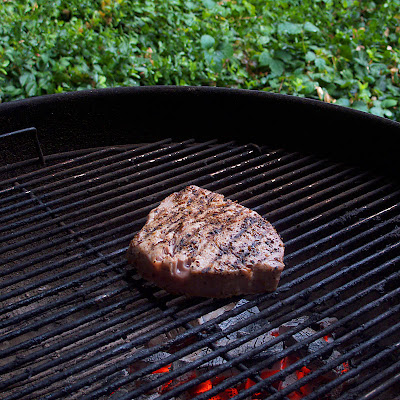
Why oh why does one of my favorite wines in the world have to be corked? Gah! And I had prepared an ahi steak with oil, salt, pepper, crushed cumin seed, and Italian salsa verde (flat parsley, oil, caper, and lemon zest) for the occasion. Instead, we waited another 20 mins to fire up the coals as we chilled down a bottle of...
Dirler-Cade Riesling Grand Cru Spiegel 2004
While I've never had a Trimbach, Dirler is my Alsace superstar, as their biodynamically-raised wines are so well proportioned, without the rock-em sock-em richness and residual sugar that so many other Alsatians bring to the table. That said, on nights two and three this shows a lot of baby fat and banana stank; in that respect it's not at all like the non-cru Bollenberg 2004, which has not one ounce of fat.
Before and after that awkward phase, though, this has an unbelievable combination of intensity, clarity, and purity. On the nose, a cornucopia of orchard and tropical fruits tumble onto acres of mountain stone; meanwhile, the farmer next door refills the kerosene tanks in his pickup truck. This is true even when the glass is empty. The body is very creamy and feels full on the tongue yet floats above it; it's warm and friendly yet delicate and poised; I'm thinking Grace Kelly or Michelle Obama. It's completely dry and very precise, with great structure, while plush fruit and filigreed minerals haunt the long finish.
My ultimate verdict: wait another five years before opening, then serve with a poached something-or-other in buerre blanc — this Spiegel was slightly overwhelmed by the fleshy tuna.
Renaissance Cabernet Sauvignon Première Cuvée 1995
Whereas many producers' tête de cuvées come from extra-ripe grapes or are lavished with expensive new oak, Renaissance does none of that. Instead, they pick and raise their best lots much the same way they raise their basic wines and let the terroir speak.
This isn't quite infanticide to drink this now. It's more like cutting a man down in his 30s (chilling enough, don't you think?). But over the course of three nights, this wine, which is 24% merlot and a mere 12.4% abv, proved that it will just get better. It kicks off with intense aromas of plum pudding, beef broth, black pepper, gray sea salt, blackberries, blueberries, and spice cake. It's structured yet velvety (more velvety than the "standard" 1995 cabernet), with a preliminary attack of sweet black fruit quickly giving way to bold tannins and a more austere rendering of the fruit. A note of cherry rings on the bright, brothy finish, and its spiciness is quieter compared to several other Renaissance wines, although a white pepper note lingers with the tannins for some time.
This is elegant and balanced, and the little bit left on night three shows a slight melting of the tannins and hints of blackcurrant and dried fruit on the palate. Although this was really good with the lamb that I grilled, it would have been even better had I decanted it 24 hours before serving.
Wednesday, July 30, 2008
BYOB Excursion 1: Mado
Zug was in town so we went to Mado, a new Wicker Park joint that does the whole "the farmers just brought us produce this morning and we'll cook it up simply" thing. I know a lot of foodies are just so over the whole concept but it's ultimately a traditional approach to food that I find extremely satisfying, if done with care and a dash of creativity.
Another reason I chose Mado is that it's BYO. I am increasingly attracted to BYO restaurants because while I am a haphazardly decent cook, I simply haven't the talent to frame certain wines the way they should be framed. And so I kick off the premiere of what should be a semi-regular series, the BOYB excursion.
Case in point: a 1997 Domaine du Closel Savennières Clos de Papillon should be reserved for a good meal, and so I brought it with appetizers in mind. At 11 years old this wine is performing very nicely, thank you very much, as you would expect of a well-made Savennières from a highly-regarded vineyard. It's amber colored and its honeyed nose tricked my friend into thinking this would be a sweet wine; and while it's anything but austere, it's not sweet. It is a full, almost rich wine with characteristics of overripe pear, honey, porcelain, and wool, and it performs beautifully on the palate, with a slight prickle of ginger and a poised, elegant finish.
Our delicious appetizers framed the wine very well. The Closel was good with our cold carrot soup, very good with the coddled farm egg, zucchini and almond dish, and absolutely beautiful with the waxy yellow and green beans that were tossed with basil and lemon. Zug loved the coddled egg best, whereas the ultra-fresh, snappy dish of beans was my favorite.
Up next was the main course, and for this we pulled out the 2006 Damiani Meritage from the Finger Lakes region of New York. I've never had a Finger Lakes wine, as they're exceedingly rare in Chicago, but I would have thought that the first one I'd try would be one of the area's vaunted rieslings. Instead, Zug brought this Meritage — 42% cabernet sauvignon, 33% merlot, and 25% cabernet franc — all the way from his hometown of Ithaca, so it would have been churlish to have not to open it for our entrees.
You wanna know something? I like Damiani's Meritage better than 95% of the west coast red blends I've had. It's lean, polished, full of character, and most impressively, very well balanced. Its juicy, sour cherry and red berry attack resolves into cassis and graphite on the midpalate, and well-integrated oak provides a hint of spice on the finish. Its acidity is so fresh and lively that it actually reminds me of a good Barbera, and the wine ended up overshadowing my decent yet rather basic hangar steak and gorgonzola polenta. It was somewhat better with Z's better cucumber-festooned white fish fillet.
A side note about the alcohol levels here. The Meritage is but 12.9%, which certainly contributes to its old school claret feel. The Closel pushes it at 14.7%, yet it too is balanced, and not the least bit flabby or hot.
Despite my unexciting steak, I give a big thumbs up to the entire night. Really, I am still thinking about those waxy beans. Oh, and I snuck out the unfinished wines at the end of the night — both do quite nicely on day two with pasta with pesto, and both should drink well over the next five years.
Tuesday, April 1, 2008
Another Renaissance, and Another
A recent, small flood of Renaissance Vineyards wine has compelled me to open two floodgates, lest the dam burst.
First up, a short and easy note about the 2004 Renaissance Syrah, which I brought to my friend Paul's dinner party, at which he made a bacon-flecked quiche. This is a relatively early, easy drinker compared to the 2002. Its acid core is less mighty, its essence slightly less profound, but it's still nothing less than terrific. It features roll-your-eyes-back-in-your head aromas of meat and spice and all the dark, lively fruit you could hope for. And it's pure, motherscratcher, thanks to the clear Sierra skies, the thin granite/diorite soils, and the organic viticulture. Now, I didn't spend as much time with my wine as I might have, as the dinner party was a lively ricochet of conversation, but I noticed it, secretly and otherwise. Yes, I noticed.
The 2000 Renaissance Cabernet Sauvignon, which I drank at home over the course of three days, is one fascinating time trip. The grape is typically not my thing and I wasn't bowled over by this wine, but it is most definitely alive. The first day, it's a massive, impenetrable wall of black and blue fruits, a hint of espresso, and tannins. Although it was obviously not overextracted, overripe, or overoaked, I could only taste youth and climate.
It's shocking to me that a 2000 California cab can taste so young and primary in 2008, but that's part of the story here.
This was a different animal on day two. Hello, red fruits! The nose was dusty dark cherry as if it were Sangiovese in drag. I was not expecting this. The robust acidity was delivered with well-structured red fruits of pomegranate, cranberry, and cherry, and if the finish was still a bit short, it had a nice, high presence at the midpalate, and it went nicely with my Middle Eastern food.
On the third and final day, secondary characteristics of leather and spice box emerged. The cherry flavors flagged slightly yet maintained some refreshing acidity, while the tannins likewise softened without losing all sense of structure. Time to break out a brisket.
Renaissance claims that due to their low yields (1-1.5 tons per acre on average), their production costs are anywhere from 5-6 times the Napa/Sonoma averages. If Napa averages 4-5 tons per acre, the math isn't quite there, but no matter: the drinking satisfaction is exponentially higher; and yet this Cab cost just $30, a bargain compared to many a slop pail sloshed out in Napa.


 Posts
Posts


