Saturday, April 16, 2011
A Mosse and a Baudry from 2009
Bernard Baudry Chinon Les Granges 2009
I adore Baudry's wines and I was expecting full young fruit, easy drinking, and expressive typicité in equal measure, with a low 12.5% alcohol promising a snappy attack. In practice, this has all the classic, lovely aromas I love about Chinon, but although the wine is nicely proportioned, with the acidity and fruit and minerality seemingly in their right places, the palate is strangely muted; it just doesn't have the spark, the informal elegance, or the mid-palate depth that I associate with Les Granges at this age. I drank this over three days' time in the hopes it would blossom, but it never unfurled (and actually it just turned slightly medicinal by the third night). Curious. John Gilman reported a favorable experience; might this be undergoing a particularly sullen adolescence?
Mosse Anjou Blanc 2009
I'm really honing in on the structure and acidity of the 2009 Loire whites I try (and by "whites" I really mean Muscadet and chenin from its many appellations). I'm asking myself if they have the bones and the guts for aging, or if even hints of softness that apparently mark some wines obscure terroir and suggest a short life.
Agnès and Réné Mosse's basic Anjou Blanc suffers not the least from softness. Rather, I was overjoyed (as in, you would have told me to settle down) to find a marvelous and highly expressive wine with considerable focus and complexity. There's some passionfruit on the nose that's allied to cantaloupe and ginger aromas, but any tropical fruit characteristics are solely aromatic. It's the snappy, medium-bodied palate that really makes me happy; there's a spicy singularity here that obviates the need to list the many descriptors I could use, particularly as it's so complete and quite long. That the vines for this cuvée were planted within the last ten years make the complexity and singularity that much more impressive. The mere 7 grams of RS are not enough to render this a sec tendre; it tastes completely dry, and the alliance of austerity and voluptuousness that is a hallmark of top-notch Anjou sec is in full force here. People, can you feel the love? I sure can.
Posted by Wicker Parker at 9:44 AM 4 comments
Labels: g - Cabernet Franc, g - Chenin Blanc, r - Anjou, r - Chinon
Monday, January 10, 2011
I Forbid the God of Cliché
I'm drinking a white in the winter and a sparkling wine on a Monday that's not a holiday and a French wine with nominally Italian food (pasta with pesto). I don't have a flute because I don't want one, so into the wide-bowled Burgundy glass it goes. Little about this scenario is "correct."
Still, everything feels right. Pinon (nice Wine Doctor profile here) provides an unmasked, acid-driven expression of Vouvray. There are no autolytic aromas to hype, no poached pear on toast flavors to profile. "This is me," it says — the crunchy honeycomb flavors, the telltale chenin bitterness, the fine minerality — and the acidity cuts nicely through the rich green herby pasta. It's slightly oxidized, in a good way. Have I had drier white wine? Yes. But not that much drier.
Today feels to me like a good day not for the simple, but for the unadorned.
Posted by Wicker Parker at 6:50 PM 0 comments
Labels: g - Chenin Blanc, r - Loire, r - Vouvray
Monday, July 5, 2010
Visiting Romain Guiberteau in Saumur
At last I reached the Mothership: the Loire Valley, home of my adored chenin, home of rare indigenous varieties secreted in small plots, and home to some of the most dynamic set of winemakers in the world, many of whom pursue natural winemaking in their own ways and on their own terms. As much as I would have loved to have visited the Touraine, I focused on the Layon because of its schist and because I correctly assumed the winemakers there would have particularly interesting things to say.
But before I hit the Layon, I stayed in Saumur and biked down to Domaine Guiberteau in Mollay, just west of the great calcareous vineyards of Brézé. After experiencing three of Romain Guiberteau's wines earlier this year, it was a no-brainer to visit, a must.
Romain's grandfather bought up vineyards some decades ago but the domaine began bottling its own crop only in the mid-80s, and Romain has taken the domaine in a completely natural direction: No chemical sprays, no chaptalization, no enzymes or stabilizers, indigenous yeasts only, and a leave-it-alone approach — to paraphrase Romain, when you leave a wine alone, such as letting chenin rest on its lees rather than stirring it, it may take longer for the wine to be what it will be, but it will be better when it gets there.
Like many a Burgundian, Romain begins the tasting with the reds, which are made entirely from cabernet franc. 2009 marks a new direction for the domaine-level wines, as they are now to be aged in inox only rather than used barrels as was previously the case (and will still be the case for the lieu-dits). This allows him to respond to clients' requests for a lower-priced wine, but he also now prefers to emphasize the fruit. He finds that his reds up through 2006 are too big and concentrated for his taste. I think they have the stuffing and balance to age very well and are not at all overly large, but that is my taste. Regardless, it's clear that more recent vintages are not the least bit lesser; they are merely different.
2009 Rouge: The domaine wine had just finished malo two weeks prior to my arrival and it will be bottled in September. It is a beautiful wine, very pure, and the greatness of the vintage shines through. It is the essence of cabernet franc, fresh and deep and savory. 75% of the grapes are plucked from calcareous soils and 25% are of argile.
2008 Rouge: This spent 15 months in used barrels. 2008 was a high acid year and it was a difficult vintage, as 60% of the crop was lost to a freeze. Between my bad French and his much better English I try to understand the nature of the freeze — apparently it was not frost — but I will have to let this point be a mystery for the time being. But there's no question about this wine's beauty with its lovely dark fruits. Again, there is no trace of overripeness or overextraction, and for it the wine seems effortless. Romain says this should be particularly good in 2012.
2007 Les Motelles Rouge: This 1.4 ha lieu-dit is planted on argile in Montreuil-Bellay and the wine spent 18 months in a mix of one, two, and three year old barrels. This is lighter and more floral than the 2008 domaine, as befits a cabernet franc from 2007, but it still has good tannins and a lovely raspberry aspect. I ask about disease pressure and other problems, but Romain said he experienced none of that in 2007.
2007 Les Arboises Rouge: Romain does use some new barrels for this wine but there is not a trace of vanillin or toast. Rather, its purity is striking. This comes from a calcareous lieu-dit in Brézé and it's a bit less floral than the Motelles and shows greater acidity. The balance is great, too, and I love the red plum-like fruit. Like the Motelles, the vines for this wine were planted over 50 years ago.
Now it's time for the whites. Romain says he trades with winemakers from both Burgundy and from the south; he gets their reds, they get his whites, everyone is happy. I have nothing to trade, but I am still happy. Asia should be happy, too, as they get 40% of his production. Here in the US, only Illinois sees his wines.
2009 Domaine Blanc: This spent six months sur lie — no battonage, as previously mentioned. I've tasted a good amount of dry, unoaked Loire chenin over the years, and they are often nice straightforward wines for easy drinking. This is several notches above those wines. Just as the rouge is the essence of cabernet franc, this wine is the essence of dry chenin from primarily calcareous soils. Gorgeous apple flavors here, with depth and presence. Some young vine fruit is blended with fruit from 55 year old vines.
2008 Clos de Guichaux: This is a monopole of extremely young vines grown on argilo-calcaires, but Romain does not want to print "monopole" on the label until he is sure that the wines will perform well year in and year out, through difficult vintages and easy. The vineyard has only 30 cm of soil atop the bedrock. Romain likes this with cream sauces since its high acidity really cuts through richer food. For my part, I find this is gorgeous, with beautiful peach-driven flavors and impeccable balance. This spent 13 months in two to four year old barrels.
2007 Clos des Carmes: This is another monopole and it says so on the label. It's 2.6 hectares but only 0.5 ha worth makes it into this wine; the rest goes into the Brézé blanc. Interestingly, the vines were only 3 years old when the grapes were harvested and yet this cuvée was aged in 100% new oak for 24 months, which unlike the other wines imparts some vanillin character. Romain does not follow a recipe; he says that the batch that was aged in these barrels turned out the best and so he decided to bottle it separately.
2007 Brézé Blanc: I guess I'm an unoriginal thinker, because my notes again use the word "gorgeous." That's not to say that the wine isn't distinctive: it shows honeyed aromas that the above whites do not, and it's full in the nose and even fuller in the mouth. Of course, it's still dry. It has the acidity to move things along and the wine is both fully present — it hits every part of the palate in just the right way — and very long. This spent 24 months in new and used barrels, and no obvious oak flavors come through. It's complex and transparent. I ask Romain what makes Brézé special, why the wines from this slope are just that much better than most other spots in Saumur, and he says he doesn't know, exactly.
But to invoke Gertrude Stein, there's there there, and Romain confesses that he's very lucky: he has access to great terroir and is making a solid living without compromising his approach. Luck, yes, but also skill: these are the best Saumur wines of any that I've had. I climb back on to my bike and see a youngster looking at me inquisitively from inside the house. Someone inside is playing a piano; family is over for the day and Romain goes back inside to join them.
Posted by Wicker Parker at 11:48 AM 6 comments
Labels: g - Cabernet Franc, g - Chenin Blanc, r - Loire, r - Saumur, Spring 2010 Trip to France
Tuesday, March 16, 2010
Guiberteau's Fabulous Saumurs
Why the blogs are not abuzz over the wines from Saumur's Domaine Guiberteau is beyond me. Nothing from even Jim's Loire or any other Loire-friendly, English language blog out there that I can see. The wines are a tad pricey (mid-20s), but they're worth it as far as I'm concerned. I'm very happy that my friend Erin turned me onto them!
The wines are ultra-clean, but they are also naturally-made, transparent, and completely expressive of place. If I (and Google Translate) interpret their French-only web site correctly, the domaine hand-harvests both their organically-grown chenin blanc and their cabernet franc from 25+ year old vines to the tune of 45 hl/ha. Romain Guiberteau ferments the wine solely with native yeasts, eschews all enzymes and stabilizers, and ages the basic "domaine" level wines in two to four year old oak barrels (the top wines do see some new oak, but I've not had them). The soils are clay and calcareous silex.
The first wine I experienced from Guiberteau was the 2005 Saumur Blanc, and it's stunning. The aromas of lavender, paraffin, and apple skin show great clarity. The wine is dry and utterly precise on the palate, with a come-to-jesus delivery of elegant concentration (and concentrated elegance) — the pear and melon fruit is layered with chalky minerality, stony lemon, rainwater, and firm, well-structured acidity. The texture is full and nicely defined — the angles haven't been overly sanded down — and the finish is long.
2007 may have been a more difficult vintage, but the 2007 Saumur Blanc is, in its own way, just as successful as the 2005. It's very firm and dry as befits the vintage, but there's a richness underlying the steely, high-acid structure. It's slightly chalky on the nose; otherwise, it's quite closed aromatically speaking. It's more expressive on the palate, with flavors of melon, tart apple, honey, and nuts, and it's very dry on the long, citric finish. It's exceptionally well balanced and has the bones to age, and it should blossom as it does — it's just a baby!
Finally, I was gratified to comes across the 2006 Saumur Rouge on the wine list at the vegetarian-focused Green Zebra. This 2006 was just barely coming into its drinking window, as you'd expect from a concentrated, well-made Saumur rouge from this structured vintage, but expressive it was: a twinge of herbs, some black olive notes, beautiful acidity, and good earthiness. It was a great companion with my green papaya salad, my earthy dal, and even the pan-seared scallops served with braised mushrooms. Meanwhile, my dining companion, who's not geeky like me but enjoys solid reds with good fruit, very much liked it as well.
Do these wines represent the Platonic ideal of excellent Saumur? Maybe! I've never had the Saumur-Champignys of Clos Rougeard, for example, so I'd rather not spout such things off. But I'm happy to spout off about Romain Guiberteau's wines in general.
Posted by Wicker Parker at 5:15 PM 1 comments
Labels: g - Cabernet Franc, g - Chenin Blanc, r - Loire, r - Saumur
Thursday, November 26, 2009
My Decanter (or, Anticipation)
Happy Thanksgiving, everyone. I'm hosting a gaggle of people and I've been merrily planning and cooking for the last several days. For example, I've already made the broth for the mushroom risotto, baked the Indian sweet potato pastry spirals, cooked the fiery sweet potatoes which I'll broil right before the meal, and made the Indian-spiced bean and vegetable salad. Later today, I'll make another vegetable salad (daikon, carrot, and green bean, blanched and julienned and dressed with a soy-based sauce), squash stuffed with bacon and apple, and tofurkey. Hey, I like tofurkey!
While these dishes may not sound traditionally Thanksgiving-ish, they are earthy much like the more traditional fare. So I still need to serve earthy, medium-bodied wines, just as I would for a more obviously traditional feast.
To that end, I've lined up the gorgeous 2002 Dirler Schimberg Pinot Gris, the elegant 2005 J.K. Carriere Willamette Valley Pinot Noir, and for those who want a more full-fruited red wine, the 2006 Domaine Gayda Chemin de Moscou, which is a Vin de Pay d'Oc from a 200m high vineyard in the Malepere appellation north of Limoux (see Google map) that's 55% syrah, 40% grenache, and 5% cinsault. We'll actually start the meal with a shot-sized pour of Isastegi Basque cider to accompany an arugula salad, and then at the close of the meal, I'll serve the 2005 Baumard Cuvée le Paon, a botrytised Layon wine that Baumard makes in only the best vintages. (Backup wines in case of extra guests or cork taint: Carriere's 2005 Chardonnay and the lovely 2008 Tenuta delle Terre Nere Rosso from Mt. Etna.)
The Carriere pinot has great structure and acidity and I will definitely need to decant it a few hours before the meal. The Paon, however, really needs a decant — it's outrageously young and the Baumard house style is reductive — so 12 hours ago I decanted it into... an old glass coffee carafe that I salvaged from a dead coffee maker. Yep, that's my decanter. It's perfect: it's wide, easy to clean, features a pour spout that makes double decanting a snap, and was absolutely free. And it of course works. I'm happy to report that some of the Paon's cavity-inducing baby fat has been shed and it's growing deeper and more complex, with excellent acidity and those quiet and remarkable tones of bitter herbs that I love in chenin.
OK, it's time to start the last of my cooking — no time to lose! Happy Thanksgiving to all of us.
Posted by Wicker Parker at 9:17 AM 0 comments
Labels: g - Chenin Blanc, r - Layon, r - Loire
Sunday, June 21, 2009
Demi-Sec Faceoff #4: Foreau vs. Schwibinger
Posted by Wicker Parker at 1:09 PM 0 comments
Labels: Demi-Sec Faceoff, g - Chenin Blanc, g - Riesling, r - Loire, r - Rheinhessen, r - Vouvray
Monday, June 1, 2009
Three Recent Values
Wow, I have not been keeping up on the blogging like I should. Here are some notes on a few good values I've had recently until I can get a more coherent article together.
Willow Crest Pinot Gris Yakima Valley 2007
A lot of pinot gris in the Northwest, and when it's done well, I really like it for its spicy orchard fruits. In too many bottlings, though, it lacks the zip and the verve I look for. So I wasn't expecting a lot from this $10 bottle, which is grown in Washington state's Yakima Valley — quite far from Oregon, where most domestic pinot gris is made. But this wine hits all the marks for Northwestern pinot gris. It has those pear and spice flavors, a hint of smoke in the aroma, fresh acidity, medium weight, and good balance. So it outperforms many $15 bottles of this type.
Château d'Assas Coteaux du Languedoc Cuvée Classique 2006
It's lovely to find a $13 red from the Languedoc that shows good balance, character, and weight without any trace of heat or overripe fruit. I feel somehow that the universe is being kind to me. This blend of syrah, grenache, and mourvèdre shows aromas of violet, blackberry, clove, and orange zest. The palate's where this really shines, as brisk, citric acidity helps lift this full bodied wine over the palate, while the minerality, solid tannic structure, and black fruits show good staying power on the finish. Oh, and it's only 12.5% abv.
Domaine des Aubuisières Vouvray Cuvée de Silex 2008
We're getting to the $17 price point now, but it's hard to find a decent Vouvray for less. Happily, this is much better than decent. Bernard Fouquet makes this wine in the sec tendre ("tender dry") style, with just enough residual sugar to temper chenin blanc's high acidity. This is an extremely satisfying bottling, with slightly smoky aromas (that'd be the silex talking), gorgeous acidity, and minerality up the wazoo. The fruit is pure and creamy and suggests flavors of apple, pear, and grapefruit; the latter fruit is particularly prevalent on the finish and "talks" perfectly with the flinty minerals and gingery spice. If I had three arms, I'd give this three thumbs up. And given the great acid structure here, this should age very nicely.
Posted by Wicker Parker at 6:20 AM 0 comments
Labels: $10, g - Chenin Blanc, g - Pinot Gris, r - Languedoc, r - Vouvray, r - Yakima Valley
Thursday, March 12, 2009
Demi-Sec Faceoff #3: Richter vs. Aubuisières
It's been an eon since the last demi-sec faceoff — high time for bout number three! In this corner we have a 2005 Vouvray from Domaine des Aubuisières, and in that corner a 1990 Spätlese from VDP producer Max Ferd. Richter. Touch gloves, gentlemen!
Of course, this isn't actually a competition. These are of course very different wines, not least of all given the obvious age difference. Rather, I love to explore the virtues and distinctions of demi-secs — to see what makes them tick, to see how they differ and how they relate, and to test them with food.
In this pairing, the issue of acidity really came to the fore. Chenin blanc from Vouvray and riesling from the Mosel can be some of the most thrilling wine on earth, but if they don't have enough acidity, the wine will lack clarity and the ability to pair well with certain foods, or even end up simply and overly sweet.
Domaine des Aubuisières Vouvray Les Girardières 2005
Bernard Fouquet is a highly regarded winemaker who pursues a "less interventionist" approach: the vines receive minimal treatments, the grapes are harvested by hand, and sulfur is applied in small doses. The Les Girardières is grown in silex-based soils, rather than the limestone tuffeaux typical in Vouvray, and it's fermented in vat rather than oak.
Aubuisières should be applauded for posting good technical info to their web site. Many people have noted that 2005 Loire whites seem to lack acidity, and Aubuisières's numbers tell the story: while the 2007 Les Girardières has 8.1 grams per liter of acidity, the 2005 vintage has but 4.8 grams per liter — nearly half a more typical "classic" vintage. Despite this, the residual sugars in the two wines (which I really wish I could compare head-to-head) are quite similar: 26 g/l vs. 28 g/l in the 2005.
As with many other white Loire wines, the lack of acidity here is apparent. The aromas show apple, honeydew, and faint hints of beeswax and wool. I get sweet apple and canteloupe flavors upon entry, a soft round body, and the wine finishes with good minerality, tangy citrus and a pleasing hint of bitter herbs. But despite the tang, a lack of adequate acidity turns a potentially very good and complex wine into one that's a bit flabby and simple-sweet, and as it didn't improve over five days, I doubt this wine's aging potential. Despite the sweetness, this didn't work so well with a spicy Malaysian noodle dish, although that might be due to the bitter herb characteristics.
Max Ferd. Richter Erdener Treppchen Riesling Spätlese 1990
At 18+ years old this is remarkably fresh. This would surprise me in any case, but all the more so because the crusty, blackened cork demonstrated evidence of heat damage, as the wine had leaked up and over the top of the cork. When you look at the photo above right, you might just feel the alarm I felt. Yet appearances can deceive, and this wine was actually in very good shape. Whew!
I have no specific knowledge of how the acid-to-sugar ratios in this wine stack up, but the Richter web site does post numbers for more recent vintages, and their 2007 Spätlesen average roughly 70 g/l of residual sugar and 8 g/l of acidity. Of course, this Erdener Treppchen would have tasted much different 15 years ago — much sweeter by comparison — but I'm looking at that acidity number (again, not that I know the 1990's stats, but this is an instructive guideline).
Enough with numbers! I only mean to use them as signposts. They can't tell us anything about the grapes, the vintage, the vineyard, the winemaking, and the years that have passed. To the glass!
The nose on this Erdener Treppchen is rich with petrol, mango, and fig, but for all its aromatic voluputousness, it's trim and nicely proportioned on the palate. Apple and peach dominate, although the fruit is buttressed by lovely herb, lime, and spicy-sweet mango notes that show good length on the crunchy finish. That said, we come back to the acidity issue. While it is by no means bereft of acidity, it is slightly blurry on the palate, and I feel it could use a touch more acidity and more apparent mineral transparency. It's therefore not as precise as I would hope from a $40 wine — and I tasted this over five days to be sure.
Still, it's at its most complex and expressive on day 5, and in contrast to the Les Girardières Vouvray, this paired well with the Malaysian noodles. So if you have a bottle of this, why not hold it for a while and see what happens? It is very fresh, and it may yet go where it needs to be.
Posted by Wicker Parker at 5:58 PM 0 comments
Labels: Demi-Sec Faceoff, g - Chenin Blanc, g - Riesling, r - Loire, r - Mosel, r - Vouvray
Tuesday, March 3, 2009
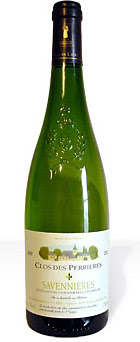
Soucherie's 2000 Savennières Clos des Perrieres
I can't get over how my friend Erin can't get over the notion that Savennières is, in Mike Steinberger's words, a wine like a cat. But then, I can't get over Savennières, period. Loire chenin blanc is one of my big touchstones so naturally Savennières is in turn one of my big touchstones. From these schist soils springs a wine like no other: expressive yet reserved, honeyed yet uncompromisingly dry, captivating yet not so interested in being caught. Like, um, a cat. Or as McDuff said, like The Fall.
More prosaically, a good Savennières has a strong personality but goes great with a wide variety of food. And if you give these wines the age they deserve, so much the better.
The 2000 Chateau de Soucherie Savennières Clos des Perrieres is a case in point. It's ready to drink but still very young. When I put my nose in the glass, there's a lot of there there, and yet the essence of the wine is elusive, just out of reach, mysterious. Sure, I could list all kinds of descriptors — cinnamon-dusted pears, honey-glazed rocks, strawberries wrapped in mint leaves — but that only gets me halfway there. It's likewise elusive if long on the palate: the mineral energy is terrific, the body is full yet precise, the fruit is chalky and lemon-tart and sweet, the finish is riddled with herbs like tarragon, but I cannot truly capture what it all means. It's strikingly pure, and I am shocked to learn that this was aged in oak, given its delicate force, its weightless weight.
I am not shocked, however, that this goes great with a spicy, turmeric-doused root vegetable soup, nor that it's a fantastic match with pan-fried cod seasoned with salt, pepper, and a healthy squeeze of lemon. I think I'm going to have to buy several more bottles so I can enjoy this over the next 20 years!
Posted by Wicker Parker at 7:56 PM 0 comments
Labels: g - Chenin Blanc, r - Loire, r - Savennières
Saturday, November 8, 2008
A Campaign Promise Fulfilled
I promised that I would drink the 2002 Huët Vouvray Petillant Brut on election night. In fact, I'd been saving it for a year for just that night. But I didn't follow through. Instead, capital-H History called, and I celebrated with 150,000 of my fellow Chicagoans at the Barack Obama rally in Grant Park.
I opened the Huët the following night instead. So let's just call the promise fulfilled.
This is an uncommon wine of uncommon beauty, an expression of chenin blanc I've never quite had. I could spend a lot more time with many more bottles to fathom its depths. That night, and the next, I found an aroma that reminds me of mustard seeds sauteed in clarified butter. The nose also showed deep honey wax and spiced apples. The mousse was fine and luscious, the yin to the precise acidity's yang. An astonishing depth unfolded over the long finish: the round texture gave way first to subtle bready notes and then to layers of salty minerals, zingy ginger, and at its core, a platonic ideal of green apple.
The Petillant Brut was everything I wanted it to be and everything I expected it would be. But until I actually experienced it, I couldn't really know it or feel it.
It's like the moment when Obama officially won Virginia. Yes, I expected the victory, but only when he had actually won the former capital of the Confederacy did the full weight of history press down upon me. Days later, it is still pressing.
Posted by Wicker Parker at 7:57 AM 2 comments
Labels: g - Chenin Blanc, r - Loire, r - Vouvray
Wednesday, July 30, 2008
BYOB Excursion 1: Mado
Zug was in town so we went to Mado, a new Wicker Park joint that does the whole "the farmers just brought us produce this morning and we'll cook it up simply" thing. I know a lot of foodies are just so over the whole concept but it's ultimately a traditional approach to food that I find extremely satisfying, if done with care and a dash of creativity.
Another reason I chose Mado is that it's BYO. I am increasingly attracted to BYO restaurants because while I am a haphazardly decent cook, I simply haven't the talent to frame certain wines the way they should be framed. And so I kick off the premiere of what should be a semi-regular series, the BOYB excursion.
Case in point: a 1997 Domaine du Closel Savennières Clos de Papillon should be reserved for a good meal, and so I brought it with appetizers in mind. At 11 years old this wine is performing very nicely, thank you very much, as you would expect of a well-made Savennières from a highly-regarded vineyard. It's amber colored and its honeyed nose tricked my friend into thinking this would be a sweet wine; and while it's anything but austere, it's not sweet. It is a full, almost rich wine with characteristics of overripe pear, honey, porcelain, and wool, and it performs beautifully on the palate, with a slight prickle of ginger and a poised, elegant finish.
Our delicious appetizers framed the wine very well. The Closel was good with our cold carrot soup, very good with the coddled farm egg, zucchini and almond dish, and absolutely beautiful with the waxy yellow and green beans that were tossed with basil and lemon. Zug loved the coddled egg best, whereas the ultra-fresh, snappy dish of beans was my favorite.
Up next was the main course, and for this we pulled out the 2006 Damiani Meritage from the Finger Lakes region of New York. I've never had a Finger Lakes wine, as they're exceedingly rare in Chicago, but I would have thought that the first one I'd try would be one of the area's vaunted rieslings. Instead, Zug brought this Meritage — 42% cabernet sauvignon, 33% merlot, and 25% cabernet franc — all the way from his hometown of Ithaca, so it would have been churlish to have not to open it for our entrees.
You wanna know something? I like Damiani's Meritage better than 95% of the west coast red blends I've had. It's lean, polished, full of character, and most impressively, very well balanced. Its juicy, sour cherry and red berry attack resolves into cassis and graphite on the midpalate, and well-integrated oak provides a hint of spice on the finish. Its acidity is so fresh and lively that it actually reminds me of a good Barbera, and the wine ended up overshadowing my decent yet rather basic hangar steak and gorgonzola polenta. It was somewhat better with Z's better cucumber-festooned white fish fillet.
A side note about the alcohol levels here. The Meritage is but 12.9%, which certainly contributes to its old school claret feel. The Closel pushes it at 14.7%, yet it too is balanced, and not the least bit flabby or hot.
Despite my unexciting steak, I give a big thumbs up to the entire night. Really, I am still thinking about those waxy beans. Oh, and I snuck out the unfinished wines at the end of the night — both do quite nicely on day two with pasta with pesto, and both should drink well over the next five years.
Posted by Wicker Parker at 5:13 PM 4 comments
Labels: BYOB Excursion, g - Cabernet Sauvignon, g - Chenin Blanc, r - Finger Lakes, r - Loire, r - Savennières
Friday, July 18, 2008
Demi-Sec Faceoff #2: Chidaine vs. Keller
It's time for another demi-sec faceoff, following the one from last October. In one corner we have François Chidaine's 2005 Les Bournais from Montlouis sur Loire, and in the other corner, we have Klaus-Peter Keller's 2006 Riesling Spätlese from the Rheinhessen. Gentlemen, put your gloves on.
François Chidaine Les Bournais from Montlouis sur Loire 2005
The Les Bournais is a young vine cuvee from Chenin Blanc grapes planted in 1999. Chidaine apparently feels that this is perhaps his best terroir in Montlouis, and the clay and limestone soils found here are more akin to Vouvray than the clay and silex typically found in Montlouis (source: Peter Liem). In fact, the name of this type of limestone is bournais, so don't forget to tell your friends. Chidaine grows all his grapes organically and yet prefers to not label his wines with this information.
The Les Bournais is a BIG wine from a big ripe vintage, and at first its astonishing 47 grams of RS dominates the palate in a single-minded attack. I may call it a demi-sec, but most people will call it sweet. It needs time, so I sampled it over four days. By the end of this period, it had turned into a deep, smoky, honeyed wine with considerable heft; it was almost crunchy, as if I were biting into honeycomb. If it's not as precise or deep as a wine made from older vines, it's anything but flabby. The finish is most impressive, long and golden, the pear, almond, hazlenut, apple, and honeydew flavors lingering beautifully.
Weingut Keller Riesling Spätlese Rheinhessen 2006
Whereas Weingut Keller was previously known for its sweeter bottlings, young Klaus-Peter Keller took over from his father in 2001 and has hence made it his mission to craft exceptional dry riesling. He's been so successful, in fact, that his Grosse Gewachs (great growths) and his cult G-Max bottling command stratospheric prices and are in such demand that mere mortals like myself may never lay eyes on them, say nothing of nose and tongue.
Fortunately, Klaus-Peter still crafts off-dry and sweet wines that are more readily available. This one, his basic spätlese, is golden, pure, and precise, with lovely texture from entry to finish. The filigreed sweetness on the attack is completely integrated with the pure, appley acidity, with a mouthfeel that's full without being heavy or viscous. One of the interesting things is that it doesn't have the minerality that his dry wines apparently do, but I didn't notice at first, as the finish is nonetheless clean, long, and fully-present. What was readily apparent to me is that it didn't have the lime twist on the finish that I often find in slate-driven Mosels, and indeed, Keller's vineyards in the Rheinhessen are of clay and limestone.
So who's the winner? The answer, my friend, is that you are, should you choose either of these beautiful wines, and doggone it, people will like you. As with all things, the question is of utility and context.
The Les Bournais is a big, big wine and in the short term I'd decant well ahead of time, then pair this with a great chevre (Humboldt Fog, anyone?). In ten years the sweetness will surely be less overt, the sugars integrated, and thus ready for richer main courses that feature cream sauces, braised meats, or carmelized vegetables. Keller's spätlese is more ethereal, more filigreed, and less sweet than this Chidaine bottling, and in the short term it is more flexible at the table; you could pair this with summery dishes, Asian cuisine, or cold meats. Of course, it will be just as long-lived as the Les Bournais, and it will also gain plenty of complexity over time.
Posted by Wicker Parker at 5:44 AM 2 comments
Labels: g - Chenin Blanc, g - Riesling, r - Loire, r - Montlous, r - Rheinhessen
Tuesday, November 27, 2007
Buddha In the Loire
Writers often describe wines as beautiful or deep. The following two wines may be that, but to me, they more specifically embody wisdom and enlightenment. It's no surprise to me, anyway, that both come from the Loire and are imported by Louis/Dressner.
François Pinon Cuvée Tradition Vouvray 2006
Can François Pinon do any wrong? 2006 was a difficult vintage in the Loire — warm rain plagued the region beginning in mid-August and abundant grey rot tested nerves — but Pinon's organically-grown, naturally-vinified, lees-aged Cuvée Tradition is practically the equal of his 2005 and 2004 releases. It may not be quite as full and creamy as those vintages, not so reubenesque yet sleek, but it's equally fresh and clean. And while I don't get figs from this vintage, this vin tendre (tender wine — between off-dry and bone-dry) has the telltale Chenin Blanc note of honeydew and a zippy, clean spice on the finish. Pinon proves as much as anyone that a good producer, an intelligent and wise and opportunistic producer, can usher excellence through less-than-excellent conditions.
Bernard Baudry Les Grezeaux Chinon 2003
Loire reds usually hit me on an intellectual rather than atavistic level. They may say interesting things, but soon enough I'm thinking about picking up cat food.
Baudry's Les Grezeaux says the right things. It's hand-harvested at 40 hl/ha, fermented in cement, and aged in used rather than new barriques. On the first day, the complimentary aromas of black olive, black currant jelly and asparagus were well-integrated and the flavors were simultaneously concentrated and light and pure (the 12.5% abv is remarkably low for such a hot vintage). The acidity was robust and the tannins were gripping but very smooth, and the clean, minerally finish brought to mind well-filtered glacier water. All these compliments said, I admired it rather than loved it.
On day three, though, I was felled by a love bomb. In the first place, all those distinct aromas had stitched together more completely and a soft sandalwood note emerged. Second, the flavors, minerality, and acidity were likewise better integrated. Most impressive to my pleasure center, the mouthfeel became smoother, richer, almost velvety, without compromising the structure or the fresh, clean finish. The net effect is that this wine is completely itself. It rubs my third eye; and if I haven't quite seen Nirvana, Baudry's Cabernet Franc amply demonstrates its good karma.
Posted by Wicker Parker at 5:52 AM 4 comments
Labels: g - Cabernet Franc, g - Chenin Blanc, r - Chinon, r - Loire, r - Vouvray
Tuesday, October 16, 2007
Vouvray vs. Mosel: 2005 Demi-Sec Faceoff
I am assuming we all have a story of the day everything changed, when wine went from being an enjoyable commodity to being something more important. In my case, it was when I walked into a wine shop two years ago and asked the merchant what would go best with a wheel of Humboldt Fog cheese. His answer: "You should try a Vouvray. It will change your life."
Little did he know.
When I matched that cheese with a fairly humble 2002 Yves Breussin Réserve, my eyes rolled back in my head at least twice. It was the shock of the new; my whole body buzzed. My atoms never realigned as they were.
My obsession with Chenin Blancs from the Loire Valley continues to metastasize. Sec, vin tendre, demi-sec, moelleux — bring 'em on! If you ask me if I want a Chenin from the Vouvray, Savennières, Montlouis, or Layon regions, my answer will be, "Yes, please." I used to be content to buy one bottle at a time of a Huet, a Chidaine, a Baumard. Now I buy two at a time. And yet, I think, wouldn't a third bottle really help me track the wine as it evolves? We all know where this is heading.
Strange, then, that my admiration for the nerve, versatility, honesty, and transparency of Loire Chenin Blanc did not sooner translate to an admiration for the (quite different) nerve, versatility, honesty, and transparency of German Riesling. Chalk it up to my prejudice, ignorance, and carelessness. "Riesling — isn't that the wine of rich old Englishmen and young Americans raised on Coke?" Ah, but I know better now, with a special nod to the passionate Terry Theise and his insightful, grab-you-by-the-lapels catalogs.
With the leaves turning and temperatures falling, my thoughts turn to more serious whites. Let's have a few, shall we? For better comparison, these are both food-friendly, lightly sweet table wines from the brilliant 2005 vintage. Both will improve with age; these are snapshots destined to take on sepia.
Dr. H. Thanish Brauneberger Müller-Burggraef Juffer-Sonnenuhr Riesling Spätlese Mosel 2005
A draught of this is like a breath of mountain air, light and clean; and as the lychee and baked apple flavors resolve into lime on the finish, the wine starts pressing down on the tongue, the way a masseuse leans into your back with the heel of his hand. Not that you'd mistake that weight for anything heavy, or big, but it's persistent. White spice emerges against pasta with pinjur, while the sweetness, the acidity, and the food-friendly alcohol levels (9.5%) are that eggplant-and-tomato sauce's perfect dance partners.
François Chidaine Vouvray Le Bouchet 2005
Now this, by contrast, has weight. Yet it's a baby. It's so young. It's NASCENT. There's not much obvious about this organically grown demi-sec Vouvray, but pay attention to this quiet child and you might think he (Lorie Chenins are never macho but always male, in my mind) is a prodigy. Time will tell. Meanwhile, this happy baby is well-tempered and curious and not fussy. Telltale Loire beeswax hits the nose. Rich but nascently lifting notes of fig, pear tart, tangerine, and cinnamon-dusted baked apples consume every sense and resolve into an unmistakable note of ruby red grapefruit, whether or not it's confronted with spicy stir fry flavors — which which, of course, it pairs very well. Interestingly, the sweetness quickly spreads beyond the front of the tongue and resolves into an impression of flaky pastry. Give it a few years and this fucker is going to FLY.
Posted by Wicker Parker at 8:00 PM 0 comments
Labels: g - Chenin Blanc, g - Riesling, r - Loire, r - Mosel, r - Vouvray