
 Barolo! Dolcetto! Asti, Alba, Langhe! This could be a cheer for the Piedmont, which more than any other wine region in the world — outside of the Loire, of course — showcases a stunningly diverse, interesting, and high-quality array of soils and grapes and wines. I adore so many of these wines when raised with care, from flirty Moscato d'Asti to zen-like Barolo, that it was difficult to choose the ones to drink and write about for the McDuff-hosted Wine Blogging Wednesday 54, "A Passion for Piedmont."
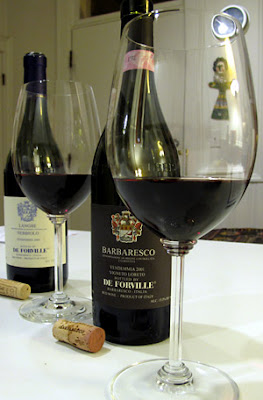
So what to choose? I waited for a door to open. It did, and behind that door was a single vineyard Barbaresco from De Forville. And as I stumbled upon De Forville's Langhe Nebbiolo, I opened that door as well.
Importer Neal Rosenthal doesn't have a whole lot to say about De Forville in his book Reflections of a Wine Merchant, beyond noting that the Anfosso family makes majestic wine. The DeForville family (who would eventually merge with the Anfossos through marriage) started growing nebbiolo in the 1840s, and as was common back in the day, they sold their wine wholesale in barrel. It took them nearly 100 years to start bottling their wines, although the DeForvilles must have done so before many of their peers, particularly considering that Barbaresco wasn't recognized as an appellation until 1964.
The winemaking at De Forville is traditional: used casks rather than new barriques, racking rather than micro-oxygenation, restraint rather than rotofermentation, and so forth. And thank the gods, for I don't want soft, bashed fruit that occludes acidity and dirt. Piedmont nebbiolo should demand that I meet it halfway, seduce me with its perfume but not yield easily to a first impression. It should hit the head and the heart, and demand to be scrutinized and loved in equal measure. If Marlene Dietrich were being bottled, the Anfossos might be the ones bottling her.
De Forville Langhe Nebbiolo 2005
Let's start off with the young'un, which at under $20 is a very good value. Over two days this proved to be lovely and meaty, smooth and substantive. The aromas are deep and satisfying, a subtle yet complex melange of garam masala, strawberry, rose petal, and rare steak. The wine is lively on the palate, with plenty of cherry fruit, brisk acidity, complete front-to-back presence — it's particularly full at midpalate — and a decently long finish. It only has enough tannin to provide good structure (your tender cheek flesh is safe) and tar and leaf notes show up subtly only on night two. The big surprise here is the resemblance to certain Loire cabernet franc. In fact, if I drank this blind beside Bernard Baudry's entry level Chinon, I might not be able to tell the difference. Crazy.
De Forville Barbaresco Vigneto Loreto 2001
Everything that could be good and true in a single vineyard Barbaresco is found here. I could stick my nose in the glass for days, as this goes beyond the telltale roses and tar aromas, with a complex and mysterious depth of fruit, earth, and hoisin sauce. It may be a cliché to say a wine's aroma is haunting, but in this case it's true. On the palate the Loreto balances a silky and sweet presence with excellent structure and great lift, and the flavors include Indian spices, umami notes, black cherry, and leather. The tannins are most ferocious on night three but they re-integrate on night four. Every sip on every night showed terrific length and great grace. At $45 this may be a rare treat, but it's also a rare beauty.
As for food, what would you not want to pair with these nebbioli? Well, I would avoid spicy, sweet, and bitter foods (neither an Asian noodle salad nor a green salad were particularly good matches) in favor of meaty, earthy, savory foods. Think hard cheeses, meats cooked any which way, mushroom-based dishes, risotto, and pasta. The wines were wonderful with a pork chop marinated in sage and orange juice and also paired nicely with a simple seared tuna steak.
Of course, with wines this good, I'll pair the food to the wine, not the reverse.
Wednesday, February 18, 2009
WBW 54: A Passion for Piedmont
Posted by Wicker Parker at 7:28 PM 4 comments
Labels: g - Nebbiolo, r - Barbaresco, r - Piedmont
Saturday, September 6, 2008
Is Italian, Is Not Italian
As if anticipating the cooler weather to come, I recently opened two reds that I'd normally pair with the heartier fare of autumn. This is actually par for me — I think of the wines I'll want in the coming season, then anticipation turns quickly into action. (The equal and inverse result: I have a few leaner whites and rosés that are begging to be drunk soon, but I'll get to those soon enough...)
Ferrando Nebbiolo di Carema White Label 2003
You will learn a lot about the Carema appellation generally and Luigi Ferrando specifically if you read importer Neal Rosenthal's Reflections of a Wine Merchant. I'll let you read Rosenthal's personal perspective on your own, but suffice it to say that Carema is a tiny, 40 acre appellation that lies in the steep, slate-strewn hills of subalpine Piedmont. Nebbiolo is the grape, but, as Rosenthal puts it, "[it] is an elegant and graceful wine with a subtle tenacity that is breathtaking... Ferrando's Carema does not have the force or tannic presence of its regal brethren, Barolo and Barbaresco; but there is a balance and energy within this wine that gives it punch and staying power."
Staying power? Yes, I should think so. Ferrando's Black Label is a reserve bottling made only in the very best vintages; this is the regular White Label release, and even so, five years on it is only beginning to mature. For now, it requires a serious decanting at the very least, what with its rock-ribbed acidity and still-resolving tannins. There's a serious sour cherry component here and behind its armor there's the suggestion of depth. I'll wait at least five years to open my next bottle, after which this will be very, very good.
Palmina Mattia 2004
Half a world away and one vintage on comes this refosco-dominated blend from Palmina, the Santa Barbara-based winery that's dedicated to growing Italian varietals. Refosco is a high-acid red grape indigenous to Friuli and Slovenia and, in Palmina's able hands, it is no less acidic or refreshing. In fact, this deep purple wine's acidity was unyielding on its first night, but it showed nicely on night two. The acidity is energetic and the tannins are fine-grained yet substantial, and so the aromas and flavors of plum, graphite, dried herb, currant, and smoke are simultaneously bright and dark.
Plum? Graphite? From refosco? No, that would be the 30% cabernet franc and 15% merlot talking. Refosco speaks of acidity and pepper, and the Mattia pairs well with both peppered fresh heirloom tomato and spicy pork sausage. Although it's showing some depth now now, this should catch fire in the next few years.
Posted by Wicker Parker at 11:10 AM 0 comments
Labels: g - Nebbiolo, g - Refosco, r - Carema, r - Piedmont, r - Santa Barbara


 Posts
Posts


