Monday, January 10, 2011
I Forbid the God of Cliché
I'm drinking a white in the winter and a sparkling wine on a Monday that's not a holiday and a French wine with nominally Italian food (pasta with pesto). I don't have a flute because I don't want one, so into the wide-bowled Burgundy glass it goes. Little about this scenario is "correct."
Still, everything feels right. Pinon (nice Wine Doctor profile here) provides an unmasked, acid-driven expression of Vouvray. There are no autolytic aromas to hype, no poached pear on toast flavors to profile. "This is me," it says — the crunchy honeycomb flavors, the telltale chenin bitterness, the fine minerality — and the acidity cuts nicely through the rich green herby pasta. It's slightly oxidized, in a good way. Have I had drier white wine? Yes. But not that much drier.
Today feels to me like a good day not for the simple, but for the unadorned.
Posted by Wicker Parker at 6:50 PM 0 comments
Labels: g - Chenin Blanc, r - Loire, r - Vouvray
Thursday, January 6, 2011
Olivier Cousin's Anjou Grolleau
I say "apparently" because I didn't know that limestone soils were found in Anjou until I looked up Olivier Cousin, whose lively, peppery, berry-in-a-barn 2009 "Le Cousin" Grolleau I drank recently, and Jenny & Francois tell us that all of Cousin's grapes come from limestone and clay soils. Olivier plows his vineyards solely by horse and vinifies both biodynamically and naturally, without additions of any kind (it's truly sans soufre), and these grapes come from 30+ year old vines near Martigné-Briand.
I should back up a second: grolleau is a red grape variety indigenous to the Loire that in many ways reminds me of pineau d'aunis. Both are refreshing, peppery, high-acid grapes that are favored by many a natural winemaker in the Loire. But whereas the few pineau d'aunis I've tried struck me as overly peppery and a tad harsh, the grolleau I've tried (including Jerome Saurigny's) seemed to me earthier, gentler, and deeper. This one from Cousin shows some sharp acidity, yet its texture is quite soft if also nicely structured, possibly thanks to its limestone soils. The herb notes start edging toward tobacco, although they don't quite get there, thankfully, and there are savory soy notes here, too.
While the "Le Cousin" is hardly stern, it irritates me to see that this well-structured if light-bodied wine is described by certain parties as a quaffer, a wine you don't have to think much about. I couldn't disagree more. Even if this wine's flavors and aromas weren't so unique, which alone should pique a wine lover's interest, its delicacy and depth are readily apparent and invite contemplation, even as its joyfulness is equally apparent. Serve it at cellar temperature and everything about this wine becomes even more apparent.
Posted by Wicker Parker at 8:27 PM 1 comments
Labels: g - Grolleau, r - Anjou, r - Loire
Tuesday, January 4, 2011
Not a Rosé, At First Blush
I have decided that 2011 is going to be a great year. And to get the year kicked off, I'm going to fete this exuberant little number that I admittedly drank a few months ago but which would have been great over the last weekend. It's a wine that seemingly shouldn't be what it is, and is definitely what it says it is not.
"Ceci n'est pas un rosé," says the Anjou producer Domaine des Sablonnettes, who are really a couple named Christine and Joël Ménard. And you'd believe them at first blush, so to speak. Look at it: this cabernet franc and cabernet sauvignon blend couldn't possibly be rosé? Ah, but it is, and not surprisingly it's a Vin de Table, not one approved by the appellation authorities.
If "vibrant" is a Loire hallmark, this wine was so vibrant that it seemed to possess a life and an imagination of its own. It had a snoot of earth and rhubarb and garden herbs and crazy dry rocks. The firm, tart, joyful palate made me think of a raspberry-strewn rock garden; and then it turned so long and airy on the finish. I was really taken with this.
I cannot find much information about this wine, save that the Ménards grow the grapes biodynamically, never inoculate or chaptalize, that sort of thing. Had I known of the Ménards last June I would have dropped by when I passed through Rablay sur Layon, the better to understand them and their not-rosé. An opportunity lost.
No, stop! This is not a wine for brooding upon regrets! It is for celebrating, and I in turn will simply celebrate it. Cheers to us all!
Posted by Wicker Parker at 6:12 AM 0 comments
Labels: g - Cabernet Franc, g - Cabernet Sauvignon, r - Anjou, r - Loire
Sunday, July 25, 2010
With Jérôme and Sophie Saurigny, Anjou
If you have turned your back on what Bordeaux too often stands for, you need to know about Jérôme Saurigny. He did so literally in 2005, quitting his work there and turning instead to Anjou and making wine naturally on his own at Domaine Saurigny. On paper he sounds utterly crazy. Who in his right mind would macerate cabernet franc for four months without sulfur, CO2, or temperature control? He went to enology school in Bordeaux, didn't they teach him anything down there? But Jérôme's wines do not taste foolish or crazy. They are utterly alive, fresh, vivid, and their exuberance reflects his personality.
Jérome is part of what I think of as the VdF crew of the Layon, young natural winemakers who exchange ideas and occasionally collaborate but ultimately pursue their own individual paths to making natural wine. The ones I met created rather than inherited their domaines, work long days in the vineyards and the chai, and live simply. Some actually do produce AC bottlings, but the Saurignys now only release Vin de Table / Vin de France bottlings. Between the size of their holdings — 6+ ha in the Saurignys' case — and their unpretentious pricing (these are not garagistes), I can't imagine that anyone in the VdF crew is getting rich.
The most important thing to know about the Saurignys is just how great they are, really warm and generous and welcoming. Just for starters, I arrived 20 minutes late for my appointment at Domaine Saurigny in Saint-Aubin-de-Luigné, but Sophie Saurigny was genuinely unfussed about my late arrival. Jérôme himself wasn't there when I arrived — he was over at Les Griottes with Sebastien Dervieux pressing gamay after it had been macerating for eight (!) months — but that meant I could spend some time talking with Sophie.
Sophie told me about Jérôme's stints in Bordeaux and how he found the wines ultimately boring. Here in the Layon, they take the natural approach; they only fight humidity with Bordeaux mixture and otherwise only plow, prune, and do other hand-driven work to maintain vine health. My French is poor, but I did my best to understand the full story. For example, I ask Sophie about biodynamics, and I think she said that the biodynamic approach is fine for larger domaines but that they choose the natural-only approach.
Jérôme arrived as if on a gust of wind with Luis (sp?), who'd been assisting Jérôme and Sébastien over at Les Griottes. Sophie provided cherries and pork rillots (aka rillettes), which are a specialty of the Layon, to snack on as Jérôme led the tasting. This was not some quiet, formal affair: Jérôme tore off chunks of bread, ran around gathering tasting samples, downed wine, and good-naturedly answered all my questions. Jérôme used to skateboard and he has a free, roguish energy which mirrors that in his wines.
2008 Au Suivant... VdT: We began with this cabernet franc made from 15 and 30 year old vines from St. Aubin. It's the one I referred to above where the grapes were macerated for four months in resin/epoxy tank (a vessel favored by the VdF crew), but I must emphasize that the wine is balanced, without a hint of overextraction or excess tannin. The wine is utterly alive, with a gorgeous nose of flowers and beautiful red fruits. Its acid and tannin structure are perfect, and it is a joy to drink. What a great way to start a tasting! It's also only 12% abv, which is typical at this domaine, and as with all the Saurigny wines since 2007, there are no sulfur additions whatsoever, not even at bottling.
2008 Ange Ou Démon: It's a pun — Anjou / Ange Ou — and a potentially helpful one at that, as VdF labels cannot explicitly advertise the region or the appellation, just a zip code. Look closely and you'll also see this tiny print: "L.CFCS8." More specifically, it's 25% cabernet franc and 75% cabernet sauvignon, and it's darker on the nose and much darker on the palate than the Au Suivant. This underwent one month of maceration and the tannins are both fine and lovely. Again, the acidity here is beautiful.
2008 Pactole: My first grolleau! Jérôme said this grape gives a lot of juice and not a lot of tannins. It's yet another lively, lovely wine. It's spicy, but its pepper character is finer and less aggressive than pineau d'aunis, to which it bears a resemblance, and I like it more. It's red berried but not to the point of cranberry; it's not that tart. Pactole translates as "gold mine" — another joke given this variety's commercial viability? This is only 11.5% abv.
Now we taste a few whites from bottle.
2008 Chenapan: "Rogue" indeed: this completely dry chenin is unlike any I've had. Its color is peach, almost like the label! The nose hints of oxidation but it's very fresh on the palate and laced with ginger and ground pepper. It's also a bit tannic! I asked about skin contact, but Jérôme said there was none, and that the tannins come from the schist. The vines are located high on a slope above the Layon. This is a fabulous wine.
2009 Sauvignon: With rare exception (e.g. the best Sancerre) I only like varietal sauvignon blanc when it comes from granite or schist, and this is indeed terrific. It's slightly orange/straw colored and a bit cloudy, but it's of course young yet. But despite its youth, it's expressive, and the schist lends a slightly spicy character to the wine. Not a catbox in sight. Jérôme says the 2009 harvest was very easy.
Now we switch to unbottled reds from tank.
2009 Gamay: Jérôme doesn't find this interesting — "pour la soif," he says. There's a bit of residual sugar still, but despite that I like the wine's purity.
2009 Grolleau: Grolleau may not have a lot of tannins, but this sample is quite tannic. I get purple fruits on the nose and it's very young in the mouth. This one Jérôme really likes.
2009 Pinot Noir: Jérôme doesn't intend to bottle this, it's just for the Saurignys and their friends. It has a big, beautiful nose but it's medium-light in the mouth, a bit tannic, and shows a strange hint of band-aid.
Back to bottled wine! Even though I was spitting, this was a lot of wine!
2008 Gamma GT: I asked why "GT" but I couldn't understand the answer. Sometimes you have to say, "Répétez, s'il vous plaît," and sometimes you should just move on. Jérôme and Sophie both said they find a hint of paper in the finish. I did not, but it's not as expressive as their other 2008 reds: hints of schist and smoke, but only a little.
Les Griottes La Griotte: This c. franc / c. sauvignon blend is made by the Saurignys' friend Sebastien Dervieux at Les Griottes, who likewise eschews sulfur and all other additions. It was unlabeled so Jérôme didn't know if it was the 2007 or the 2008. Upon tasting I thought it was the 2007 and Jérôme agreed. It showed very pure and firm blackcurrant fruit and good concentration, and it was quite young and tannic, so it needs some time yet.
2009 Les Griottes Mousseaux Moussaillon: Bottlecapped bubbly! Again, this is a peach-colored, chenin-based mousseaux. It's a touch oxidized but delicious for it. Jérôme said this was disgorged during a very cold snap in winter. Much later in the day, as we were cleaning the press, I happily quaffed a glass of this.
Now to Jérôme's sweet wines. These slayed me, as they showed the beautiful balance and weightlessness that I look for in sweet wines. And again, despite the risks, these wines have no SO2 as of the 2007 vintage.
2007 "S": This has 200 g/l of sugar but, as Jérôme and Sophie said, it "drinks like water." This is balanced and complex and expressive, with absolutely gorgeous apricot, honey, and ginger notes.
2005 "S": This comes from the Saurignys' first vintage and it has a lot more sugar: 300 g/l. Nevertheless it's not at all heavy, even if it is very rich on the palate, with brown sugar and apricot characters. Very nice lift here for a 2005, which at other Loire domaines can suffer a touch from too little acidity.
2009 liquoreux barrel samples: Jérôme vinifies the non-botrytisized grapes separately from those with botrytis, even in years like this where there was very little botrytis. The former sample was very pure, with great acidity, while the botrytisized sample was likewise very pure but included an interesting lychee note.We are done at the chai, time to pile in the car to go to Les Griottes and see how the gamay is coming along. Here I meet Sebastien Dervieux, whom I frankly can't understand in the slightest. Luis tells me that Sebastien and Jérôme make liberal use of the local slang, which combined with my minimalist French explains things. Sebastien and Jérôme press the macerated-for-eight-months gamay with a very gentle pneumatic wooden press, which also explains a thing or two: tasting the freshly pressed juice, I find it really tannic — damn is it tannic! — but not at all bitter or overextracted. It is fresh and vital.
The rest of the afternoon is a whirlwind: lunch at the Saurignys' home in Rochefort, visits with a few of Jérôme's friends, and then back to the chai to clean the press. I helped out for a few moments after filming this video, which shows the glamorous side of being a winemaker:
Finally, we paid a visit to Domaine Mosse, whose 2005 Anjou sec flipped my wig over a year ago (I literally cried out, "Oh my god! This is like a Savennières!"). Agnès and Réné were in Toulouse but I met two of their sons, who welcomed me into their home and graciously had me taste a few wines. The Mosses do bottle with sulfur, but at extremely low levels. The 2009 Achillée VdT rosé is a quaffable blend of grolleau, cf, cs, and gamay. It has too much RS to be labeled for AC status but it's unconfected and shows nice herbs. The 2008 Anjou Blanc is totally dry and has the telltale spicy characteristics of schist-derived chenin, although some of the 5 year old vines are rooted in clay. It's quite clean and verges on medium-full. The 2007 Le Champ Boucault has nearly 200 g/l of RS but has all the acidity required to help balance the wine and drive it down the palate. Lots of apricot here, and not at all heavy.
Sadly, the day had to end, and I needed to head back to my B&B before night fell, lest I get lost. And while the Mosse wines are imported into the US by Louis/Dressner, I'm sad to say that neither Domaine Saurigny nor Les Griottes are available here unless and until some wise importer decides otherwise. Yes, yes, I understand how reluctant importers are to ship sans soufre wines, but I'm going to complain, anyway. Well, if you find yourself in Paris, do yourself a favor and head over to Crus et Découvertes, which Jérôme suggested was the best place in Paris to find his wines.
By the way, I'd like to thank Bert of Wine Terroirs for posting the story of his visit to Domaine Saurigny last March; without him, I wouldn't have known to visit. So thanks, Bert! You should check out his post for even more details about the Saurigny wines.
Posted by Wicker Parker at 7:37 PM 0 comments
Labels: r - Layon, r - Loire, Spring 2010 Trip to France
Monday, July 5, 2010
Visiting Romain Guiberteau in Saumur
At last I reached the Mothership: the Loire Valley, home of my adored chenin, home of rare indigenous varieties secreted in small plots, and home to some of the most dynamic set of winemakers in the world, many of whom pursue natural winemaking in their own ways and on their own terms. As much as I would have loved to have visited the Touraine, I focused on the Layon because of its schist and because I correctly assumed the winemakers there would have particularly interesting things to say.
But before I hit the Layon, I stayed in Saumur and biked down to Domaine Guiberteau in Mollay, just west of the great calcareous vineyards of Brézé. After experiencing three of Romain Guiberteau's wines earlier this year, it was a no-brainer to visit, a must.
Romain's grandfather bought up vineyards some decades ago but the domaine began bottling its own crop only in the mid-80s, and Romain has taken the domaine in a completely natural direction: No chemical sprays, no chaptalization, no enzymes or stabilizers, indigenous yeasts only, and a leave-it-alone approach — to paraphrase Romain, when you leave a wine alone, such as letting chenin rest on its lees rather than stirring it, it may take longer for the wine to be what it will be, but it will be better when it gets there.
Like many a Burgundian, Romain begins the tasting with the reds, which are made entirely from cabernet franc. 2009 marks a new direction for the domaine-level wines, as they are now to be aged in inox only rather than used barrels as was previously the case (and will still be the case for the lieu-dits). This allows him to respond to clients' requests for a lower-priced wine, but he also now prefers to emphasize the fruit. He finds that his reds up through 2006 are too big and concentrated for his taste. I think they have the stuffing and balance to age very well and are not at all overly large, but that is my taste. Regardless, it's clear that more recent vintages are not the least bit lesser; they are merely different.
2009 Rouge: The domaine wine had just finished malo two weeks prior to my arrival and it will be bottled in September. It is a beautiful wine, very pure, and the greatness of the vintage shines through. It is the essence of cabernet franc, fresh and deep and savory. 75% of the grapes are plucked from calcareous soils and 25% are of argile.
2008 Rouge: This spent 15 months in used barrels. 2008 was a high acid year and it was a difficult vintage, as 60% of the crop was lost to a freeze. Between my bad French and his much better English I try to understand the nature of the freeze — apparently it was not frost — but I will have to let this point be a mystery for the time being. But there's no question about this wine's beauty with its lovely dark fruits. Again, there is no trace of overripeness or overextraction, and for it the wine seems effortless. Romain says this should be particularly good in 2012.
2007 Les Motelles Rouge: This 1.4 ha lieu-dit is planted on argile in Montreuil-Bellay and the wine spent 18 months in a mix of one, two, and three year old barrels. This is lighter and more floral than the 2008 domaine, as befits a cabernet franc from 2007, but it still has good tannins and a lovely raspberry aspect. I ask about disease pressure and other problems, but Romain said he experienced none of that in 2007.
2007 Les Arboises Rouge: Romain does use some new barrels for this wine but there is not a trace of vanillin or toast. Rather, its purity is striking. This comes from a calcareous lieu-dit in Brézé and it's a bit less floral than the Motelles and shows greater acidity. The balance is great, too, and I love the red plum-like fruit. Like the Motelles, the vines for this wine were planted over 50 years ago.
Now it's time for the whites. Romain says he trades with winemakers from both Burgundy and from the south; he gets their reds, they get his whites, everyone is happy. I have nothing to trade, but I am still happy. Asia should be happy, too, as they get 40% of his production. Here in the US, only Illinois sees his wines.
2009 Domaine Blanc: This spent six months sur lie — no battonage, as previously mentioned. I've tasted a good amount of dry, unoaked Loire chenin over the years, and they are often nice straightforward wines for easy drinking. This is several notches above those wines. Just as the rouge is the essence of cabernet franc, this wine is the essence of dry chenin from primarily calcareous soils. Gorgeous apple flavors here, with depth and presence. Some young vine fruit is blended with fruit from 55 year old vines.
2008 Clos de Guichaux: This is a monopole of extremely young vines grown on argilo-calcaires, but Romain does not want to print "monopole" on the label until he is sure that the wines will perform well year in and year out, through difficult vintages and easy. The vineyard has only 30 cm of soil atop the bedrock. Romain likes this with cream sauces since its high acidity really cuts through richer food. For my part, I find this is gorgeous, with beautiful peach-driven flavors and impeccable balance. This spent 13 months in two to four year old barrels.
2007 Clos des Carmes: This is another monopole and it says so on the label. It's 2.6 hectares but only 0.5 ha worth makes it into this wine; the rest goes into the Brézé blanc. Interestingly, the vines were only 3 years old when the grapes were harvested and yet this cuvée was aged in 100% new oak for 24 months, which unlike the other wines imparts some vanillin character. Romain does not follow a recipe; he says that the batch that was aged in these barrels turned out the best and so he decided to bottle it separately.
2007 Brézé Blanc: I guess I'm an unoriginal thinker, because my notes again use the word "gorgeous." That's not to say that the wine isn't distinctive: it shows honeyed aromas that the above whites do not, and it's full in the nose and even fuller in the mouth. Of course, it's still dry. It has the acidity to move things along and the wine is both fully present — it hits every part of the palate in just the right way — and very long. This spent 24 months in new and used barrels, and no obvious oak flavors come through. It's complex and transparent. I ask Romain what makes Brézé special, why the wines from this slope are just that much better than most other spots in Saumur, and he says he doesn't know, exactly.
But to invoke Gertrude Stein, there's there there, and Romain confesses that he's very lucky: he has access to great terroir and is making a solid living without compromising his approach. Luck, yes, but also skill: these are the best Saumur wines of any that I've had. I climb back on to my bike and see a youngster looking at me inquisitively from inside the house. Someone inside is playing a piano; family is over for the day and Romain goes back inside to join them.
Posted by Wicker Parker at 11:48 AM 6 comments
Labels: g - Cabernet Franc, g - Chenin Blanc, r - Loire, r - Saumur, Spring 2010 Trip to France
Tuesday, April 27, 2010
A Few Luscious Voluptuaries
I want to talk about yeasts soon, but for now, two tasting notes.
Clos du Mont-Olivet Côtes du Rhône Vieilles Vignes Montueil-la-Levade 2007
I can't get over the creamy texture of this Clos du Mont-Olivet. Like a good cappuccino, a cream note is swirled effortlessly into a dark and slightly bitter base. Of course, there's more going on here than that — the nose shows dark fruit, dried herbs, rain on blacktop; the wine is full and dark yet fresh on the palate; the acid / tannin balance is nicely realized — but it's the effortless, unconfected texture that wins me over. Bonus geek notes: the grapes for this wine are only partially destemmed, carignan makes up a small part of the blend, and the fruit is not as sweet as you'd expect from a 2007 CdR.
Bernard Baudry Chinon Les Grézeaux 2005
I joined a friend for dinner at Cafe Absinthe and I was impressed by the wine list. I ordered duck breast, he ordered beef tenderloin. In other circumstances I might have selected the 2004 Clos Roche Blanche "Pif" but if a Baudry's on the list, the idea of passing it by is frankly unbelievable. That's because the wine is frankly unbelievable. The Grézeaux, which comes from gravelly terroir, is harmonious to the point of ur-dom; it's hard to speak of the wine's components when it's so freakin' together. It possesses a smooth, effortless grace. It is undeniably young — still unfolding, yet to achieve its zen-point, as it surely will in the decades to come — but it's also precocious and very expressive now, and if I had any of this wine stashed away, it'd be difficult to keep my hands off it.
Posted by Wicker Parker at 5:55 PM 1 comments
Labels: r - Chinon, r - Loire, r - Rhône
Tuesday, March 16, 2010
Guiberteau's Fabulous Saumurs
Why the blogs are not abuzz over the wines from Saumur's Domaine Guiberteau is beyond me. Nothing from even Jim's Loire or any other Loire-friendly, English language blog out there that I can see. The wines are a tad pricey (mid-20s), but they're worth it as far as I'm concerned. I'm very happy that my friend Erin turned me onto them!
The wines are ultra-clean, but they are also naturally-made, transparent, and completely expressive of place. If I (and Google Translate) interpret their French-only web site correctly, the domaine hand-harvests both their organically-grown chenin blanc and their cabernet franc from 25+ year old vines to the tune of 45 hl/ha. Romain Guiberteau ferments the wine solely with native yeasts, eschews all enzymes and stabilizers, and ages the basic "domaine" level wines in two to four year old oak barrels (the top wines do see some new oak, but I've not had them). The soils are clay and calcareous silex.
The first wine I experienced from Guiberteau was the 2005 Saumur Blanc, and it's stunning. The aromas of lavender, paraffin, and apple skin show great clarity. The wine is dry and utterly precise on the palate, with a come-to-jesus delivery of elegant concentration (and concentrated elegance) — the pear and melon fruit is layered with chalky minerality, stony lemon, rainwater, and firm, well-structured acidity. The texture is full and nicely defined — the angles haven't been overly sanded down — and the finish is long.
2007 may have been a more difficult vintage, but the 2007 Saumur Blanc is, in its own way, just as successful as the 2005. It's very firm and dry as befits the vintage, but there's a richness underlying the steely, high-acid structure. It's slightly chalky on the nose; otherwise, it's quite closed aromatically speaking. It's more expressive on the palate, with flavors of melon, tart apple, honey, and nuts, and it's very dry on the long, citric finish. It's exceptionally well balanced and has the bones to age, and it should blossom as it does — it's just a baby!
Finally, I was gratified to comes across the 2006 Saumur Rouge on the wine list at the vegetarian-focused Green Zebra. This 2006 was just barely coming into its drinking window, as you'd expect from a concentrated, well-made Saumur rouge from this structured vintage, but expressive it was: a twinge of herbs, some black olive notes, beautiful acidity, and good earthiness. It was a great companion with my green papaya salad, my earthy dal, and even the pan-seared scallops served with braised mushrooms. Meanwhile, my dining companion, who's not geeky like me but enjoys solid reds with good fruit, very much liked it as well.
Do these wines represent the Platonic ideal of excellent Saumur? Maybe! I've never had the Saumur-Champignys of Clos Rougeard, for example, so I'd rather not spout such things off. But I'm happy to spout off about Romain Guiberteau's wines in general.
Posted by Wicker Parker at 5:15 PM 1 comments
Labels: g - Cabernet Franc, g - Chenin Blanc, r - Loire, r - Saumur
Thursday, December 10, 2009
Drinking Subzero
With the wind chill making it feel like -3 Fahrenheit, is there any better time to be drinking Muscadet? Well, it's what I've been drinking the last few nights — specifically, Henri Poiron's 2008 Domaine des Quatres Routes Sèvre-et-Maine. The only background info I've found on this wine comes from Jim's Loire, and then only that this domaine (of the two that are Poiron's) is sited on schist, a bit unusual for this granite-dominated appellation.
When I first opened it I thought it a dead ringer for a Chablis, but soon enough the seashell characteristics turned into the more quintessentially Muscadet characteristics of lemon and salty rocks. It shows good concentration and weight, and for all its clean, acidic snap it's a pleasantly warming wine, just the ticket for an absurd cold snap.
Posted by Wicker Parker at 7:41 PM 1 comments
Labels: r - Loire, r - Muscadet
Thursday, November 26, 2009
My Decanter (or, Anticipation)
Happy Thanksgiving, everyone. I'm hosting a gaggle of people and I've been merrily planning and cooking for the last several days. For example, I've already made the broth for the mushroom risotto, baked the Indian sweet potato pastry spirals, cooked the fiery sweet potatoes which I'll broil right before the meal, and made the Indian-spiced bean and vegetable salad. Later today, I'll make another vegetable salad (daikon, carrot, and green bean, blanched and julienned and dressed with a soy-based sauce), squash stuffed with bacon and apple, and tofurkey. Hey, I like tofurkey!
While these dishes may not sound traditionally Thanksgiving-ish, they are earthy much like the more traditional fare. So I still need to serve earthy, medium-bodied wines, just as I would for a more obviously traditional feast.
To that end, I've lined up the gorgeous 2002 Dirler Schimberg Pinot Gris, the elegant 2005 J.K. Carriere Willamette Valley Pinot Noir, and for those who want a more full-fruited red wine, the 2006 Domaine Gayda Chemin de Moscou, which is a Vin de Pay d'Oc from a 200m high vineyard in the Malepere appellation north of Limoux (see Google map) that's 55% syrah, 40% grenache, and 5% cinsault. We'll actually start the meal with a shot-sized pour of Isastegi Basque cider to accompany an arugula salad, and then at the close of the meal, I'll serve the 2005 Baumard Cuvée le Paon, a botrytised Layon wine that Baumard makes in only the best vintages. (Backup wines in case of extra guests or cork taint: Carriere's 2005 Chardonnay and the lovely 2008 Tenuta delle Terre Nere Rosso from Mt. Etna.)
The Carriere pinot has great structure and acidity and I will definitely need to decant it a few hours before the meal. The Paon, however, really needs a decant — it's outrageously young and the Baumard house style is reductive — so 12 hours ago I decanted it into... an old glass coffee carafe that I salvaged from a dead coffee maker. Yep, that's my decanter. It's perfect: it's wide, easy to clean, features a pour spout that makes double decanting a snap, and was absolutely free. And it of course works. I'm happy to report that some of the Paon's cavity-inducing baby fat has been shed and it's growing deeper and more complex, with excellent acidity and those quiet and remarkable tones of bitter herbs that I love in chenin.
OK, it's time to start the last of my cooking — no time to lose! Happy Thanksgiving to all of us.
Posted by Wicker Parker at 9:17 AM 0 comments
Labels: g - Chenin Blanc, r - Layon, r - Loire
Saturday, November 14, 2009
The Loire Transmitted Via Baudry and Puzelat ca. 2007
After I fell in love with dry and demi-sec Vouvray some years ago, I was driven to learn more about Loire chenin, and so I crossed the river to Montlouis and went downriver to Savennières. I began reading about reading about the nearby appellations, and soon enough my palate was making loop-de-loops throughout the Loire. Hello, Bourgueil, hello, Chinon, pleased to meet you. I was initially more intellectually engaged by Loire reds than emotionally engaged, but then I found some that changed that dynamic, although doubtlessly my palate became more open to these wines simply by virtue of exposure.
The rains of 2007 in the middle Loire did not necessarily cause dilution, but acid and tannin levels are typically lower than in the more structured vintages that surround it, and people more experienced than I say that 2007 Loire reds are early drinkers compared to 04, 05, 06, 08, and (it is thought) 09. That is, while my favorite producers' wines are transparent in every vintage, the wines from 2007 will likely express the terroir and the vintage more quickly and are less apt to last. I continue to put this received wisdom to the test.
Thierry Puzelat Le Telquel (lot 2007)
It's now more common for American shoppers to see Loire reds made from grapes other than cabernet franc, and among the 500,000 cuvees that Thierry Puzelat makes, both with his brother under the Clos Tue Boeuf moniker and on his own, is this 100% gamay, a negociant bottling sourced from a variety of vineyards in the central Loire. Back in August of 2008, Mr. McDuff reported that there was "no mistaking it for anything other than Gamay" due to its pure and bright red fruit. With a further year's evolution under its skinny belt, I actually could mistake this for something other than gamay, but I would not, I think, mistake it for anything but the Loire.
Certainly with its nose of black cherry, smoke, roasted barley, black olive, and worcestershire sauce, I wouldn't peg this as Beaujolais — the olive note in particular recalls, say, Saumur, although the barley and smoke notes push this wine closer to the Clos Roche Blance 2007 Gamay. The Telquel is fairly concentrated and the texture is more rustic than refined, and driven by robust cherry-tart acidity. There's plenty of primary, non-sweet fruit on the palate — tangy plum, mostly, with a hint of olive — yet it's just starting to turn autumnal, with aspects of dried leaves and brown earth minerality.
Is this an expressive early drinker? You betcha. I suspect the acidity will seem harsh after the fruit fades but I expect this to drink very nicely over the next 6-12 months.
Bernard Baudry Chinon Les Granges 2007
Baudry's entry-level Les Granges, per the excellent profile at The Wine Doctor is "a wine produced from 6 hectares of vines planted on alluvial sand and gravel soils on the banks of the Vienne between 1985 and 1988; when the Vienne bursts its banks the vineyard can flood, and Baudry has been known to undertake pruning from a rowing-boat." Um, wow.
Les Granges is meant for early drinking — at least by Baudry standards. I'm not sure whether this sees oak or not. The Baudry web site mentions nothing about oak aging, but I've read elsewhere that it is aged in older, more neutral oak. It hardly seems to matter, as I am consistently bowled over by the purity, elegance, and transparency of M. Baudry's wines (even the 2003 Les Grézeaux was astonishingly elegant given the crushing heat of the vintage).
My rule of thumb is to wait three years before opening better Loire cabernet franc, a rule that even this meant-for-early-drinking wine validated to some degree, as it was fairly tight when first opened. But no worries: over the course of the evening it slowly revealed aromas of coffee, smoke, candied ginger (!), sweet black cherry, and especially iodine. It also became very expressive on the palate, as the flavors of cherry, graphite, and blackcurrant are nicely framed by (and integrated with) both acidity and tannins. Finally, there are fine, pure, iodine-rich minerals on the medium-long finish.
It's a mystery to me why I don't have more Baudry in my life. I think that's a mystery I should solve.
Posted by Wicker Parker at 10:53 AM 2 comments
Labels: g - Cabernet Franc, g - Gamay, r - Chinon, r - Loire
Monday, July 20, 2009
Jacky Preys's 2007 Fié Gris Touraine
The internets are alive with the sound of people clicking onto Bernard's great post on how Jackie Preys essentially resurrected the fié gris grape from oblivion. Click over to it now if you haven't already.
Posted by Wicker Parker at 5:02 PM 5 comments
Labels: g - Fié Gris, r - Loire, r - Touraine
Sunday, June 21, 2009
Demi-Sec Faceoff #4: Foreau vs. Schwibinger
Posted by Wicker Parker at 1:09 PM 0 comments
Labels: Demi-Sec Faceoff, g - Chenin Blanc, g - Riesling, r - Loire, r - Rheinhessen, r - Vouvray
Sunday, April 12, 2009
2006 Crochet Sancerre with Pasta Fagioli
I visited a friend in San Francisco, and among other things we camped overnight in Big Basin Redwoods State Park. I'm in pretty decent shape but hiking up and down and up and down the Santa Cruz Mountains left my calves feeling a bit sore even two days after the fact. So when I returned to Chicago, I decided to feed them a nice plate of
noodles and beans pasta fagioli. I had a meyer lemon handy so I dressed the fagioli in herbs and lemon juice and popped open Lucien Crochet's 2006 Sancerre.
I rarely drink Sancerre, or any sauvignon blanc for that matter, so I was inclined to compare it to the '07 Vacheron I so recently adored. But I thought the better of it (different vintage and all that) and decided to let the Crochet stand on its own delicious merits.
Lucien Crochet Sancerre 2006
According to importer Neal Rosenthal, Crochet sources his "basic" Sancerre from a variety of vineyards, harvests the grapes manually, ferments exclusively in steel tank, and avoids malolactic. In 2006 this led to a wine that ably straddles the gooseberry-grass divide and, more importantly to my palate, is simultaneously creamy and precise.
The aromas suggest lemon and white flowers, while delicate hints of smoke and chalk add intrigue. On the palate the wine is quite ripe but also firm, zesty, and energetic. This shows great poise and the minerality on the finish is pure, clear, and fairly long. Interestingly, I found that a great white pepper note emerged when paired with the lemony — and well-peppered — pasta fagioli.
In other words, the 2006 Crochet fulfilled one of my essential wine commandments: that wine be self-posessed and true but marry well with an appropriate pairing. And at the end of the day — or at least at the end of a hike — what more could I ask for?
Speaking of commandments, happy Easter and Passover to all y'all...
Posted by Wicker Parker at 10:41 AM 4 comments
Labels: g - Sauvignon Blanc, r - Loire, r - Sancerre
Thursday, March 12, 2009
Demi-Sec Faceoff #3: Richter vs. Aubuisières
It's been an eon since the last demi-sec faceoff — high time for bout number three! In this corner we have a 2005 Vouvray from Domaine des Aubuisières, and in that corner a 1990 Spätlese from VDP producer Max Ferd. Richter. Touch gloves, gentlemen!
Of course, this isn't actually a competition. These are of course very different wines, not least of all given the obvious age difference. Rather, I love to explore the virtues and distinctions of demi-secs — to see what makes them tick, to see how they differ and how they relate, and to test them with food.
In this pairing, the issue of acidity really came to the fore. Chenin blanc from Vouvray and riesling from the Mosel can be some of the most thrilling wine on earth, but if they don't have enough acidity, the wine will lack clarity and the ability to pair well with certain foods, or even end up simply and overly sweet.
Domaine des Aubuisières Vouvray Les Girardières 2005
Bernard Fouquet is a highly regarded winemaker who pursues a "less interventionist" approach: the vines receive minimal treatments, the grapes are harvested by hand, and sulfur is applied in small doses. The Les Girardières is grown in silex-based soils, rather than the limestone tuffeaux typical in Vouvray, and it's fermented in vat rather than oak.
Aubuisières should be applauded for posting good technical info to their web site. Many people have noted that 2005 Loire whites seem to lack acidity, and Aubuisières's numbers tell the story: while the 2007 Les Girardières has 8.1 grams per liter of acidity, the 2005 vintage has but 4.8 grams per liter — nearly half a more typical "classic" vintage. Despite this, the residual sugars in the two wines (which I really wish I could compare head-to-head) are quite similar: 26 g/l vs. 28 g/l in the 2005.
As with many other white Loire wines, the lack of acidity here is apparent. The aromas show apple, honeydew, and faint hints of beeswax and wool. I get sweet apple and canteloupe flavors upon entry, a soft round body, and the wine finishes with good minerality, tangy citrus and a pleasing hint of bitter herbs. But despite the tang, a lack of adequate acidity turns a potentially very good and complex wine into one that's a bit flabby and simple-sweet, and as it didn't improve over five days, I doubt this wine's aging potential. Despite the sweetness, this didn't work so well with a spicy Malaysian noodle dish, although that might be due to the bitter herb characteristics.
Max Ferd. Richter Erdener Treppchen Riesling Spätlese 1990
At 18+ years old this is remarkably fresh. This would surprise me in any case, but all the more so because the crusty, blackened cork demonstrated evidence of heat damage, as the wine had leaked up and over the top of the cork. When you look at the photo above right, you might just feel the alarm I felt. Yet appearances can deceive, and this wine was actually in very good shape. Whew!
I have no specific knowledge of how the acid-to-sugar ratios in this wine stack up, but the Richter web site does post numbers for more recent vintages, and their 2007 Spätlesen average roughly 70 g/l of residual sugar and 8 g/l of acidity. Of course, this Erdener Treppchen would have tasted much different 15 years ago — much sweeter by comparison — but I'm looking at that acidity number (again, not that I know the 1990's stats, but this is an instructive guideline).
Enough with numbers! I only mean to use them as signposts. They can't tell us anything about the grapes, the vintage, the vineyard, the winemaking, and the years that have passed. To the glass!
The nose on this Erdener Treppchen is rich with petrol, mango, and fig, but for all its aromatic voluputousness, it's trim and nicely proportioned on the palate. Apple and peach dominate, although the fruit is buttressed by lovely herb, lime, and spicy-sweet mango notes that show good length on the crunchy finish. That said, we come back to the acidity issue. While it is by no means bereft of acidity, it is slightly blurry on the palate, and I feel it could use a touch more acidity and more apparent mineral transparency. It's therefore not as precise as I would hope from a $40 wine — and I tasted this over five days to be sure.
Still, it's at its most complex and expressive on day 5, and in contrast to the Les Girardières Vouvray, this paired well with the Malaysian noodles. So if you have a bottle of this, why not hold it for a while and see what happens? It is very fresh, and it may yet go where it needs to be.
Posted by Wicker Parker at 5:58 PM 0 comments
Labels: Demi-Sec Faceoff, g - Chenin Blanc, g - Riesling, r - Loire, r - Mosel, r - Vouvray
Monday, March 9, 2009
Drink Your Green Vegetables!
Do you like a hit of eucalyptus or mint in your cabernet sauvignon? Do you appreciate the green bell pepper flavors you can find in Loire cabernet franc? I sure do. Such qualities are rightly damned when they reflect underripe grapes or the dilution caused by overly high yields, but in the right proportions these characteristics can be interesting, worthy, and true.
I look for a hint of vegetables in my Loire cabernet franc, and I find them in the 2006 Filliatreau Saumur-Champigny La Grande Vignolle. This wine, which comes from the eponymous vineyard that's romantically sited between the Loire River and chalk cliffs into which houses have been carved, tees off with aromas of sweet smoke, roasted meat, ground pepper, purple flowers, green olive, and tart red fruits. Fabulous. As it's a bit on the dark side I wasn't surprised that the fruit is fairly concentrated, though not overextracted, and that the tannins are still a bit aggressive. In other words, it's got some oomph, but I expect that it'll be deeper and silkier in a year or two (good Loire cabernet franc needs at least three years to unfurl its flag). Finally, it has very nice acidity, a healthy dose of minerals, and of course the vegetable flavors — particularly broccoli and green bell pepper — are a feature rather than a bug, as they accent the drinking experience nicely. Meat and vegetables in one wine: it's like a meal!
Whereas I look for vegetables from a Saumur-Champigny, I would not expect that vegetable flavors would be welcome in a Northern Rhône syrah, and yet in the case of the 2005 Cave de Tain L'Hermitage Vin de Pays des Collines Rhodaniennes, they are. It's varietally correct, with aromas of bramble, stems, black pepper, violets, and blackberries, but it also includes a hint of fresh, juicy, green bell pepper. These characteristics are delivered to the palate with some really nice acidity and spice. There's plenty of ripe black fruit in this barely-medium bodied wine, and a clean, rocky, bell peppery finish. I do want to emphasize that the fruit is certainly ripe; the vegetable component is subtle and it is a feature, not a bug. So while the wine is not complex, it is balanced and very satisfying.
The kicker? It's only $10. Oh wait, there's a second kicker: the alcohol level's only 12%. You can drink this on a Monday night, as I'm doing this very moment.
Posted by Wicker Parker at 7:22 PM 0 comments
Labels: $10, g - Cabernet Franc, g - Syrah, r - Loire, r - Rhône, r - Saumur-Champigny
Tuesday, March 3, 2009
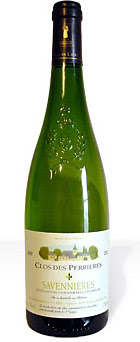
Soucherie's 2000 Savennières Clos des Perrieres
I can't get over how my friend Erin can't get over the notion that Savennières is, in Mike Steinberger's words, a wine like a cat. But then, I can't get over Savennières, period. Loire chenin blanc is one of my big touchstones so naturally Savennières is in turn one of my big touchstones. From these schist soils springs a wine like no other: expressive yet reserved, honeyed yet uncompromisingly dry, captivating yet not so interested in being caught. Like, um, a cat. Or as McDuff said, like The Fall.
More prosaically, a good Savennières has a strong personality but goes great with a wide variety of food. And if you give these wines the age they deserve, so much the better.
The 2000 Chateau de Soucherie Savennières Clos des Perrieres is a case in point. It's ready to drink but still very young. When I put my nose in the glass, there's a lot of there there, and yet the essence of the wine is elusive, just out of reach, mysterious. Sure, I could list all kinds of descriptors — cinnamon-dusted pears, honey-glazed rocks, strawberries wrapped in mint leaves — but that only gets me halfway there. It's likewise elusive if long on the palate: the mineral energy is terrific, the body is full yet precise, the fruit is chalky and lemon-tart and sweet, the finish is riddled with herbs like tarragon, but I cannot truly capture what it all means. It's strikingly pure, and I am shocked to learn that this was aged in oak, given its delicate force, its weightless weight.
I am not shocked, however, that this goes great with a spicy, turmeric-doused root vegetable soup, nor that it's a fantastic match with pan-fried cod seasoned with salt, pepper, and a healthy squeeze of lemon. I think I'm going to have to buy several more bottles so I can enjoy this over the next 20 years!
Posted by Wicker Parker at 7:56 PM 0 comments
Labels: g - Chenin Blanc, r - Loire, r - Savennières
Monday, February 2, 2009
2007 Domaine Vacheron Sancerre Blanc
I picked up some Humboldt Fog and asked myself, "What to drink?" The obvious answer, for me, is a slightly demi-sec Vouvray, which makes for a magical pairing. But this time I opted for others' obvious answer: Sancerre.
Over the years I've given little attention to Sancerre blanc given my lack of enthusiasm for sauvignon blanc in general. But as Jim Budd notes, "the Sancerres that are worth drinking completely transcend Sauvignon Blanc’s two-dimensional varietal character... [and] often have a thrilling minerality and precision of flavour."
Domaine Vacheron delivers exactly that. Now, you should read Jim's post on his September 2008 visit to Domaine Vacheron, but I'll summarize a few key points. The Vacherons implemented a biodynamics regime a decade ago and their vineyards' soils are composed equally of silex and limestone. In recent years they have backed off the extraction levels and also now use fewer small barrels in favor of 600 L vats, and have even changed the pruning system for new plantings, eschewing the Guyot system in favor of cordon so as to reduce yields. They don't stop experimenting, thinking things through, and above all doing everything they can to emphasize terroir.
Given the wine's ability to age, the very pale 2007 is obviously very young, and it was tightly wound, if deeply aromatic, when first opened. I got calcerous lemon, slightly bitter grapefruit pith, and energetic salty minerals. A strong and pure spine of acidity provides excellent structure, but again, you are at arm's length from the wine's core essence. But by night three the body becomes rounder, even creamy, without losing an iota of its weightlessness, acid precision, or salty drive, and the elegant, multilayered alfalfa and lemon cream notes really sing on the long finish, particularly at midpalate.
This is a delicate wine, and my spicy vegetable soup overwhelmed it, but once it had evolved it was indeed fantastic with the Humboldt Fog. It should also be great with steamed bivalves or light, grilled whitefish. Decant now or cellar for later — preferably both.
Posted by Wicker Parker at 4:44 PM 3 comments
Labels: g - Sauvignon Blanc, r - Loire, r - Sancerre
Saturday, December 6, 2008
BYOB Excursion 2: Coast
Many moons ago several of us went to Coast to eat sushi, drink wine, and celebrate my friend Kyle's birthday. What is it about women and sushi? We were some of the only men in there, and it's a pretty large restaurant. Maybe I should be asking why the men were so few. The sushi was fresh, the ingredients creatively assembled, the tempura perfectly light and crisp (I usually avoid tempura), and of course you can bring any damn wine you please.
Huët Le Mont Demi-Sec Vouvray 2002
By the time I had arrived the boys had already opened this to sip in the waiting area. I would have placed this third in line, but I sure as hell wasn't going to refuse a glass. Not surprisingly, this was pretty tight and had only begun to open by the time we polished off the bottle, but even so it showed gorgeous purity, with lovely acidity, just a hint of sweetness, and long, gorgeous minerality. This youngster's really gonna be something someday.
Soutiran Grand Cru Champagne Brut n/v
Undoubtedly the wine of the night for me and for my dining companions, who oohed and ahhed as we noshed on light and crunchy vegetarian maki. I have no idea which vintage this was based upon, nor do I know the disgorgement date, but in any case this Ambonnay brut, which is dosed at 10.6 grams, was perfect. The bready / yeasty notes were not overly toasted one whit, and they were perfectly integrated with the chalky red and white fruit. The mousse was full and elegant, while the cut was marvelously precise. The energy here was phenomenal. The grapes (60% pinot noir, 40% chardonnay) for the Soutiran are not subject to chemical fertilizers or pesticides.
Chateau Carbonnieux Pessac-Léognan 2004
This is the wine I would have had us start with. Following up the Soutiran with this trim and reserved wine could have been disappointing, but the Carbonnieux had no problem holding its own. It was green-gold rainwater in the glass, so right away you can see that a light hand was used during the oak regime. The hay and apple aromas were somewhat muted, yet the balance and presence here is impeccable. The citrus and minerals on the palate were nicely sustained, and it paired nicely with the heartier plates we ordered. Still, if I had more of this, I'd wait another three to five years to let this develop further.
Austin Hope Rousanne 2004
We ended the night with this late-ish-harvest rousanne from Paso Robles producer Austin Hope, who sources the grapes from the Santa Lucia Highlands. In retrospect, we should have waited to digest our meal before moving on this this 4th bottle, as it was too big and heavy coming on the heels of the food and wine that had preceeded it. In fact, if I was to do this all over again, I would have paired this with braised pork and not have brought it at all to a sushi joint. Ah, but nothing ventured, and all that.
Posted by Wicker Parker at 7:20 AM 2 comments
Labels: BYOB Excursion, r - Bordeaux, r - Champagne, r - Loire, r - Vouvray
Saturday, November 29, 2008
Thanksgiving and CRB Gamay
The 2007 Clos Roche Blanche Cuvée Gamay took me over the moon on Thanksgiving. I roasted a boneless turkey breast (adapted from a Rachel Ray recipe, of all things) and reduced the crap out of some apple juice for the gravy, while my friends made black eyed peas with mushrooms, scalloped corn, green bean casserole, and sweet potatoes. Excepting the sweet potatoes, which were loaded with brown sugar and marshmallows, the CRB was brilliant with everything.
The wine was able to express its personality clearly without overshadowing, or being overshadowed by, the food. The dishes were earthy, peppery, and naturally sweet, and so was the wine. Just as importantly, the Cuvée Gamay had the structure and body to stand up to all that rich food and the acidity to refresh the palate and power me toward the next bite — it was so easy to keep going without feeling blurry or loaded down. Think of running hand in hand with someone who's running barely faster than you: you're in sync and pulled forward simultaneously.
Beyond its energy, what really got me were the subtle wood smoke tones, which rung as clearly on the palate as they did on the nose, and they ultimately made the experience great rather than simply appropriate and delicious. I'm guessing that the smokiness arrives courtesy of Clos Roche Blanche's flint and limestone soil, but what I don't have to guess is what I'll be serving with Christmas dinner.
Posted by Wicker Parker at 8:42 AM 2 comments
Labels: g - Gamay, r - Loire, r - Touraine
Saturday, November 8, 2008
A Campaign Promise Fulfilled
I promised that I would drink the 2002 Huët Vouvray Petillant Brut on election night. In fact, I'd been saving it for a year for just that night. But I didn't follow through. Instead, capital-H History called, and I celebrated with 150,000 of my fellow Chicagoans at the Barack Obama rally in Grant Park.
I opened the Huët the following night instead. So let's just call the promise fulfilled.
This is an uncommon wine of uncommon beauty, an expression of chenin blanc I've never quite had. I could spend a lot more time with many more bottles to fathom its depths. That night, and the next, I found an aroma that reminds me of mustard seeds sauteed in clarified butter. The nose also showed deep honey wax and spiced apples. The mousse was fine and luscious, the yin to the precise acidity's yang. An astonishing depth unfolded over the long finish: the round texture gave way first to subtle bready notes and then to layers of salty minerals, zingy ginger, and at its core, a platonic ideal of green apple.
The Petillant Brut was everything I wanted it to be and everything I expected it would be. But until I actually experienced it, I couldn't really know it or feel it.
It's like the moment when Obama officially won Virginia. Yes, I expected the victory, but only when he had actually won the former capital of the Confederacy did the full weight of history press down upon me. Days later, it is still pressing.
Posted by Wicker Parker at 7:57 AM 2 comments
Labels: g - Chenin Blanc, r - Loire, r - Vouvray


