
 Lately I've been opening some nice bottles before their time. Willful infanticide, yes, but I've been in the mood to drink great wine and I've been wanting to conduct a real-world test on how the wines are holding up and how they will likely evolve, rather than rely on received wisdom, no matter how well-informed that wisdom might be.
Château Pradeaux Bandol 2003
I'm well aware of this wine's typical lifespan — due in part to the mourvèdre grape's ability to resist oxidation, but largely due to Pradeaux's traditional, uncompromising winemaking regimen — but I figured I figured I should check in to see how this wine weathered the heat of 2003. Would this be an early drinker?
Um, no. Turns out this is classic Pradeaux, and you'd never know this came from a hot vintage. Which isn't to say it's impenetrable, for behind the wall of tannins this 6 year old shows great beauty, with a spicy, smoky nose of blackberries, pepper, grilled meat, and subtle hints of lavender and fresh green herbs. The balance, structure, and acidity here are impeccable, and if the tannins are rough and grip the tongue even on the fourth night sampled, the texture shows great grace and layers of purple flowers, silky cherry (fresh and dried, sweet and tart) and blackberry fruit. So, still tight, but complex and complete; it's definitely showing what it will become, particularly if given the ten-plus additional years it deserves.
Huët Le Mont Demi-Sec 2002
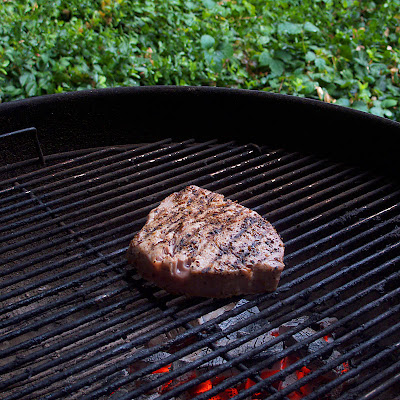
Why oh why does one of my favorite wines in the world have to be corked? Gah! And I had prepared an ahi steak with oil, salt, pepper, crushed cumin seed, and Italian salsa verde (flat parsley, oil, caper, and lemon zest) for the occasion. Instead, we waited another 20 mins to fire up the coals as we chilled down a bottle of...
Dirler-Cade Riesling Grand Cru Spiegel 2004
While I've never had a Trimbach, Dirler is my Alsace superstar, as their biodynamically-raised wines are so well proportioned, without the rock-em sock-em richness and residual sugar that so many other Alsatians bring to the table. That said, on nights two and three this shows a lot of baby fat and banana stank; in that respect it's not at all like the non-cru Bollenberg 2004, which has not one ounce of fat.
Before and after that awkward phase, though, this has an unbelievable combination of intensity, clarity, and purity. On the nose, a cornucopia of orchard and tropical fruits tumble onto acres of mountain stone; meanwhile, the farmer next door refills the kerosene tanks in his pickup truck. This is true even when the glass is empty. The body is very creamy and feels full on the tongue yet floats above it; it's warm and friendly yet delicate and poised; I'm thinking Grace Kelly or Michelle Obama. It's completely dry and very precise, with great structure, while plush fruit and filigreed minerals haunt the long finish.
My ultimate verdict: wait another five years before opening, then serve with a poached something-or-other in buerre blanc — this Spiegel was slightly overwhelmed by the fleshy tuna.
Renaissance Cabernet Sauvignon Première Cuvée 1995
Whereas many producers' tête de cuvées come from extra-ripe grapes or are lavished with expensive new oak, Renaissance does none of that. Instead, they pick and raise their best lots much the same way they raise their basic wines and let the terroir speak.
This isn't quite infanticide to drink this now. It's more like cutting a man down in his 30s (chilling enough, don't you think?). But over the course of three nights, this wine, which is 24% merlot and a mere 12.4% abv, proved that it will just get better. It kicks off with intense aromas of plum pudding, beef broth, black pepper, gray sea salt, blackberries, blueberries, and spice cake. It's structured yet velvety (more velvety than the "standard" 1995 cabernet), with a preliminary attack of sweet black fruit quickly giving way to bold tannins and a more austere rendering of the fruit. A note of cherry rings on the bright, brothy finish, and its spiciness is quieter compared to several other Renaissance wines, although a white pepper note lingers with the tannins for some time.
This is elegant and balanced, and the little bit left on night three shows a slight melting of the tannins and hints of blackcurrant and dried fruit on the palate. Although this was really good with the lamb that I grilled, it would have been even better had I decanted it 24 hours before serving.
Monday, August 10, 2009
Infanticide Is Painless
Sunday, June 21, 2009
Demi-Sec Faceoff #4: Foreau vs. Schwibinger

Saturday, April 18, 2009
Dirler Riesling Bollenberg 2004
 I am generally skeptical of effusive happy talk, so I'll just warn you in advance that I have had a series of remarkable wines that can only encourage purple prose.
For example, I cast as cold an eye as possible on the Dirler Riesling Bollenberg 2004, but all I could think was, "How can such a ridiculously beautiful, delicate, and multifaceted wine not be from a grand cru vineyard?" Dirler is a producer that never boarded the residual sugar train and while not austere, this frankly doesn't even show a lot of fruit. What this does show is an elegant and classic minerality. That is, it doesn't taste particularly eccentric, nor is the acidity particularly sharp. Rather, it's a dry and remarkably transparent wine with great length that pairs brilliantly with a wide variety of food, from pan-seared pork to steamed green beans.
The nose shows crisp green apple along with subtle hints of petrol, melon, and cow milk cheese. OK, there is a rush of fruit to the palate at first, but this is one of those rare cases where delicacy is aggressive, as the fruit is quickly supplanted by that gorgeous, filagreed, and very long minerality, courtesy the pink sandstone that surrounds the village of Bollenberg.
On the other hand, the white orchard fruit does show prominently when paired with a firm, slightly aged, and deliciously creamy goat cheese from the Pyrenees called chabrin. I thought of this wine when I smelled the cheese in the store, yet I got more from the pairing than I bargained for.
Tuesday, March 31, 2009
A 2007 Spätlese Trocken From Huff

Georg Gustav Huff Niersteiner Hipping Riesling Spätlese Trocken 2007
The name's a mouthful, but so is the wine. This hails from the esteemed Niersteiner Hipping vineyard, about which I unfortunately know little, except that it's a steep, ESE-facing vineyard in the heart of the Rheinhessen. You'll find a more comprehensive discussion on the terroir of the vineyards near Nierstein at The Wine Doctor.
You may know that 2007 is considered a "spätlese vintage" in Germany, as in many cases the spätlesen are extraordinarily balanced. I unfortunately have no experience with Huff's trocken prior to this one, but I can tell you that this wine has lovely aromas of green apple, ripe peach, and smoky gray sea salt. The palate more than equals the nose: it is simultaneously rich, fruity, dry, precise, delicate, and complex. Subtle — but not shy — notes of herbs, smoke, lime, and rocky minerals join the party on the finish.
The presence at midpalate is particularly impressive, and with its fruit and body this paired well with a cracked pepper-heavy quinoa pilaf. The real question is, what would I not pair this with? Thanks to its beautiful fruitiness, minerality, and complexity, the Huff Spätlese Trocken is a food lover's dream: it should pair very well with everything from spicy Thai takeout to complex, fastidiously prepared cuisine, from ultra-fresh vegetarian dishes to cured or grilled meats.
The only caveat here is that it's bottled with a plastic cork, so drink up.
Thursday, March 12, 2009
Demi-Sec Faceoff #3: Richter vs. Aubuisières
 It's been an eon since the last demi-sec faceoff — high time for bout number three! In this corner we have a 2005 Vouvray from Domaine des Aubuisières, and in that corner a 1990 Spätlese from VDP producer Max Ferd. Richter. Touch gloves, gentlemen!
Of course, this isn't actually a competition. These are of course very different wines, not least of all given the obvious age difference. Rather, I love to explore the virtues and distinctions of demi-secs — to see what makes them tick, to see how they differ and how they relate, and to test them with food.
In this pairing, the issue of acidity really came to the fore. Chenin blanc from Vouvray and riesling from the Mosel can be some of the most thrilling wine on earth, but if they don't have enough acidity, the wine will lack clarity and the ability to pair well with certain foods, or even end up simply and overly sweet.
Domaine des Aubuisières Vouvray Les Girardières 2005
Bernard Fouquet is a highly regarded winemaker who pursues a "less interventionist" approach: the vines receive minimal treatments, the grapes are harvested by hand, and sulfur is applied in small doses. The Les Girardières is grown in silex-based soils, rather than the limestone tuffeaux typical in Vouvray, and it's fermented in vat rather than oak.
Aubuisières should be applauded for posting good technical info to their web site. Many people have noted that 2005 Loire whites seem to lack acidity, and Aubuisières's numbers tell the story: while the 2007 Les Girardières has 8.1 grams per liter of acidity, the 2005 vintage has but 4.8 grams per liter — nearly half a more typical "classic" vintage. Despite this, the residual sugars in the two wines (which I really wish I could compare head-to-head) are quite similar: 26 g/l vs. 28 g/l in the 2005.
As with many other white Loire wines, the lack of acidity here is apparent. The aromas show apple, honeydew, and faint hints of beeswax and wool. I get sweet apple and canteloupe flavors upon entry, a soft round body, and the wine finishes with good minerality, tangy citrus and a pleasing hint of bitter herbs. But despite the tang, a lack of adequate acidity turns a potentially very good and complex wine into one that's a bit flabby and simple-sweet, and as it didn't improve over five days, I doubt this wine's aging potential. Despite the sweetness, this didn't work so well with a spicy Malaysian noodle dish, although that might be due to the bitter herb characteristics.
Max Ferd. Richter Erdener Treppchen Riesling Spätlese 1990
At 18+ years old this is remarkably fresh. This would surprise me in any case, but all the more so because the crusty, blackened cork demonstrated evidence of heat damage, as the wine had leaked up and over the top of the cork. When you look at the photo above right, you might just feel the alarm I felt. Yet appearances can deceive, and this wine was actually in very good shape. Whew!
I have no specific knowledge of how the acid-to-sugar ratios in this wine stack up, but the Richter web site does post numbers for more recent vintages, and their 2007 Spätlesen average roughly 70 g/l of residual sugar and 8 g/l of acidity. Of course, this Erdener Treppchen would have tasted much different 15 years ago — much sweeter by comparison — but I'm looking at that acidity number (again, not that I know the 1990's stats, but this is an instructive guideline).
Enough with numbers! I only mean to use them as signposts. They can't tell us anything about the grapes, the vintage, the vineyard, the winemaking, and the years that have passed. To the glass!
The nose on this Erdener Treppchen is rich with petrol, mango, and fig, but for all its aromatic voluputousness, it's trim and nicely proportioned on the palate. Apple and peach dominate, although the fruit is buttressed by lovely herb, lime, and spicy-sweet mango notes that show good length on the crunchy finish. That said, we come back to the acidity issue. While it is by no means bereft of acidity, it is slightly blurry on the palate, and I feel it could use a touch more acidity and more apparent mineral transparency. It's therefore not as precise as I would hope from a $40 wine — and I tasted this over five days to be sure.
Still, it's at its most complex and expressive on day 5, and in contrast to the Les Girardières Vouvray, this paired well with the Malaysian noodles. So if you have a bottle of this, why not hold it for a while and see what happens? It is very fresh, and it may yet go where it needs to be.
Friday, July 18, 2008
Demi-Sec Faceoff #2: Chidaine vs. Keller
It's time for another demi-sec faceoff, following the one from last October. In one corner we have François Chidaine's 2005 Les Bournais from Montlouis sur Loire, and in the other corner, we have Klaus-Peter Keller's 2006 Riesling Spätlese from the Rheinhessen. Gentlemen, put your gloves on.
François Chidaine Les Bournais from Montlouis sur Loire 2005
The Les Bournais is a young vine cuvee from Chenin Blanc grapes planted in 1999. Chidaine apparently feels that this is perhaps his best terroir in Montlouis, and the clay and limestone soils found here are more akin to Vouvray than the clay and silex typically found in Montlouis (source: Peter Liem). In fact, the name of this type of limestone is bournais, so don't forget to tell your friends. Chidaine grows all his grapes organically and yet prefers to not label his wines with this information.
The Les Bournais is a BIG wine from a big ripe vintage, and at first its astonishing 47 grams of RS dominates the palate in a single-minded attack. I may call it a demi-sec, but most people will call it sweet. It needs time, so I sampled it over four days. By the end of this period, it had turned into a deep, smoky, honeyed wine with considerable heft; it was almost crunchy, as if I were biting into honeycomb. If it's not as precise or deep as a wine made from older vines, it's anything but flabby. The finish is most impressive, long and golden, the pear, almond, hazlenut, apple, and honeydew flavors lingering beautifully.
Weingut Keller Riesling Spätlese Rheinhessen 2006
Whereas Weingut Keller was previously known for its sweeter bottlings, young Klaus-Peter Keller took over from his father in 2001 and has hence made it his mission to craft exceptional dry riesling. He's been so successful, in fact, that his Grosse Gewachs (great growths) and his cult G-Max bottling command stratospheric prices and are in such demand that mere mortals like myself may never lay eyes on them, say nothing of nose and tongue.
Fortunately, Klaus-Peter still crafts off-dry and sweet wines that are more readily available. This one, his basic spätlese, is golden, pure, and precise, with lovely texture from entry to finish. The filigreed sweetness on the attack is completely integrated with the pure, appley acidity, with a mouthfeel that's full without being heavy or viscous. One of the interesting things is that it doesn't have the minerality that his dry wines apparently do, but I didn't notice at first, as the finish is nonetheless clean, long, and fully-present. What was readily apparent to me is that it didn't have the lime twist on the finish that I often find in slate-driven Mosels, and indeed, Keller's vineyards in the Rheinhessen are of clay and limestone.
So who's the winner? The answer, my friend, is that you are, should you choose either of these beautiful wines, and doggone it, people will like you. As with all things, the question is of utility and context.
The Les Bournais is a big, big wine and in the short term I'd decant well ahead of time, then pair this with a great chevre (Humboldt Fog, anyone?). In ten years the sweetness will surely be less overt, the sugars integrated, and thus ready for richer main courses that feature cream sauces, braised meats, or carmelized vegetables. Keller's spätlese is more ethereal, more filigreed, and less sweet than this Chidaine bottling, and in the short term it is more flexible at the table; you could pair this with summery dishes, Asian cuisine, or cold meats. Of course, it will be just as long-lived as the Les Bournais, and it will also gain plenty of complexity over time.
Wednesday, May 14, 2008
My First Feinherb
Given my love of off-dry Loire Chenin Blanc and my resolution to drink more German Riesling, last December I picked up a bottle of the 2005 Günter Steinmetz Mosel-Saar-Ruwer Alte Reben Feinherb Riesling. Feinherb is an informal designation for off-dry and "alte reben" translates to "old vine." Old vine grapes from a great vintage vinified to off-dry? Seemed worth a try — and this comes from two ungrafted plots in the Muhlheimer Sonnenlay vineyard to boot.
Despite the great praise from reliable quarters, I found this a bit disappointing. Perhaps I waited too long to drink this. The nose is a killer: it's minerally and has more than a hint of cardamom, which always hooks me. The problems here are the finish and the longevity. The issue with the finish was immediately apparent: after rolling through an array of fine and focused yellowness — yellow apple, banana, a bit of pineapple, certainly lemon — I found there wasn't much to the finish, even though the mouthfeel is plenty weighty. It just kind of... goes away. It was a good compliment to some spicy dal but I can't say it reached new heights in the pairing.
By the third day, the nose is still great, but the wine has lost focus on the palate and is even trending toward flabbiness. Egad! This is not the right way to put on weight, as indeed it did (a bit). There is some acidity here but it's not enough to maintain focus. There's a lot that's good about this wine but I think I should've drunk this younger.
Thursday, May 8, 2008
Old World Riesling for WBW 45
Crikey! I forgot to post my Riesling entry for WBW 45; I am a day late, if not a dollar short. To add to the ignominy, the only old world Riesling I've had of late — despite my resolution nine months ago to drink more Riesling — is the 2006 Schmitges Grey Slate Dry Riesling, and I already posted about that. So I will blatantly worm my out of this sad state of affairs by writing about a Riesling I drank five months ago.
Tim of Winecast, this month's host, is right: there's nothing like German Riesling. Many of the (dry) examples I've had from places such as Austria and New Zealand are rich, egg yolky, almost heavy wines. I'm pretty sure this is because Riesling is a grape given to high extract. But as good as these wines can be, they rarely manage to be ethereal and dense simultaneously, whereas Riesling grown in the porphyry and slate slopes of the Nahe and the Mosel produces this magic regularly.
People often invoke apples, minerals, and sometimes red fruits to describe German Riesling, and I do, too. But for me, the signature of many of the young'uns is A) what I call tangerine mist aromas, the smell you get when peeling the fruit, and B) the twist of lime that frequently visits the finish. In other words, a haunting nose and an incredibly refreshing finish that feels dry even when the wine is actually a bit sweet. Lemon in water is thirst-quenching; so a good Mosel can be, too.
All this said, there can be a down side to German Riesling, and that's sulfur. Some producers use quite a lot and it can give me a stomach ache; and combined with Riesling's high extract, I can also come to feel bloated, full, even when I've had little to eat (yet another reason why I prefer the world's other versatile white, Chenin Blanc from the Loire, but I digress). It's a weird state of affairs but the fact is, I have to be careful when trying a new one to take small sips first and see how it goes. The flip side is that if this happens, and if it's a particularly good wine, I can store it in the fridge for days and sample along the way — because good Riesling lasts and lasts!
I realize this is painting with a broad brush. Riesling is the perhaps the world's most "transparent" grape, the one that most clearly transmits its terroir, so taken together its voices are incredibly diverse. Put all German Rieslings in one room and you have a veritable Tower of Babel.
Really, so much can be said about Riesling and I'm not the guy to say it. I'm far from expert here and I've had almost no aged Riesling. So if you want to know more, I strongly recommend you read both Rockss & Fruit and Terry Theise's loooong catalogs; and meantime, onto the review!
The wine in question is the 2006 Dönnhoff Estate Riesling. How good is a Dönnhoff at its most basic level? This is the question I wanted to answer while I wait for Helmut Dönnhoff's 2005 Oberhauser Brücke Spatlese to reach maturity in, oh, 2015 or beyond.
Dönnhoff, considered among Germany's very best, is based in the Nahe region. The estate wine isn't even a QmP, just "qualitätswein" rendered at 9.5% abv. Whereas QmP wines are not allowed to be chaptalized (i.e. have sugar added during the fermenting process to increase alcoholic strength), qualitätswein wines are allowed this. But I have a hard time believing Dönnhoff did this, both because of the terrific, ripe growing season of 2006 and because this wine is so pure. It tastes halbtrocken (only slightly sweet) at the front of the mouth but finishes quite dry. Lovely aromas of tangerine mist, Fuji apple, and peach kind of alternate in my mind with pineapple and banana. The same goes for the flavors, although these resolve most specifically to tangerine and minerals on the crisp, mouthwatering finish. OK, I don't get the lime twist at the end but it's still unmistakably a wine of place, and it's nicely poised . It only improves after 72 hours, becoming more itself. It's a bit expensive for a basic Riesling ($19) but for a wine of place from a top producer that's this enjoyable, I'm not going to complain.
Saturday, April 26, 2008
Coming Home to a Dry Riesling
After a 6+ hour plane delay — thank you, O'Hare International — I got home from Mexico last night at 2:00 in the morning. I can never fall straight into bed after a long day so I uncorked the one dry Riesling I have, the 2006 Schmitges Grey Slate Dry Riesling from the Mosel, and sipped a glass as I was unpacking. The wine is unmistakably German thanks to its obviously-advertised gray slate qualities. It's pale and has a honeyed apple nose like a classic Kabinett and actually has a (very) slight impression of sweetness on the palate but at 13% abv it is dry, and it finishes with a nice twist of lime and tangerine. It sits nicely atop the midpalate and it would probably be great with the delicious cold poblano pepper soup my friend Juliet ate (I had a spoonful) at Los Danzantes, a slow food restaurant in Mexico City's Coyoacán neighborhood.
A coincidence, then, to log in to the internets today and find Eric Asimov's recent article on dry Riesling.
Tuesday, October 16, 2007
Vouvray vs. Mosel: 2005 Demi-Sec Faceoff
I am assuming we all have a story of the day everything changed, when wine went from being an enjoyable commodity to being something more important. In my case, it was when I walked into a wine shop two years ago and asked the merchant what would go best with a wheel of Humboldt Fog cheese. His answer: "You should try a Vouvray. It will change your life."
Little did he know.
When I matched that cheese with a fairly humble 2002 Yves Breussin Réserve, my eyes rolled back in my head at least twice. It was the shock of the new; my whole body buzzed. My atoms never realigned as they were.
My obsession with Chenin Blancs from the Loire Valley continues to metastasize. Sec, vin tendre, demi-sec, moelleux — bring 'em on! If you ask me if I want a Chenin from the Vouvray, Savennières, Montlouis, or Layon regions, my answer will be, "Yes, please." I used to be content to buy one bottle at a time of a Huet, a Chidaine, a Baumard. Now I buy two at a time. And yet, I think, wouldn't a third bottle really help me track the wine as it evolves? We all know where this is heading.
Strange, then, that my admiration for the nerve, versatility, honesty, and transparency of Loire Chenin Blanc did not sooner translate to an admiration for the (quite different) nerve, versatility, honesty, and transparency of German Riesling. Chalk it up to my prejudice, ignorance, and carelessness. "Riesling — isn't that the wine of rich old Englishmen and young Americans raised on Coke?" Ah, but I know better now, with a special nod to the passionate Terry Theise and his insightful, grab-you-by-the-lapels catalogs.
With the leaves turning and temperatures falling, my thoughts turn to more serious whites. Let's have a few, shall we? For better comparison, these are both food-friendly, lightly sweet table wines from the brilliant 2005 vintage. Both will improve with age; these are snapshots destined to take on sepia.
Dr. H. Thanish Brauneberger Müller-Burggraef Juffer-Sonnenuhr Riesling Spätlese Mosel 2005
A draught of this is like a breath of mountain air, light and clean; and as the lychee and baked apple flavors resolve into lime on the finish, the wine starts pressing down on the tongue, the way a masseuse leans into your back with the heel of his hand. Not that you'd mistake that weight for anything heavy, or big, but it's persistent. White spice emerges against pasta with pinjur, while the sweetness, the acidity, and the food-friendly alcohol levels (9.5%) are that eggplant-and-tomato sauce's perfect dance partners.
François Chidaine Vouvray Le Bouchet 2005
Now this, by contrast, has weight. Yet it's a baby. It's so young. It's NASCENT. There's not much obvious about this organically grown demi-sec Vouvray, but pay attention to this quiet child and you might think he (Lorie Chenins are never macho but always male, in my mind) is a prodigy. Time will tell. Meanwhile, this happy baby is well-tempered and curious and not fussy. Telltale Loire beeswax hits the nose. Rich but nascently lifting notes of fig, pear tart, tangerine, and cinnamon-dusted baked apples consume every sense and resolve into an unmistakable note of ruby red grapefruit, whether or not it's confronted with spicy stir fry flavors — which which, of course, it pairs very well. Interestingly, the sweetness quickly spreads beyond the front of the tongue and resolves into an impression of flaky pastry. Give it a few years and this fucker is going to FLY.
Sunday, September 30, 2007
Finger My Lakes
I'd love to try Riesling and Cabernet Franc from the Finger Lakes, but goddamn it, they are very hard to come by in Chicago. Zug recommends the wines from Damiani; I shall keep my eyes open for them. Funny, but just after Zug e-mailed me about Damiani, I saw that Jancis just posted about Finger Lakes wines, fingering (heh) Fox Run, Heron Hill, King Ferry, Red Newt, Treleaven, and Hermann J Wiemer as the best.
Speaking of Riesling, I opened the 2005 Joh. Jos. Christoffel Erben Ürziger Würzgarten Riesling Kabinett the other night. Deceptive, this one. Sweetness is its first trick: it smells like a cinnamon-dusted pie made from strawberries, kiwi and apple, and a wall of sugar hits the front of the mouth. Yet the finish feels dry and quenching, a twist of a salted lime. Upon entry it also conned me into thinking it's a lighthearted, monolithic simpleton. Turns out this is a viscous, extracted little beast, and it sits on the tongue, and sits, and sits. Third, the acidity is cloaked. Sure, there's some, but you don't really experience it until you pucker the inside of your mouth after you swallow; suddenly, the acidity blooms, and the mouth starts watering. Finally, subtle Würzgarten spice notes emerge only at warmer temps.
This all portends the wine it will be; I should buy another bottle and cellar 'til 2015. At $17 per bottle, I can afford to!


 Posts
Posts


