
I am reading The Battle for Wine and Love, the remains of a 2000 Baumard Savennières in hand — low in acid, expected given the vintage, but drinking very, very well — and in the spirit of each I offer this live 2006 performance by The Fall. Unspoofulated for 30 years and counting. Get past the 15 seconds of Robert Plant clapping and then CRANK IT.
Thursday, May 22, 2008
This Song Is a Tannat
Wednesday, May 14, 2008
My First Feinherb
Given my love of off-dry Loire Chenin Blanc and my resolution to drink more German Riesling, last December I picked up a bottle of the 2005 Günter Steinmetz Mosel-Saar-Ruwer Alte Reben Feinherb Riesling. Feinherb is an informal designation for off-dry and "alte reben" translates to "old vine." Old vine grapes from a great vintage vinified to off-dry? Seemed worth a try — and this comes from two ungrafted plots in the Muhlheimer Sonnenlay vineyard to boot.
Despite the great praise from reliable quarters, I found this a bit disappointing. Perhaps I waited too long to drink this. The nose is a killer: it's minerally and has more than a hint of cardamom, which always hooks me. The problems here are the finish and the longevity. The issue with the finish was immediately apparent: after rolling through an array of fine and focused yellowness — yellow apple, banana, a bit of pineapple, certainly lemon — I found there wasn't much to the finish, even though the mouthfeel is plenty weighty. It just kind of... goes away. It was a good compliment to some spicy dal but I can't say it reached new heights in the pairing.
By the third day, the nose is still great, but the wine has lost focus on the palate and is even trending toward flabbiness. Egad! This is not the right way to put on weight, as indeed it did (a bit). There is some acidity here but it's not enough to maintain focus. There's a lot that's good about this wine but I think I should've drunk this younger.
Monday, May 12, 2008
A Bad Frost in Muscadet
This news is a month old, but I just saw this Decanter item reporting that the 2008 Muscadet vintage might be cut in half due to a bad April frost. In some vineyeards nearly 100% of the crop was lost. Savennières, Coteaux du Layon, and Saumur-Champigny were also hit, but not nearly so badly.
Sure, this is hardly on the scale of the great quake in Sichuan, but I'm sure life is hard enough on Muscadet growers as it is and I feel badly that this happened. So here's hoping the second-generation buds indeed come to fruit.
Saturday, May 10, 2008
Alain Brumont Starter Kit
I meant to write this post on winemaker Alain Brumont last year, but then Wine Spectator wrote a big-assed profile on this Gascon, ruining my mojo. But enough time has elapsed to recover.
Brumont is a unique figure. He grew up helping his father in the vineyard but he apparently did not get serious about wine until after he visited Bordeaux in the '80s. After that, he became single-minded to the point that, per Andrew Jefford in The New France, he became "the Citzen Kane of Madiran." He dominates this region, which is labeled as Madiran on bottles of red wine and as Pacherenc du Vic-Bihl on whites, and he is passionately dedicated to its indigenous varieties: the monstrously tannic Tannat, the thick-skinned Petit Manseng, and Petit Courbu, which Brumont has single-handed demonstrated (to me, anyway) is one of the world's great unheralded whites.
Brumont is singular in other ways, too. Again quoting Jefford: "He green-harvests three times... He has developed his own system of auto-pigeage... He makes his own compost (with horse, sheep, and cow manure, pomace, and ground stones)." Furthermore, Brumont lavishes his top wines in new oak but disdains micro-oxygenation, despite the Bordeaux influence and despite the fact that m-ox was invented to tame Tannat. Instead, the wines are racked up to four times before bottling.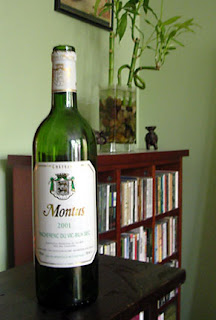 Now, Brumont owns a range of domains and I've hardly tasted all his wines. The tops is La Tyre, and at $150 a bottle, I seriously doubt I'll ever get to try it. Fortunately, most of his other wines are priced for the reality-based community and I've tried enough of them to get a bony-fingered grip on what he's doing down there. Wines from Château Bouscassé, grown in heavy, iron-flecked clay-limestone soils, need at least ten years to mature. Those from Château Montus, grown in more gravelly soils, can also benefit from some age but need less time. Brumont also seems to bottle his most accessible, earliest-drinking wines under his own name. For an excellent discussion of the terroir, the vineyards, and the winemaking, see this article from Virginia Tech.
Onto the tasting notes. The two reds I've tasted are listed first, followed by three whites. As you'll read, I'm particularly enamored of the dry whites made from Petit Courbu.
Alain Brumont Tannat-Merlot Vin de Pays des Côtes de Gascogne 2004
This one was $12. How do you tame the notoriously tannic Tannat? Cut it with Merlot! The end result surprised me: it's an enjoyably rustic red that reminded me of a Saumur Champigny, of all things, thanks to its sappy cherry and olive nose and flavors of sappy cherry and green and red plum. It's lively, with good acidity and surprisingly modest tannins.
Château Bouscassé Madiran 2000
This blend of 65% Tannat, 25% Cabernet Sauvignon, and 10% Cabernet Franc, aged on its lees for 12 months in one and two year old barrels, was my test drive to see if I wanted to buy the more expensive, 100% Tannat Viellies Vignes. In my nose-mind this attractive wine triangulates claret, Chianti, and Barbera — yet it tastes entirely French. Its heady aromas remind me of sweet black cherry, cedar, raisins, blackcurrant, and plum; in the mouth, prune and green apple come to the fore on fine but firm tannins. The acidity is forthright and its masculine structure frames, but doesn't crush, the fruit.
That said, it's not particularly deep and the finish isn't particularly long, so I won't be buying this particular $23 wine again. It was nevertheless good enough to convince me to set aside a bottle of the 2000 Viellies Vignes until sometime after 2010.
Alain Brumont Le Jardin Philosophique Pacherenc du Vic Bilh Sec 2005
For around $20 you can lug home this really lovely, unoaked, delicate-yet-full-blooded 100% Petit Courbu. Even after 5 days the floral aromas are soft and the peach aromas are fresh. The flavors were more along the gushy peach and apple line of things when first opened and then trended toward apricot, but all along the flavors have been pure; and even close to room temperature, the crisp, lemony finish is both clean as a whistle and really quite long. Just a terrific wine and an example of superior winemaking skills. Hurrah!
Chateau Montus Pacherenc du Vic-Bilh Sec 2001
This extraordinary dry white, made from 100% Petit Courbu and aged on its lees in 30% new oak, calls to mind saffron biryani, mushroom quiche, hazlenut oil, buttered straw, peaches and cream, white pepper, and, for its porcelain focus, a judiciously-oaked Savennieres. Sounds like a mess, but really it's singular and focused, and it has the muscular, long-tailed grace of a komodo dragon. Intoxicating and perfectly balanced, and every bit worth the $32. World class, baby.
Alain Brumont Vendemiaire Octobre 2000 Pacherenc du Vic Billi
Finally, dessert. Well, not so much dessert as final course, as it's only lightly sweet. Brumont harvests Petit Manseng in October, November, and (when possible) December and bottles them separately. Each is a step up in sweetness and price. This entry-level late harvest wine (no botrytis) features surprisingly delicate flavors of peach and apricot. It's nicely balanced and finishes clean. It ain't Royal Tokaji, but it ain't pancake syrup, neither.
Thursday, May 8, 2008
Old World Riesling for WBW 45
Crikey! I forgot to post my Riesling entry for WBW 45; I am a day late, if not a dollar short. To add to the ignominy, the only old world Riesling I've had of late — despite my resolution nine months ago to drink more Riesling — is the 2006 Schmitges Grey Slate Dry Riesling, and I already posted about that. So I will blatantly worm my out of this sad state of affairs by writing about a Riesling I drank five months ago.
Tim of Winecast, this month's host, is right: there's nothing like German Riesling. Many of the (dry) examples I've had from places such as Austria and New Zealand are rich, egg yolky, almost heavy wines. I'm pretty sure this is because Riesling is a grape given to high extract. But as good as these wines can be, they rarely manage to be ethereal and dense simultaneously, whereas Riesling grown in the porphyry and slate slopes of the Nahe and the Mosel produces this magic regularly.
People often invoke apples, minerals, and sometimes red fruits to describe German Riesling, and I do, too. But for me, the signature of many of the young'uns is A) what I call tangerine mist aromas, the smell you get when peeling the fruit, and B) the twist of lime that frequently visits the finish. In other words, a haunting nose and an incredibly refreshing finish that feels dry even when the wine is actually a bit sweet. Lemon in water is thirst-quenching; so a good Mosel can be, too.
All this said, there can be a down side to German Riesling, and that's sulfur. Some producers use quite a lot and it can give me a stomach ache; and combined with Riesling's high extract, I can also come to feel bloated, full, even when I've had little to eat (yet another reason why I prefer the world's other versatile white, Chenin Blanc from the Loire, but I digress). It's a weird state of affairs but the fact is, I have to be careful when trying a new one to take small sips first and see how it goes. The flip side is that if this happens, and if it's a particularly good wine, I can store it in the fridge for days and sample along the way — because good Riesling lasts and lasts!
I realize this is painting with a broad brush. Riesling is the perhaps the world's most "transparent" grape, the one that most clearly transmits its terroir, so taken together its voices are incredibly diverse. Put all German Rieslings in one room and you have a veritable Tower of Babel.
Really, so much can be said about Riesling and I'm not the guy to say it. I'm far from expert here and I've had almost no aged Riesling. So if you want to know more, I strongly recommend you read both Rockss & Fruit and Terry Theise's loooong catalogs; and meantime, onto the review!
The wine in question is the 2006 Dönnhoff Estate Riesling. How good is a Dönnhoff at its most basic level? This is the question I wanted to answer while I wait for Helmut Dönnhoff's 2005 Oberhauser Brücke Spatlese to reach maturity in, oh, 2015 or beyond.
Dönnhoff, considered among Germany's very best, is based in the Nahe region. The estate wine isn't even a QmP, just "qualitätswein" rendered at 9.5% abv. Whereas QmP wines are not allowed to be chaptalized (i.e. have sugar added during the fermenting process to increase alcoholic strength), qualitätswein wines are allowed this. But I have a hard time believing Dönnhoff did this, both because of the terrific, ripe growing season of 2006 and because this wine is so pure. It tastes halbtrocken (only slightly sweet) at the front of the mouth but finishes quite dry. Lovely aromas of tangerine mist, Fuji apple, and peach kind of alternate in my mind with pineapple and banana. The same goes for the flavors, although these resolve most specifically to tangerine and minerals on the crisp, mouthwatering finish. OK, I don't get the lime twist at the end but it's still unmistakably a wine of place, and it's nicely poised . It only improves after 72 hours, becoming more itself. It's a bit expensive for a basic Riesling ($19) but for a wine of place from a top producer that's this enjoyable, I'm not going to complain.
Wednesday, May 7, 2008
A Good, Cheap Red From Nîmes
 I can't tell you how pleased I am with the 2004 reds I've had from southern France at all price points. Freshness and vitality seem to characterize the vintage, and this $10 wine continues the run. I'm talking about the 2004 Chateau Mourgues du Gres Les Galets Rouges from the Costières de Nîmes. This appellation comprises the far southwestern arm of the Rhône region and, as the very name of this wine suggests, the same large, rolled pebbles that are found in Châteauneuf-du-Pape can be found here. The picture at right comes from the winery's web site.
The Galets Rouges is predominantly young-vine Syrah, complimented by at least 25% Grenache and 20% Mourvèdre (per Costières de Nîmes appellation rules) and a bit of old vine Carignan. It's aged in epoxy-lined concrete tanks (no oak!) for 12 months.
Coffee and blackberry notes dominate the nose, but the mouth action is what's particularly impressive: this is a completely balanced wine. The acidity and tannins are in harmony and the wine shows good length and depth. It's a large-bodied wine, and meat and pepper quietly nuzzle the ample fruit, but it's never heavy, thanks to the refreshing acidity. All for $10! OK, no one is expecting bedazzling complexity or nuance at this price and you won't find it here, but I've had enough very good cheap wine to demand balance and interest at every price point. This one delivers.
Oh, and I'm starting to wonder if 2004 is more my kind of vintage from the Rhône than the much-heralded 2005, which produced bigger, heavier wines. Being the Rhône boy that I am, I'm not about to shy away from further investigation!
Subscribe to:
Posts (Atom)


 Posts
Posts


