
I have been away for far too long. Now, I am back to tell you my wine stories.
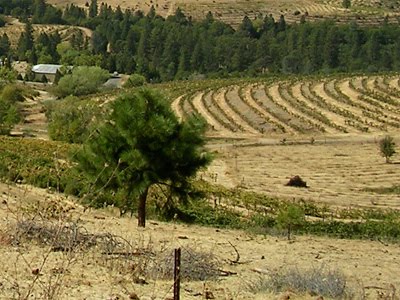
After eight years in Chicago*, I have moved to Oregon's Willamette Valley. Specifically, I live in Corvallis, which is about 50 miles south of this state's most storied vineyards. If appellations such as the Dundee Hills are quite accessible, my new site-uation gives me the ability to visit more isolated vineyards, some of which are quite small and tucked into folds of the Coast Range foothills, quite removed from the state's primary media center.
Up close, it's good to ask questions such as, What does it mean to be a grape planted at 45 degrees north in this part of the world? If Jory soils are less common than in the northern valley, what does that mean to the winemakers, and what is their conception of terroir? Why is the regional identity what it is? Who are the iconoclasts who are questioning the way things are done?
As I travel up and down the valley, I find that baseline quality is high. It's tough to find confected, fat-fruited wine; it's rare to find an overoaked wine of either color. If I pull over and visit a small producer whom I've never heard of, I'm practically assured of finding a pinot noir that was raised according to the "recipe" of reasonable brix and roughly 25% new barrels. If producers were focused on making big, dark pinots just a few years back, it's my perception that this is less the case – and if my comparison of 2009 to 2006 is accurate, it does seem that producers are dealing better with the hot vintages, with the resulting wines showing more freshness and elegance.
And yet, beyond a happy few, I've yet to find much pinot noir (or pinot gris, etc) that is terroir-expressive. Clone-expressive, yes, but too often not terroir-expressive. I wonder why this is. Is it the relative youth of many of the vines here? How strongly is it related to dry farming? Do most producers inoculate with the same "neutral" packaged yeast? How much is a question of focus? (It's been interesting to ask people about their soils. Too many get a glazed look and say "Jory," which sure makes it seem like they're making it up, or say they just don't know. I find this fascinating.)
Where are the iconoclasts and the mad scientists? A couple of guys are planting tempranillo and syrah in this cool climate. There is the guy who just harvested pinot at 17 degrees brix and who will make an undoubtedly interesting wine from it (I tasted the unfermented grapes and they are bright, alive, delicious, with brown seeds you can crunch through). Beyond these few, and beyond the deep thinkers, I wonder. Winemakers here have learned lot of tough lessons over the years and, as I understand it, the sharing of that knowledge has been invaluable about raising overall quality. But there is a fine line between regional identity and groupthink, and it'll be interesting to find out what ideas hold sway, why they are held, and how they are applied.
I've babbled enough for now. Let me just sum up by saying that it's good to be back.
* Since I no longer live in the Wicker Park neighborhood, does that mean I have to change the blog name?
Sunday, November 13, 2011
Now Living in the Willamette Valley
Saturday, April 16, 2011
A Mosse and a Baudry from 2009

Bernard Baudry Chinon Les Granges 2009
I adore Baudry's wines and I was expecting full young fruit, easy drinking, and expressive typicité in equal measure, with a low 12.5% alcohol promising a snappy attack. In practice, this has all the classic, lovely aromas I love about Chinon, but although the wine is nicely proportioned, with the acidity and fruit and minerality seemingly in their right places, the palate is strangely muted; it just doesn't have the spark, the informal elegance, or the mid-palate depth that I associate with Les Granges at this age. I drank this over three days' time in the hopes it would blossom, but it never unfurled (and actually it just turned slightly medicinal by the third night). Curious. John Gilman reported a favorable experience; might this be undergoing a particularly sullen adolescence?
Mosse Anjou Blanc 2009
I'm really honing in on the structure and acidity of the 2009 Loire whites I try (and by "whites" I really mean Muscadet and chenin from its many appellations). I'm asking myself if they have the bones and the guts for aging, or if even hints of softness that apparently mark some wines obscure terroir and suggest a short life.
Agnès and Réné Mosse's basic Anjou Blanc suffers not the least from softness. Rather, I was overjoyed (as in, you would have told me to settle down) to find a marvelous and highly expressive wine with considerable focus and complexity. There's some passionfruit on the nose that's allied to cantaloupe and ginger aromas, but any tropical fruit characteristics are solely aromatic. It's the snappy, medium-bodied palate that really makes me happy; there's a spicy singularity here that obviates the need to list the many descriptors I could use, particularly as it's so complete and quite long. That the vines for this cuvée were planted within the last ten years make the complexity and singularity that much more impressive. The mere 7 grams of RS are not enough to render this a sec tendre; it tastes completely dry, and the alliance of austerity and voluptuousness that is a hallmark of top-notch Anjou sec is in full force here. People, can you feel the love? I sure can.
Thursday, February 17, 2011
Random Whites Roundup, February 2011

Ilarria Irouléguy Blanc 2009
This white Irouléguy, a 50/50 blend of organically grown petit manseng and petit courbu, is one reason why I'll be posting more soon-ish on the wines of Southwestern France. It starts with tropical fruit on the nose (guava, passion fruit) and then, intriguingly, it goes all orchardy on the palate, showing crisp white fleshed fruit and grass/straw/herb characteristics. Bee sting acidity is nicely intertwined with minerals and a fleshy yet tightly coiled body that's very dry, even austere. This has superb length and self-confidence, but it's somehow unshowy to boot. I should have bought more! Fun fact: petit courbu is the same grape as Txakoli's hondarribi zuri.
Stéphane Tissot Savagnin Arbois 2004
Hmmm, not entirely sure about this Tissot. I get full fathom five brine, acidity that lashes the tongue like a cat o' nine tails, nuts clattering across the counter, lemon pith — yes, this is forceful rather than delicate, and it showed better on the second night, as it has relaxed somewhat. Still, it's awfully aggressive. I'm not your go-to guy on all things Jura but I like Montbourgeau's more delicate expressions of oxidized whites more, although perhaps this just needed more time (or less, not sure).
Brick House Chardonnay Ribbon Ridge 2008
Oaked New World chardonnays rarely thrill me, but this Puligny-esque effort from Oregon's Brick House almost does due to its bright acidity, well-structured flesh, creamy yet firm texture, and — the most important thing to me — its strong mineral signature, which really brings home the complexity on the finish. I wouldn't say this is lightly oaked, and for my personal tastes (and because it limits food pairing choices considerably) I would like to see less, but on a more objective level this is really very good. Also, it's far from drowning in popcorn butter. I would guess that the oak-derived flavors of nut and vanillin will be still more well-integrated in the coming years, as this has the balance for some aging.
Tuesday, February 15, 2011
Random Reds Roundup, February 2011
Here are a few really cool reds I've had in the past two months. Different countries, different regions, different grape varieties, but each have strong, noble personalities that suggest great and long lives lived on their terms. If you don't like tasting notes, move along.
Vieux Télégraphe Châteauneuf-du-Pape La Crau 1998
I drank this elegant, beautifully poised VT in the heart of winter, just as one should. It showed no baby fat on night one, no exuberant fruit, yet it still drank very young and lacked secondary characteristics. It was also very clean, with no hint of brett or funk. It advanced significantly on night two – lots of tobacco and earth came to the fore, the umami was cranking, with soy and mushroom notes entangling the fresh purple berry fruit, and the tannins turned leathery. I won't pretend to understand this wine based on just one bottle but I get the sense this wine will have a lot to say over the next 10+ years as its tannins resolve and its fruit fades. If I had to do it all over again, I'd decant two to four hours ahead of time and make sure it was all gone by night's end.
Renaissance selects grapes from their best, rockiest soils for their VdT bottlings. As with their cabernets, their syrahs are living — and long-lived — wines that emerge on their own terms. Some go through more than one adolescent period before emerging into early maturity at, say, five to ten years. I tracked this seven year old over three days (with no preserving gas or whatever, just a dark place and a cork) and even at day three this was remarkably youthful. It showed lively and spicy tannins, robust acidity, primary fruit, and serious, refined minerality. It actually started off middleweight, then with air gained heft without ever losing its freshness, proportion, and balance. Despite its 14.5% alcohol this shows not heat but rather cooling mint tones on the palate. Otherwise, the wine is characterized by Provencal herbs, black pepper, blackcurrant (this is not a fruity syrah), and rocks. This rough-elbowed youngster is evolving into something very promising, indeed, and in many ways already evokes a very good Cornas, and it certainly will have the life span of one.
Giacomo Conterno Barbera d'Alba Cascina Francia 2005
Even five years in the acidity is very strong willed and I waited, on its terms, for it to decide when it wanted to be drunk. Even 24 hours later ('twas left in bottle with only one glass consumed) it was a very firm if exotically scented barbera, all cedar and huckleberry laced with meatiness and spice, and the tannins delivered a swift slap to the cheeks. It's concentrated, yet almost weightless, and very fresh and pure, and really it needed quite a bit more time. Given its tannins I thought this would go well with steak but the fruit was too bright - pasta bolognese, maybe?
Sunday, February 13, 2011
2009 Beaujolais, Or At Least Four of Them

So I applied a jaundiced eye toward 2009 Beaujolais, and at first my skepticism seemed appropriate given one rather ho-hum bottle I had and another that showed California weight allied with simplistic overripe flavors, and which was almost bad. But these were feints, as I found some from reliable producers that are not just fresh and lovely and drinkable right now (I find that cru Beaujolais typically needs at least 2 full years from harvest, if not more, to show well), but which are even deeper and and more complete than usual, and which therefore seem to justify much of what I've read. Sure, time will tell, but sometimes the time to ask is right now.
Pierre Chermette Beaujolais 2009
Certainly I would expect this bottle to be lighter and more now-ish than any of the below cru wines, but I was pretty surprised by just how ethereal this was, and just how engaging I found it. It's sappy and long and stony, but not complicated. It's fermented in concrete and stainless steel solely with indigenous yeasts and it's a joyful wine for drinking right now — heck, right this minute, if you have a bottle handy.
Christian Ducroux Régnié 2009
This is a terrific expression of granitic Beaujolais, unsulfured and very clean. Initially the semi-carbonic fruitiness struck me as a bit rote, but the wine blossomed over a few nights and in the end it seemed lively yet contemplative. It's a wine that enunciates. It's nicely structured (the acidity is prominent without being sharp), stony and a bit peppery, with lovely raspberry fruit.
Marcel Lapierre Morgon 2009
When I touched this bottle at a local shop, I thought, "Wow, it's hot. I'd better buy this certainly-ruined wine so that people are not misled into thinking Lapierre makes crap." Perversely, I later thought, "I can't open this, it's too young to show well." I opened it anyway, and found I was wrong on two counts. This was not merely sound, approachable, and tasty, it was subtle, impeccable, multidimensional, complex, and harmonious. The stuff was cranking. Sour cherry, chorizo, mushroom, and rhubarb aromas carried over to the palate and were joined by granite-derived black pepper and coriander spice, a subtly tannic structure, and juicy boysenberry fruit. So fresh. So pure. So long. How so young a wine can be both complete now and also ageworthy is a notion I cannot address. RIP M. Lapierre.
Coudert Fleurie Clos de la Roilette Cuvée Tardive 2009
Katherine Hepburn as a wine. The 2009 Cuvée Tardive (which is not a late harvest wine, but rather a wine made from old, even 80 year old, vines) is firm and structured right out of the gate, with an upright, formal bearing that keeps you at arm's length; you have to admire it from afar at first. Soon enough it turns more inviting, whereupon you can banter with its complex beauty. Strawberries and crushed raspberries, polished stones, savory spices, black pepper, red floral elements, and a touch of smoke, all delivered with suave sophistication. It's concentrated, with fine and structured tannins, but shows little weight. This is gonna last a loooong time.
Thursday, February 10, 2011
A Roussanne From Jean-Paul Brun

Although the label advises one should drink up quickly due to the very low sulphur additions, this held up well over two days. Full pear and apple flavors are delivered in the context of a creamy texture enhanced by minerals, savory hazelnut tones, a top note of chalk and smoke — as if nuts had been lightly toasted — and a slight bitterness that's very nice to experience. There's a lot going on here, but it all seems effortlessly complete and together, and not overly intellectual.
The grapes spring from Brun's yellow limestone (terres dorées), not unlike the limestone soils in (warm) western Paso Robles and the (cool) Chignin cru of Savoie where roussanne can also excel. That said, roussanne can also perform very well in a variety of soils, including granitic and volcanic soils. The grape is a bitch from the farmer's perspective but if mesoclimactic conditions are favorable then a roussanne can be a particularly interesting wine from mineral-giving soils, and a rebuke to anyone who thinks that whites are inherently less interesting and serious than reds. To winemakers in such sites I say: more, please.
Saturday, January 22, 2011
On Good Producers in Bad Vintages

The wine was a disaster. Fruit baked dead, no complexity, zero finish. We muddled through it rather than enjoyed it.
I choose carefully and I have been rewarded, e.g. Bernard Baudry's great successes with his 2003 Chinons. And of course I've had Fèlsina's Rancias previously. But this was a cautionary tale served at a restaurant's mark-up.
Wednesday, January 12, 2011
Is Xinomavro a Blue Cheer Cover Band?
For its name, which translates to "acid black," you'd be forgiven for thinking that xinomavro is a Blue Cheer cover band. It is, rather, a red Greek grape that is said to resemble both pinot noir and nebbiolo. As I drink the one xinomavro I have ever had, the 2005 Xinomavro Naoussa from Katogi & Strofilia, I get the comparison. The sweet tannins, nutmeg-suggestive aromas, and soft earthiness of this pale colored wine remind me of cool-climate Valle d'Aosta from the upper left corner of Italy, but with more stuffing. Its firm, acid-driven structure also made me think of a gentler take on young Langhe nebbiolo.
I'm not your xinomavro go-to guy; I simply lack the background. I can tell you, however, that I want to learn more. I can tell you that this wine comes from the Naoussa region in northwestern Macedonia (Google terrain map here), a Continental climate region that allows xinomavro exclusively. I can tell you that Palate Press published a good Markus Stoltz article last year and that John Szabo's article in All About Greek Wine is particularly fascinating, as Szabo compares xinomavro's anthocyanin and polyphenol counts relative to nebbiolo.
If xinomavro is always (?) put in oak, these articles and my palate both tell me that Katogi might sand down the grape's rougher edges more than they might have to, and that I should find a more complex, terroir-expressive wine in the better bottles. But it's a good introduction to xinomavro and I like the wine's energy.
Fushitsusha is not a Blue Cheer cover band, either, but I suspect that if some godless god threw Blue Cheer into a black hole, they'd be the result. For those who can stand them, this Japanese band produced a fistful of masterpieces in the 80s and 90s; this is but a taste, and their dense, crushing energy is nearly the opposite of what you'll find in the xinomavros of Greece.
Monday, January 10, 2011
I Forbid the God of Cliché

I'm drinking a white in the winter and a sparkling wine on a Monday that's not a holiday and a French wine with nominally Italian food (pasta with pesto). I don't have a flute because I don't want one, so into the wide-bowled Burgundy glass it goes. Little about this scenario is "correct."
Still, everything feels right. Pinon (nice Wine Doctor profile here) provides an unmasked, acid-driven expression of Vouvray. There are no autolytic aromas to hype, no poached pear on toast flavors to profile. "This is me," it says — the crunchy honeycomb flavors, the telltale chenin bitterness, the fine minerality — and the acidity cuts nicely through the rich green herby pasta. It's slightly oxidized, in a good way. Have I had drier white wine? Yes. But not that much drier.
Today feels to me like a good day not for the simple, but for the unadorned.
Thursday, January 6, 2011
Olivier Cousin's Anjou Grolleau

I say "apparently" because I didn't know that limestone soils were found in Anjou until I looked up Olivier Cousin, whose lively, peppery, berry-in-a-barn 2009 "Le Cousin" Grolleau I drank recently, and Jenny & Francois tell us that all of Cousin's grapes come from limestone and clay soils. Olivier plows his vineyards solely by horse and vinifies both biodynamically and naturally, without additions of any kind (it's truly sans soufre), and these grapes come from 30+ year old vines near Martigné-Briand.
I should back up a second: grolleau is a red grape variety indigenous to the Loire that in many ways reminds me of pineau d'aunis. Both are refreshing, peppery, high-acid grapes that are favored by many a natural winemaker in the Loire. But whereas the few pineau d'aunis I've tried struck me as overly peppery and a tad harsh, the grolleau I've tried (including Jerome Saurigny's) seemed to me earthier, gentler, and deeper. This one from Cousin shows some sharp acidity, yet its texture is quite soft if also nicely structured, possibly thanks to its limestone soils. The herb notes start edging toward tobacco, although they don't quite get there, thankfully, and there are savory soy notes here, too.
While the "Le Cousin" is hardly stern, it irritates me to see that this well-structured if light-bodied wine is described by certain parties as a quaffer, a wine you don't have to think much about. I couldn't disagree more. Even if this wine's flavors and aromas weren't so unique, which alone should pique a wine lover's interest, its delicacy and depth are readily apparent and invite contemplation, even as its joyfulness is equally apparent. Serve it at cellar temperature and everything about this wine becomes even more apparent.
Tuesday, January 4, 2011
Not a Rosé, At First Blush
I have decided that 2011 is going to be a great year. And to get the year kicked off, I'm going to fete this exuberant little number that I admittedly drank a few months ago but which would have been great over the last weekend. It's a wine that seemingly shouldn't be what it is, and is definitely what it says it is not.
 "Ceci n'est pas un rosé," says the Anjou producer Domaine des Sablonnettes, who are really a couple named Christine and Joël Ménard. And you'd believe them at first blush, so to speak. Look at it: this cabernet franc and cabernet sauvignon blend couldn't possibly be rosé? Ah, but it is, and not surprisingly it's a Vin de Table, not one approved by the appellation authorities.
If "vibrant" is a Loire hallmark, this wine was so vibrant that it seemed to possess a life and an imagination of its own. It had a snoot of earth and rhubarb and garden herbs and crazy dry rocks. The firm, tart, joyful palate made me think of a raspberry-strewn rock garden; and then it turned so long and airy on the finish. I was really taken with this.
I cannot find much information about this wine, save that the Ménards grow the grapes biodynamically, never inoculate or chaptalize, that sort of thing. Had I known of the Ménards last June I would have dropped by when I passed through Rablay sur Layon, the better to understand them and their not-rosé. An opportunity lost.
No, stop! This is not a wine for brooding upon regrets! It is for celebrating, and I in turn will simply celebrate it. Cheers to us all!
Monday, November 1, 2010
Better Med Red Than Dead
 Eric Asimov's mourvèdre-themed column today reminds me not only that it's been far too long since I've drank Bandol (my 2001 and 2003 Pradeaux are resting comfortably off-site) but that I should tell you about the newly-released 2006 Mediterranean Red from Sierra Foothills producer Renaissance, which was sent to me as a press sample a few weeks ago. The Renaissance vineyard is riddled with all sorts of grapes and I had forgotten they grew mourvèdre, but grow it they do, and this is basically 50% mourvèdre, 25% syrah, and 25% grenache.
With 0.4% residual sugar — not so much to make it even remotely sweet or turn it into a stereotype of a California fruit bomb, but enough to render it tender — the Mediterranean Red is more generous and approachable than good, traditionally-minded Bandol of a similar age. I'd even say this youngster is exuberant. Nevertheless, the flavors and proportions certainly evoke good Bandol: the berry, spice, and leather elements are classic and stitched together seamlessly.
There's not the slightest hint of Brett here, and yet there is a wild note quivering in the background that totally says "mourvèdre." That wild note paired well with the gaminess of locally-farmed ground lamb from Mint Creek Farm, while the forthright acidity helped cut through the fat. That acidity should help the wine age a few years, as should its balanced structure. The Med Red isn't particularly complex at this stage of the game, so additional aging (beyond the 36 months it spent in old barrique) isn't a bad idea. Still, I really enjoyed this wine now. Sometimes good things come to those who don't wait.
Thursday, October 21, 2010
Wine News From Here and There
 Just a few odds and ends.
Many people agree with me that Remy Charest's article "Natural Wine: On a Practical Note.. may be the best article written of late on natural wine, as he highlights how the best practitioners are really quite pragmatic, if also dedicated and quite serious, in the way they make their wines. Really a must read.
Of course, it's easy to nod one's head at this article, as Charest profiles well-known, highly-trusted winemakers whose idea of practical intervention is to add a small shot of sulfur. What would they think of Ken Wright's practice of boiling water-logged grapes in a vacuum at 50 degrees Fahrenheit to concentrate the must? If people are not adverse to having Pierre Overnoy chaptalize (add sugar) in certain years to pump up the alcohol levels, would they be so sanguine about Wright using a high-tech device to simply take water away in a heat- and oxygen-free environment? The answer, of course, is contextual to the person learning this news (do they trust Wright?), the winemaker (what is his motivation, and how else is he intervening?), and of course the wine itself (what other reactions and results occur in the process, and what is the wine when one drinks it?).
Speaking of water in Oregon, rain is not the only threat to Oregon's exceptionally late 2010 harvest: hungry, migrating birds are wreaking havoc on vineyards throughout the state — and they quickly wise up to countermeasures. Egad.
Speaking of water in Oregon for the third time, a very alarming report from the National Center for Atmospheric Research projects that extreme drought will overcome much of the developed world by 2060, including much of Europe and the western US, if global warming emissions continue at their present rate — echoing previous studies on the subject.
Finally, in happier if less inevitable news, if you're able to get to Anjou in late November, get your buns over to St. Aubin de Luigné for Anges Vins 2010. Saurigny! Courault! Mosse! Angeli! Les Griottes! Sigh, if only I could be there...

Tuesday, October 19, 2010
And On the Second Day, He Rested
Tuesday nights are not for opening the best bottle of wine, but — correct me if I'm wrong here — we all hope for something not merely tasty, but something darn good, yes? I opened the following sub-$15 wines on various Tuesday nights and was happy with two of the three.
Château de la Roulerie Anjou Rouge 2008
This cabernet franc comes from the schistous soils of St-Aubin de Luigné and it's textbook unoaked 2008 Anjou — there's an edge to the acidity that jousts well with the dark, juicy, and fairly concentrated plum / blackcurrant fruit, the stemmy dried herb notes, the brown and rock-flecked earth tones. Did I say the fruit is juicy? Yes, but it's also almost entirely bereft of sweetness. Clearly, this is old world and old school. I really enjoy the way this wine shows a fair amount of heft upon entry and then lifts nicely toward the back of the palate, and I enjoyed it with a spicy butternut squash soup. See a nice profile of the domaine from The Wine Doctor.
Domaine Catherine Le Goeuil Côtes du Rhône Villages Cairanne 2007
The 2007 Rhônes I've had that emphasize restraint can, I think, justify much of the vintage hype. Some I've tasted show phenomenal balance and depth. This, however, is not one of them. Despite the undercurrent of minerality and the fleshy, tasty fruit, this is a bit heavy, a touch hot, and quite alcoholic, and while there is acidity, this performs as if it were acidified — it isn't quite integrated into the wine somehow.
Quattro Mani [toh-kai] Exto Gredic Vineyard 2008
Once upon a time I had a sauvignon blanc from Slovenia and I thought, "If Chablis grew sauvignon blanc, this is what it would be like." I was wrong, in the sense that there wasn't any seashell chalkiness, but there was a dry, steely, acid-forward character to the wine that I've since found in all the better Slovenian non-contact whites I've had, and which I find in this wine as well.
I'm not sure who's behind the Quattro Mani brand but the concept is to hire named vignerons to produce wines from throughout Italy and points nearby. This one's made in Slovenia by Movia winemaker Aleš Kristančič and it's damn cool and distinctive. Hell, it's even a single vineyard wine made from the friulano grape, or tocai friulano as it is also known. The nose is, vinously speaking, exotically herbal — it has leek, macerated mint, and basil aromas — and it's also a touch honeyed. Its steely structure is unmistakable, and still it's overlain by a round, almost rich, yet somehow un-fruited body. The finish is long and fairly complex, and it's a pretty mighty achievement given the price tag.
Thursday, October 14, 2010
Clos Saron's Great 2006 Home Vineyard Pinot Noir
 When I visited Clos Saron in the Sierra Foothills two years ago and first tasted the 2006 Home Vineyard Pinot Noir, I noted its restraint and purity but mentioned that it needed time, as the tannins and the finish were not yet resolved.
The wine is now emerging — blooming, really — and it's clear that I didn't understand then how good this would become.
I tasted this over two recent days, but even from pop and pour the wine is sappy, pure, elegant, mineral, light but deep, structured, long, transparent, and complex — everything pinot noir is supposed to be. Gideon Beinstock is a winemaker who emphasizes terroir by showing restraint on the oak and the sulphur (only 30 ppm added at crush, none at bottling), and this wine shows specific, rocky, spicy tannins courtesy the granite and old volcanic ash soils from whence this came. As for the flavors, they're not overboard on the cherries; rather, the Home Vineyard shows lovely citric acidity, orange notes, rocky minerals, and a complete presence throughout the mouth, front to back. It also has just 13.4% abv — the northeastern-facing vineyard is in a cool corridor at 1600 feet. The fruit is still young, the acidity is robust, so this has a long way to go.
If complex, long-lived pinot noir a la The Eyrie and Rhys turns your crank, you need to add Clos Saron to your list.
Monday, October 11, 2010
Visiting Evesham Wood, Eola Hills OR
 Longtime Evesham Wood followers were likely surprised by the note that owner Russ Raney posted back in July: "After 24 years of a mixture of euphoria and despair (only a little bit of the latter) - Mary & I faced the golden opportunity to retire early... So as of August 2010, Erin & Jordan [Nuccio] will be the new owners of Evesham Wood Winery & Le Puits Sec Vineyard."
Myself, I'd never had the wines before, but I knew their rep as some of the more elegant from Oregon, and so I set up a visit in mid-September. As we (my friends and I) discovered after winding our way up the gravelly drive, one reason you need to set up a visit is because there's no fancy tasting room: just a cellar, a tin shed, a house, and a vineyard. And dang, that vineyard: the basaltic, reddish-brown soil was gorgeous, completely uncompacted, covered in dry grass, with not an irrigation hose in sight. After all, Russ helped found the Deep Roots Coalition, which advocates for non-irrigated grape farming, and the home vineyard, Le Puits Sec, is certified organic.
But it was Erin, as the new owner, who greeted us and began the visit with a brief tour of the vineyard. Erin's a peach (new rule of thumb: the coolest people make the best wine) and he exuded a quiet respect for the soil and the grapes. Here, he said, you can see we missed a weed, but we'd rather plow than spray Roundup. Yes, Russ planted some savagnin. Savagnin? Far out! We also talked about the difficult 2010 vintage (see my previous post for details).
Erin will, for now, keep things the same at Evesham Wood: he will continue to cork bottles by hand, rack the wine twice a year from bunghole, rather than speed things along with a bulldog pup, and inoculate using yeast that Russ isolated from a bottle of Jayer rather than inoculate with a commercial yeast or leaving things to native yeast. On the other hand, Erin will continue to run his own label, Haden Fig, and on these wines he will allow himself to experiment with, for example, native fermentation. Surely these experiments will cross over to the Evesham Wood wines, with time.
Erin was kind enough to have us taste from barrel and bottle both.
2009 Le Puits Sec Pinot Noir (from barrel) - This shows tasty blueberry and good acidity despite the heat of the vintage. It's somewhat simple right now but will won't be released until September, 2011, so it has time to develop.
2009 Temperance Hill (from barrel) - Temperance Hill is a high elevation vineyard in the Eola Hills which survives the hot vintages much better than lower vineyards. I smell a very sweet herb / syrup nose that's really familiar but which I cannot put my finger on. Erin helps: "Some people say wine from this vineyard has a cannabis quality." Ding! That's it! Amazing. The texture is really smooth, and quite fresh and light, and the wine persists on the finish.
2009 Willamette Valley Pinot Noir - This was just released and we tasted it from bottle. It's made all from purchased fruit (mostly from local, Eola-Amity vineyards) and it shows a long, orangey profile. Taken together, the three 2009s demonstrate that while all are made in (mostly) the same way from the same isolated yeast, each is specific.
2008 Le Puits Sec Eola-Amity Hills Pinot Noir - Now this is great stuff; top of the pops here, my friends and I agree. It's a complete wine that shows red and black fruit, lovely acidity, gracious structure, and the kind of length and finesse you look for. My cheeks quivered with acid and fine tannin. It's one of those wines that seems necessary: it's a wine with soul.
2009 Haden Fig Willamette Valley Pinot Noir - This shows a bit of the sweet herb thing, which is present mostly at the sides of my tongue — it's enough to distract me from the midpalate. I also get some peppery spice.
If I were a better writer I'd more ably convey how good it was to be there. The wines were terrific and the vibe was right. It's not just about what's in the bottle, it's about the land, and what people are doing, and how, and why. Obviously Erin's barely into his tenure but I'm betting things will continue to go well at Evesham Wood.
Tuesday, October 5, 2010
Hens and Chicks In Oregon, Sept 2010
 I snapped the photo at right two and a half weeks ago at Evesham Wood's dry-farmed home vineyard, Le Puits Sec. Flowering was extremely late in the Willamette Valley this year thanks to a very cool late spring and the cool conditions of summer further contributed to uneven ripening (see all them green grapes?) and the old "hens and chicks" phenomenon, wherein tiny, undeveloped berries are bunched together with normal-sized berries. I saw this in every WV vineyard I laid eyes on in mid-September.
Still, things might — just might — turn out very nicely this year in Oregon. Lots of folks dropped fruit to direct ripening energy to the remaining grapes. To paraphrase Erin Nuccio of Evesham Wood, "It's like watching money fall to the floor," but that's life at the edge of ripening, and Erin, for one, prefers the cooler vintages that result in lower alcohols and greater nuance. His hope (mine, too) is that the remaining grapes are not just fully developed but show the complexity that can result from a long, cool growing season. Conscientious wineries could, with rigorous selection at the sorting table, turn out very good wines. I'm no winemaker but I don't think this vintage will be as easy on winemakers as was 2008.
Some WV wineries began harvesting last weekend, thanks in part to the modestly warm and gentle weather of the last two weeks. Others are waiting in hopes that the weather holds, meaning not that brix levels will shoot up — it's too cool for that — but that the rain holds off. We'll see: the forecast calls for nice weather over the next two days, then some rain after that. Migrating birds need to cooperate as well.
Tuesday, September 28, 2010
Keeping Portland Weird: Schöne Schlucht
 "Keep Portland Weird," goes the rallying cry, and Willamette Valley winemakers Barnaby and Olga Tuttle are doing their part. Let's count the ways.
- Barnaby and Olga use indigenous yeasts and neutral oak barrels to make wines of place / somewhereness. Nevertheless, they invoke yet another place by calling their company the Teutonic Wine Company.
- Their 2009 wines are actually labeled under the Schöne Schlucht name, which is hard to remember and nigh-impossible to pronounce — and this after labeling their wines Honig Schlucht in 2008.
- While they make pinot noir and riesling, they also make a varietal pinot meunier despite its nonexistent market reputation.
- They're so Teutonically obsessed that they would have labeled the pinot meunier as schwarzriesling if the authorities would have let them, which of course would have led consumers to believe it was a white wine, particularly as it's housed in a tapered, riesling-suggestive bottle.
- Barnaby wore an Iron Maiden shirt to a recent tasting even though a Scorpions shirt would have been more Teutonic; somehow this offness was more fitting.
The Schöne Schlucht 2009 Willamette Valley Riesling, which hails from the iron- and clay-rich Crow Valley Vineyard near Eugene, would do well in a lineup of like-minded German halbtrockens without aping them too directly. It smells like pie crust and sunny fall days and on the palate nicely balances slightly tart and slightly sweet fruit flavors while also sneaking in a hint of umami up the middle. It has good extract, weight, and length, and it turns dry on the finish, with a limey twist that I associate with slate-grown riesling, although the finish here is mellower than a Mosel. It's an effortlessly substantial and seriously joyful wine from 30 year old self-rooted vines that (no surprise) performs well with spicy food.
I also really liked the 2009 Schöne Schlucht "Bergspitze", which is a pinot noir (spätburgunder) from the 1400 foot elevation Laurel Vineyard in the Chehalem Mountains AVA. I suppose that vineyards 1000 feet lower suffered under the extreme heat in 2009, but not this one: the wine is only 12.5% and it shows a cool, mint or eucalyptus profile; as does the 2009 Schöne Schlucht Willamette Valley Pinot Meunier, which also shows a hint of meatiness. Both wines are very good in their own right and are more specific than many Oregon pinot noirs twice their price (they're in the low to mid-20s).
The 2009s are awfully young and, if very promising, still a bit angular, so I'm particularly glad to have found the more mature 2008 Honig Schlucht Willamette Valley Pinot Meunier at a different Portland shop to bring home to Chicago. The aromas here are infused with cherry, lingonberry, redwood forest, grilled steak, and a drop of Dracula-friendly blood, thanks to the iron-rich soils of the Borgo Pass vineyard near Corvallis. It's even better in my mouth, for it's not only lively and juicy but also has a dead sexy silkiness that's structured by fine tannins and the kind of acidity that makes the wine waft effortlessly over the palate. Finally, it finishes with a tingling, peppery, lightly tart, admirably long mineral sensation. Admittedly, I've never had a German schwarzriesling before, but this wine actually reminds me of a Chinon, particularly Baudry's Les Granges — and yes, it's that good. Alas, with that one bottle, it's all gone... Thank god I have two 2009s for the future.
How do young winemakers hit it out of the ballpark in their first vintage? I'm shaking my head.
Wednesday, August 25, 2010
Roussanne-a-thon! A Blind Tasting
 In the wrong hands, the roussanne grape yields a wine of sweaty corpulence, a palate-flattening liquor oil. In the right hands, all that flesh can be allied with acidity, stone, and spice to render a taut grace. After experiencing deep and mineral roussannes from Renaissance and Château de la Gardine, I started to fixate on the possibilities. What can roussanne say? In what places and in whose hands does it speak most clearly? How much attention must be paid?
I decided to host a blind tasting to find out. With a gaggle of friends, a murder of pals, we brown bagged five roussannes and compared notes. We did this not in a clean room but in a kitchen. We stacked plates with cheeses and meats, grilled lamb sausages, noshed on baba ghanouj and vinegary potato salad. The wine rag gods will need to be appeased at a later date.
I found it somewhat difficult to find wines for the tasting, which we stipulated could simply be majority roussanne. Rhône blancs are usually majority marsanne, and the applicable Rhônes I did find (Beaucastel, for example) were prohibitively expensive. Brun's roussanne from Beaujolais, which I would dearly like to try, seems not to be in Chicago. And there are only so many from California to choose from, too, as even the large stores I perused offered at most two applicable bottles.
Of course, there's barely any roussanne planted in either Oregon or Washington, and per the Tablas Creek blog there were as of 2008 only 348 acres planted in California, so it follows that availability of even domestic roussanne in Chicago is limited. Perhaps so little is grown because, as our friends in Paso say, roussanne "is a shy and erratic producer even under ideal conditions... prone to shutting down toward the end of harvest, as well as to shatter and uneven yield." Gulp.
In the end, we all brought examples from California: the 2006 Renaissance Estate Roussanne from the northern section of the Sierra Foothills ($35), the 2006 Tablas Creek Vineyard Roussanne from high on the west side of Paso Robles ($32), the 2008 Truchard Estate Roussanne from the Napa Valley side of Carneros ($20), the 2007 Qupé Roussanne Bien Nacido Hillside Estate from the Santa Maria Valley ($40) and the 2008 Booker White from the west side of Paso ($45?). Both Tablas Creek and Renaissance grow their fruit organically and ferment with native yeasts; the other three producers trod more conventional paths, although Booker is now converting to biodynamics.
After we tasted and jotted and tasted and chatted and tasted some more, it came time for us to reveal our thoughts; and fascinatingly, the wines clearly divided into three levels.
The odd wine out, and the only one to be somewhat panned, was the Booker White, which is 60% roussanne and 40% viognier. I thought it fat and syrupy and hot — it really showed its astonishing 14.9% alcohol. Others noted some bitterness, but also mentioned orange, bubblegum, or pear tart characteristics.
Up a sure notch were the low alcohol roussannes (12.5% and 12.8%, respectively) from Qupé and Renaissance. Although they shared low alcohols, they couldn't have been more different. The Qupé, which comes from a west-facing block of the notoriously cool Bien Nacido vineyard, was lush and ripe, and my friends and I noted toasty oak, sweet pear, almond, and buttercream, yet it was also described as "spry" and "crunchy." Its lack of structure underwhelmed me but I was impressed with its smoky palate and very long finish, and I didn't find it overly ripe.
By contrast, the Renaissance, farmed from a north-facing granite slope, was stonier and more structured, but also shorter. It didn't show as well as it had previously, as this bottle was slightly oxidized, and so forest floor / mushroom / earth characteristics overcame its stony and ethereal side. I also had to ding it for its short finish. Nonetheless it was balanced and showed its characteristic salted butter, yellow flower, brown spice, and rock characteristics.
All seven of us agreed that the Tablas Creek and the Truchard, both just a tick over 14%, were our two favorites. The Tablas Creek, from calcareous clay, was praised for its characteristics of flowers and stones, apricot, brown butter, and slightly salty minerals. Upon smelling its rich marzipan nose I thought, "late harvest!" but it's dry on the palate, both clean and rich, and nicely balanced. I wish it was more structured, but no one else complained about this.
For me, the Truchard had it all: excellent structure, great length, a stony nose, brown spices, ginger, and the kind of acidity that made it feel totally alive. Interestingly, all of us noted a candied note that was alternately described as dusted taffy, chalky candy, and creme brulée, but no one thought this wine confected or sweet. Is there something about the Truchard vineyard's volcanic soils that gives it this chalky candy aspect? In any case, it received the most top votes.
All the wines were smoky and quite full-bodied, but beyond that each wine was very different, and each was made from different soils and sites and made in very different ways: whole cluster pressed vs. not; partial malo vs. full malo; native vs. cultured yeast, etc. So it's not easy to say from my limited vantage point that all necessarily express terroir and not just the variety.
One thing is clear, though: just as the better producers of California chardonnay are backing away from the butter, so too are the better producers of California roussanne pursuing definition and expression. If the wines can be good to very good now and are able partners with food, future vintages of California roussanne from these and other careful producers should be even better. I look forward to getting to know them.


 Posts
Posts


