Showing posts with label g - Syrah. Show all posts

Tuesday, February 15, 2011

Random Reds Roundup, February 2011

Here are a few really cool reds I've had in the past two months. Different countries, different regions, different grape varieties, but each have strong, noble personalities that suggest great and long lives lived on their terms. If you don't like tasting notes, move along.

Vieux Télégraphe Châteauneuf-du-Pape La Crau 1998
I drank this elegant, beautifully poised VT in the heart of winter, just as one should. It showed no baby fat on night one, no exuberant fruit, yet it still drank very young and lacked secondary characteristics. It was also very clean, with no hint of brett or funk. It advanced significantly on night two – lots of tobacco and earth came to the fore, the umami was cranking, with soy and mushroom notes entangling the fresh purple berry fruit, and the tannins turned leathery. I won't pretend to understand this wine based on just one bottle but I get the sense this wine will have a lot to say over the next 10+ years as its tannins resolve and its fruit fades. If I had to do it all over again, I'd decant two to four hours ahead of time and make sure it was all gone by night's end.
Renaissance Syrah Vin de Terroir North Yuba (Sierra Foothills) 2003
Renaissance selects grapes from their best, rockiest soils for their VdT bottlings. As with their cabernets, their syrahs are living — and long-lived — wines that emerge on their own terms. Some go through more than one adolescent period before emerging into early maturity at, say, five to ten years. I tracked this seven year old over three days (with no preserving gas or whatever, just a dark place and a cork) and even at day three this was remarkably youthful. It showed lively and spicy tannins, robust acidity, primary fruit, and serious, refined minerality. It actually started off middleweight, then with air gained heft without ever losing its freshness, proportion, and balance. Despite its 14.5% alcohol this shows not heat but rather cooling mint tones on the palate. Otherwise, the wine is characterized by Provencal herbs, black pepper, blackcurrant (this is not a fruity syrah), and rocks. This rough-elbowed youngster is evolving into something very promising, indeed, and in many ways already evokes a very good Cornas, and it certainly will have the life span of one.

Giacomo Conterno Barbera d'Alba Cascina Francia 2005
Even five years in the acidity is very strong willed and I waited, on its terms, for it to decide when it wanted to be drunk. Even 24 hours later ('twas left in bottle with only one glass consumed) it was a very firm if exotically scented barbera, all cedar and huckleberry laced with meatiness and spice, and the tannins delivered a swift slap to the cheeks. It's concentrated, yet almost weightless, and very fresh and pure, and really it needed quite a bit more time. Given its tannins I thought this would go well with steak but the fruit was too bright - pasta bolognese, maybe?

Saturday, July 4, 2009

Two American Rosés

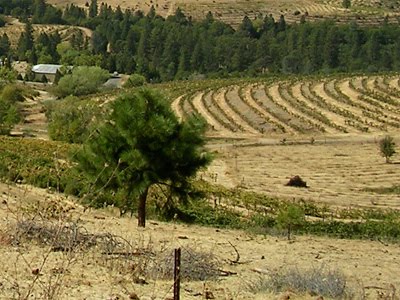
I snapped the photo at right last September at J.K. Carriere's new, to-be-planted vineyard site in Oregon's Chehalem Mountain AVA. It's appropriate for two reasons. One, the weather in Chicago this 4th of July is not unlike the weather seen at right: cool and cloudy. Two, I'm celebrating America's birthday by writing about two dry American rosés from 2008.

"Oh, rosé," you say, contempt welling into your eyeballs, "that's soooo 2006." Kidding. You know that I know that you drink rosé whenever you damn well please. And I know that you know that I drink rosé all year long, except during the darkest winter. If you're reading this blog, you're down with rosé (probably).

American dry rosés often resemble their red counterparts by erring on the side of fruit. I like minerals. I like spice. I like taut acidity. I like fruit, too, but I don't want it to muddle or obscure the other things that I like. Fortunately, I can find what I like.

J.K. Carriere Pinot Noir Glass 2008
Winemaker Jim Prosser sourced the grapes for this native-yeasted, barrel-fermented rosé from three organically or biodynamically farmed vineyards and says he "utiliz[es] lees addition and incorporat[es] Champagne methodologies from 100 years ago to strip color and broaden an earthy mid-palate, similar to a rosé Champagne from that era…without the bubbles."

I've never had a Champagne made prior to the mid-90s, so I can't directly confirm that, but I can tell you that this very pale and very, very dry rosé sings of sweet cherry, musk melon, grapefruit, and floral aromas in the mezzosoprano range. The acidity cuts a tin can like this and the palate shows soft minerals for days, while white pepper waltzes with demure cherry flavors on the long finish, which I totally dig. It's not particularly complex at this time, but it has the acid structure to go there. I have one bottle left, so we'll see...

Renaissance Rosé North Yuba 2008
Whereas J.K. Carriere produces 100% pinot noir rosé year after year from sourced grapes, Renaissance culls from their estate vineyard exclusively and is willing to radically change the composition from year to year. Whereas the 2007 rosé was based primarily on cabernet sauvignon, the 2008 (which, full disclosure, I received as a press sample) is 63% syrah and 37% cabernet sauvignon. But like the Carriere wine, this was vinified from organically-grown grapes, fermented with native yeasts (albeit in steel rather than barrel), and aged for a spell in oak — in this case, for 16 weeks in neutral German oak ovals.


This has the color of a watermelon Jolly Rancher but not its characteristics. Instead, it's a food-worthy rosé that's dry and spicy, with aromas and flavors of dry grassland, cherry, cantaloupe, and pepper. It's structured, its robust acidity is refreshing even after the wine warms to room temperature, and the finish balances fruit and minerals over 30-plus seconds. It's good partner with pasta tossed with leek, onion, and garlic, and damn, I wish I had more of this. Alas, with 2008 being a year of disastrous frost, Renaissance could only summon 57 cases.

Wednesday, May 20, 2009

Two Northern Rhone Syrah

I know I'm repeating myself, but I get slightly irritated when people criticize blowsy new world pinot noir-based wines as syrah-like. As in, "If I wanted a syrah..." The thing is, a self-respecting syrah can often be an elegant wine in its own right, no matter that it's darker (in all senses of the term) than a self-respecting pinot noir. It can simultaneously posess brawn and delicacy in equal measure. And when it's grown in granite-based soils, the wine can take on cool, stony, spicy tones that resonate.

That, at least, is what I hope for. I don't always get it.

Domaine Vincent Paris St. Joseph 2006
St. Joseph, the Chile-shaped appellation that lines the western side of the Rhône for 40 miles, has the steep granite terrain that can produce terrific syrah, but it also contains slightly less favorable terroir as well, which figures given how enormous this region is. I don't know where Vincent Paris sourced these grapes, exactly, but Polaner says the vineyards are "predominantly granite based."

Unfortunately, this wine is overly rough and rustic. Its aromas of cooked stone (which foreshadow a bit of heat on the palate), blackberry, and meat become more pronounced on the palate. The acidity is a bit rasp-making and the finish is focused on the middle front of the palate — it's distinctly absent toward the back. I call that wildly out of balance. I'd also say it's overly tart. Over four days I confirmed that this was simply not good, particularly at $30. Vincent Paris is a highly regarded producer, so I'm not sure what the deal is here.

Domaine Belle Crozes-Hermitage Les Pierrelles 2004
Let's hop over to the east bank of the Rhône to the plateau of Crozes-Hermitage. According to the Kacher Selections propaganda, "The Les Pierrelles vineyards are located below Hermitage and are covered with small calcareous/limestone granite pebbles." The grapes are 50% destemmed and 25% of the oak casks are new. I'd never had this producer's wines before, and I wasn't sure what to expect, particularly as 2004 doesn't have the best rep, and also because the wines that come from this appellation can, in my experience, be slightly dull.

But Belle pulls a nice one out of the hat: this Les Pierrelles is an elegant syrah with an unusually light footprint. The aromas are classic Northern Rhône: coffee, blueberry, cold stone, and cold grilled meat. It's smooth in the mouth, with peppery blue fruit and a subtly long minerally finish. This becomes more intensely spicy on the second night, and the tannins become a bit more burly. I could quibble at the price, which like the Paris is also $30, but I'm frankly not in the mood to quibble.

Tuesday, March 17, 2009

Renaissance's New Releases: Syrah and Roussanne

Looking down at Renaissance's roussanne vinesTransparency isn't just good for government and for financial institutions (cough, AIG, cough), it's good for wine. I like fruit as much as the next guy and don't usually take to truly austere wines, but my favorite wines show mineral energy and the stamp of place.

As I've explained ad nauseum, Sierra Foothills producer Renaissance makes terroir-driven wines: the grapes are organically farmed (they're now converting to biodynamics), harvested at roughly 24.5 Brix, fermented solely with native yeasts, and rarely aged in new oak. Because of these winemaking decisions, their wines are not just balanced and (often) elegant, they really show the rocky minerality that's unique to their steep, Hermitage-esque hill of decomposed granite, no matter how much ripe fruit the wines have.

This is certainly true of the newest Renaissance releases: the 2005 Syrah, the 2006 Roussanne Estate, and the 2006 Roussanne Vendanges Tardives.

I sampled the wines over two nights. The first night I made ravioli using fell-off-the-bone beef short ribs, steamed potato cubes dressed in cracked sea salt and pepper and olive oil, and a simple green salad tossed with balsamic vinaigrette. The second night I fixed roasted yellow pepper salad and broiled lamb chops that had been marinated in fresh meyer lemon juice, fresh rosemary, garlic, and cracked sea salt and pepper. Roquefort and grapes followed.

Speaking of transparency, you should know that I received these bottles as press samples (my first ever).

Roussanne Estate 2006
I was able to taste some 2006 reds from barrel during my visit to the winery last fall and was extremely impressed by the wines' balance and depth. As it turns out, the whites aren't so shabby, either.

The Roussanne Estate smelled a touch muted and musty when first popped, and I feared this was corked. All it took was a few minutes and a good vigorous swirl for the wine to unwind, and in fact this is hugely aromatic: the rich and intense aromas of tarragon, coriander, chai, baked fruit, and soy candle wax are lively and powerful. I also smell fresh rain on warm stone. The wine is wonderfully spicy on the palate and tastes of cardamom-dusted poached pears and lemon-splattered rock.

What's truly gobsmacking, though, is that for all the suggestions of richness, the wine is weightless. Ethereal is actually the better word. At the same time, the wine is persistent and focused. Certainly the relatively low (12.8%) alcohol level helps, but I think the bulk of the credit goes to the strong minerality. Whatever the cause, this paired well with even the meats, although it paired most majestically with the earthy, steamed potatoes.

Syrah 2005
I have had some lovely, balanced, and just plain excellent California syrah from producers such as Unti and Lavoro. But balanced or blowsy, the usual calling card for CA syrah is serious, dark fruit. This is different.

The 2005 Renaissance Syrah, which sees no new oak, has beautiful aromas of violets, fresh rain on stone, grilled meat, and sweet boysenberries. It is aromatically intense. It is not fruit-driven and shows less black fruit than any other Renaissance syrah I've had. Instead, the spicy, peppery, fine-grained tannins deliver leather and blackcurrant (!) flavors. The acidity is strong and masculine and gives the wine great lift on the palate, even as tannins coat the tongue. And there's a nascent, elegant richness that slowly shows with air.

Given how well this went with my broiled lamb chops, I could say that this primary, evolving wine is drinking well now. But I'm going to give my purchased bottles the time they deserve to develop — this should last at least two decades. And if I can't keep my hands off it, I'll decant it 24 hours before my meal.

Roussanne Vendanges Tardives 2006
When was the last time you had a late harvest Roussanne? Never? Yeah, me either. This is utterly, completely different than the Roussanne Estate. Of course, the grapes were harvested in early December 2006, a full three months after the Estate grapes, so that's not a surprise. And whereas the Estate was aged in young barrique, the VT was aged solely in large, neutral oak ovals that Renaissance imported from Germany at least a decade ago.

The nose is not unexpected for a VT — I'm talkin' pineapple, fresh and dried flowers, caramelized honey, and browwwn sugar, sugar. But here comes the surprise: it's practically dry on the palate. If it were German, you'd call it halbtrocken. It's barely sweet on the attack and is clean and very minerally on the finish. In between, the full and spicy flavors of pear, white pepper, brown spices, and rock persist on the midpalate for at least 30 seconds. It's really quite intense! A secondary surprise is that the acidity feels more acute than with the dry Estate wine, although the numbers (see below) would suggest otherwise.

Clearly, this isn't a dessert wine, so I paired this with a Roquefort cheese and fresh muscat grapes. It didn't work so well with the grapes, which were much sweeter than the wine. But while I wouldn't say you should forget Sauternes, this was terrific with the cheese, as the spiciness of each played well with each other, although it'd likely be even better with a slightly less intense cheese like Rogue River Blue.

the new Renaissance releases

WineABVpHAcidityRSAging
2005 Syrah14%3.26.47 g/l0.25%24 months in 1-6 year old barrique, then 9 months in large, neutral oak oval
2006 Roussanne12.8%3.186.9 g/l0.4%9 months in new and 1-2 year old barrique
2006 Roussanne VT14.4%3.4ns1.2%14 months in large, neutral oak oval

Monday, March 9, 2009

Drink Your Green Vegetables!

2006 Filliatreau Saumur-Champigny La Grande VignolleDo you like a hit of eucalyptus or mint in your cabernet sauvignon? Do you appreciate the green bell pepper flavors you can find in Loire cabernet franc? I sure do. Such qualities are rightly damned when they reflect underripe grapes or the dilution caused by overly high yields, but in the right proportions these characteristics can be interesting, worthy, and true.

I look for a hint of vegetables in my Loire cabernet franc, and I find them in the 2006 Filliatreau Saumur-Champigny La Grande Vignolle. This wine, which comes from the eponymous vineyard that's romantically sited between the Loire River and chalk cliffs into which houses have been carved, tees off with aromas of sweet smoke, roasted meat, ground pepper, purple flowers, green olive, and tart red fruits. Fabulous. As it's a bit on the dark side I wasn't surprised that the fruit is fairly concentrated, though not overextracted, and that the tannins are still a bit aggressive. In other words, it's got some oomph, but I expect that it'll be deeper and silkier in a year or two (good Loire cabernet franc needs at least three years to unfurl its flag). Finally, it has very nice acidity, a healthy dose of minerals, and of course the vegetable flavors — particularly broccoli and green bell pepper — are a feature rather than a bug, as they accent the drinking experience nicely. Meat and vegetables in one wine: it's like a meal!

Whereas I look for vegetables from a Saumur-Champigny, I would not expect that vegetable flavors would be welcome in a Northern Rhône syrah, and yet in the case of the 2005 Cave de Tain L'Hermitage Vin de Pays des Collines Rhodaniennes, they are. It's varietally correct, with aromas of bramble, stems, black pepper, violets, and blackberries, but it also includes a hint of fresh, juicy, green bell pepper. These characteristics are delivered to the palate with some really nice acidity and spice. There's plenty of ripe black fruit in this barely-medium bodied wine, and a clean, rocky, bell peppery finish. I do want to emphasize that the fruit is certainly ripe; the vegetable component is subtle and it is a feature, not a bug. So while the wine is not complex, it is balanced and very satisfying.

The kicker? It's only $10. Oh wait, there's a second kicker: the alcohol level's only 12%. You can drink this on a Monday night, as I'm doing this very moment.

Saturday, October 25, 2008

Scraps

I've been feeling indecisive about a lot of things in the last few weeks, and likewise I've placed all manner of wine on my table. Take, for example, the three disparate reds below.

Albet i Noya Tempranillo Penedès Classic 2006
While Albet i Noya subjects the biodynamically-grown grapes for this wine to carbonic maceration and eschews oak entirely, this is nicely structured and not at all overly fruity. That syrah comprises 10% of the finished wine has something to do with this, but it's primarily due to its acidic spine. It's quite affordable ($14) and should go well with a variety of foods, from cold soup to grilled meats.

Outis
Vini Biondi Outis 2002
The volcanic soils on the slopes of continually-erupting Mt. Etna are extremely young and very black, so you'd be excused for presuming that the wine would also be black and brash. Instead, the 2002 Outis is red-fruited and quite the elegant number. Now, it helps that this nerello mascalese-based blend (some nerello cappucino is here) is sourced from 2,000 foot elevation vineyards, and so we get a quite acidic wine with chalky and smoky red fruit aromas and mineral-laden sour cherry and strawberry flavors. This very good food wine needs air and there's still a lot of life left in it.

Jean-Louis Chave St. Joseph Offerus 2004
If this is my favorite of the trio of wines mentioned here, just know that I'm a sucker for ageable syrah that's simultaneously rustic, elegant, and deep. I first drank this 18 months ago and it continues to evolve slowly but surely, and I recommend a good decant if you want to drink this in the near future. While the stemmy, almost gritty tannins have an elbow-throwing charm when first opened, only by night three are they fully integrated into a wine of structured, masculine elegance. It has a great spine of acid and minerals, the tannins are briary, and the grilled meat and blackberry notes are great on both the nose and the palate. If I can find a few more bottles I'll sock 'em away.

Wednesday, August 20, 2008

Two California Syrahs

Syrah is the most abused grape. Yes, chardonnay is too often the Switzerland of white wines and cabernet sauvignon is in many hands merely a weed. But syrah is different. Outside of Australia, which churns out oceans of sweet and/or overbaked shiraz, the grape is typically the product of the artisan producer. And yet too many of these wines, particularly those from the new world, are little more than blueberry pancake syrup.

The best syrahs, though, can do what almost no other red wine can do, which is marry elegance and power into a succinct package, and transmit terroir with transparency. In short, they can be profound.

I drank the following 2005 California syrahs with relatively high expectations and at the end of the day I honestly didn't expect to play good cop / bad cop. Really, I only thought I'd be talking about how the two wines differ. But they really illustrate qualitative differences.

Rhys Alesia Syrah Fairview Ranch 2005
Given the praise that Eric Asmiov lavished on Rhys's pinot noir, I went ahead and bought a few bottles of both the 2006 pinot and the 2005 syrah that Rhys makes from purchased grapes and bottles under the Alesia imprint. I haven't opened the pinot but I did open the syrah, the grapes from which were grown in decomposed granitic soil in the Santa Lucia Highlands. I found it disappointing, to say the least. It's incredibly funky when first popped and the wood wasn't yet well-integrated, but the non-existent finish was the bigger problem. These issues were somewhat resolved by day two, and a nice spice note emerged, but the sweet-tannin-and-blueberry-juice character of this wine remained simplistic.

Now, this syrah actually has plenty of acidity, (probably) thanks to the cool-ish climate of the Santa Lucia Highlands, and soil seems right for syrah. Whatever the issue, this is a disappointingly simple wine. Although as so many California syrahs plain old suck, it does OK when graded on a curve.

Lavoro Syrah Sonoma Coast 2005
Without a doubt the best new world syrah I've had comes from the Renaissance Winery, who grow their syrah (organically) in the granitic soils of the Sierra Foothills. That said, the new Lavoro winery has released a syrah that, along with Reininger's 2003 Walla Walla syrah, is a pretty close second. At $45+ it's a special treat.

The Lavoro has muscle, sinew, and grace. It's well balanced, with minerality, acidity, and spice accompanying the smoky black fruit, and even a hint of red currant shows itself subtly. It's fermented as well as aged in oak, yet the wood is well-integrated, and it's very nice with grilled pork, grilled fish, and even green salad. Yes, ladies and gentlemen, a food-friendly Sonoma syrah!

But wait — there ain't no granite in the Sonoma Coast AVA! And the climate might just be hotter! So why is this so much better than the Alesia? Perhaps its the in-barrel fermentation regime, which the winemakers claim yields a wine that "is unparalleled in silkiness and texture." Or perhaps the quality is due to the iron-rich volcanic soils. Or maybe it's the climate. I can't really say...

I do have one caveat about the Lavoro: it started to fade after 48 hours. So unlike Renaissance's syrahs (let alone a traditionally-made Cornas) I wouldn't expect to cellar this past 2012. Nevertheless, Lavoro affirms that the new world can produce syrah of restraint and character as well as power. I'm glad to add another such syrah to my list.

Wednesday, May 7, 2008

A Good, Cheap Red From Nîmes

les galets rougesI can't tell you how pleased I am with the 2004 reds I've had from southern France at all price points. Freshness and vitality seem to characterize the vintage, and this $10 wine continues the run. I'm talking about the 2004 Chateau Mourgues du Gres Les Galets Rouges from the Costières de Nîmes. This appellation comprises the far southwestern arm of the Rhône region and, as the very name of this wine suggests, the same large, rolled pebbles that are found in Châteauneuf-du-Pape can be found here. The picture at right comes from the winery's web site.

The Galets Rouges is predominantly young-vine Syrah, complimented by at least 25% Grenache and 20% Mourvèdre (per Costières de Nîmes appellation rules) and a bit of old vine Carignan. It's aged in epoxy-lined concrete tanks (no oak!) for 12 months.

Coffee and blackberry notes dominate the nose, but the mouth action is what's particularly impressive: this is a completely balanced wine. The acidity and tannins are in harmony and the wine shows good length and depth. It's a large-bodied wine, and meat and pepper quietly nuzzle the ample fruit, but it's never heavy, thanks to the refreshing acidity. All for $10! OK, no one is expecting bedazzling complexity or nuance at this price and you won't find it here, but I've had enough very good cheap wine to demand balance and interest at every price point. This one delivers.

Oh, and I'm starting to wonder if 2004 is more my kind of vintage from the Rhône than the much-heralded 2005, which produced bigger, heavier wines. Being the Rhône boy that I am, I'm not about to shy away from further investigation!

Saturday, April 5, 2008

A View of BSG from Tulbaugh Mountain

The fourth season of Battlestar Galactica premiered last night so naturally I packed up some buttery, aged goat cheese, the 2004 Tulbagh Mountain Vineyards Syrah Mourvèdre, and padded over to Shawn and Kyle's.

I was glad to get into the wine before the show started. Tulbagh Mountain's Syrah Mourvèdre — 85% of the former, 15% of the latter — is certified organic and whereas many South African wines have that burnt-rubber aspect, this is a big, smoky, spicy wine that has tons of depth and grace. Blackberries and blueberries both, some meaty aromas, lots of ground black pepper, more acidity than I'd expected, and flint for days. And man, was it good with that aged goat cheese. Tulbagh Mountain Vineyards show that even with very young (5 years old) vines, impeccable farming and winemaking (no yeast innoculations, very low 25ppm sulfur) can yield a really, really good wine. It's an expensive wine, but as far as I'm concerned, it was $36 very well spent.

It was a big and nimble wine for a big and nimble episode. The opening battle sequence was probably the most dizzying and impactful I've ever seen in SF/fantasy; that the show's creators could sow such chaos without losing the viewer's understanding of events is stunning. They artfully blended New and Old Testament allegories into Gaius Balthar's arc. We all screamed when Tigh raised his gun, we murmured in astonishment as the Cylon Raider scanned Sam, and if I was slightly doubtful of Starbuck's specific act at the end of the episode, it ably demonstrated that she is different now, possessed and obsessed. Who is the last Cylon? Given her reaction when arriving at the Ionian nebula I voted for President Roslin, but Graeme pointed out that she has the blood of a half-Cylon coursing through her veins, which perhaps accounts for it. I will be forced to miss the next two episodes, as I'm taking a trip to Mexico, but I will catch up with it very shortly after returning.

BSG - Laura Roslin, Cylon?

Tuesday, April 1, 2008

Another Renaissance, and Another

A recent, small flood of Renaissance Vineyards wine has compelled me to open two floodgates, lest the dam burst.

First up, a short and easy note about the 2004 Renaissance Syrah, which I brought to my friend Paul's dinner party, at which he made a bacon-flecked quiche. This is a relatively early, easy drinker compared to the 2002. Its acid core is less mighty, its essence slightly less profound, but it's still nothing less than terrific. It features roll-your-eyes-back-in-your head aromas of meat and spice and all the dark, lively fruit you could hope for. And it's pure, motherscratcher, thanks to the clear Sierra skies, the thin granite/diorite soils, and the organic viticulture. Now, I didn't spend as much time with my wine as I might have, as the dinner party was a lively ricochet of conversation, but I noticed it, secretly and otherwise. Yes, I noticed.

The 2000 Renaissance Cabernet Sauvignon, which I drank at home over the course of three days, is one fascinating time trip. The grape is typically not my thing and I wasn't bowled over by this wine, but it is most definitely alive. The first day, it's a massive, impenetrable wall of black and blue fruits, a hint of espresso, and tannins. Although it was obviously not overextracted, overripe, or overoaked, I could only taste youth and climate.

It's shocking to me that a 2000 California cab can taste so young and primary in 2008, but that's part of the story here.

This was a different animal on day two. Hello, red fruits! The nose was dusty dark cherry as if it were Sangiovese in drag. I was not expecting this. The robust acidity was delivered with well-structured red fruits of pomegranate, cranberry, and cherry, and if the finish was still a bit short, it had a nice, high presence at the midpalate, and it went nicely with my Middle Eastern food.

On the third and final day, secondary characteristics of leather and spice box emerged. The cherry flavors flagged slightly yet maintained some refreshing acidity, while the tannins likewise softened without losing all sense of structure. Time to break out a brisket.

Renaissance claims that due to their low yields (1-1.5 tons per acre on average), their production costs are anywhere from 5-6 times the Napa/Sonoma averages. If Napa averages 4-5 tons per acre, the math isn't quite there, but no matter: the drinking satisfaction is exponentially higher; and yet this Cab cost just $30, a bargain compared to many a slop pail sloshed out in Napa.

Thursday, January 17, 2008

Three Exuberant $12 Reds!

I don't care what Brooklynguy says! I'm going to use exclamation points!! Because these are exuberant wines!!!

No, really — when I consume wines like the ones here, I envision cartoon exclamation points circling my head. To me, "exuberant" wines shower the mouth with spices and herbs. They're joyous rather than serious. Exuberant wines are full of life, carefree and vivacious, but not shallow — rather, they're engaging in ways that many serious wines are not (sometimes you feel like a nut; sometimes you don't). I don't think anyone's confused What's Opera, Doc? with Wagner — but isn't What's Opera, Doc? genius in its own right?

I've tasted the following wines over the last month or so.

Zantho Zweigelt Burgenland 2006
This Austrian red may be the most exuberant-ish-ist of them all, for this is one of the most extroverted, joyful little wines I have tasted. It bursts with pomegranate and raspberry fruit and it sings with strong notes of briar and pepper. Interestingly, I haven't been taken with the other Zantho releases I've tried (a St. Laurent and a Muskat), but this one makes me laugh.

Guilhem Durand Vieilles Vignes Syrah Vin de Pays d'Hauterive 2004
This is a really lovely Syrah from the Languedoc that overdelivers at its price point. Its rocky nose drives cool blueberry, sweet black cherry and a hint of cinnamoned green apple upward while a bit of blackberry and dried cherry join the above in the mouth. The acidity is proud but unobtrusive and the tannins are modest and the finish is long and stony and even a bit spicy; it reminds me of a nice Barbera. Refreshing, balanced and lovely.

Château Tour Boisée Minervois Cuvée Marielle et Frédérique 2004
This is the most profound of the three wines here, and I've consumed three bottles of this in the last 4 months to my total delight. It smells utterly purple: lavender and blueberry and plum. There's underbrush here, too. Briar. Thyme. Marjoram. Solid tannins and sweet blueberry fruit, with refreshing acidity and a nice long finish of herbs and blackberry. Spicy, rich, and balanced. Hurrah! This is, strikingly, dominated by Cinsault — it's 35% Cinsault, 25% Grenache, 15% each Syrah and Carignan, and 10% Mourvèdre. It was aged for 8 months in concrete vat — no oak! I can't recall a better $12 red.

Monday, October 22, 2007

A Renaissance for California Syrah

After last weekend's late harvest of summer, fall returned today with the bite of wind, chill, and rain. Why not open a Syrah, then?

Then again, why a Syrah at all? Few wines piss me off more than Australian Shiraz and Californian Syrah. The grape's one of the greats, but it's far too easy to pay far too much for overly extracted, overly alcoholic, sugar-ridden fruit bombs that reek of heat. The Cola-Cola simplicity of these monsters is particularly infuriating, which is why I usually turn to the Rhône and sometimes the Languedoc for my Syrah.

But I took a risk on the 2002 Renaissance Syrah from their organically cultured, own-rooted, very low yield, high-elevation (1700'-2300') loam-and-granite vineyard in the Sierra Foothills. Matt Kramer claimed that their 2003 "Vin de Terroir" Syrah is "intense yet balanced... a very great syrah, the sort better associated with the likes of Hermitage and Côte-Rotie than California." Kramer's palate is reasonably in line with mine, so I decided to order that wine, which is made for extended aging, along with a 2000 Cabernet and this 2002 Syrah. A bit of a risk at $30 a bottle, but it's less than many gross Californian Syrahs.

Let me tell you, I'm going to be ordering more soon. The "basic" 2002 blows away every California Syrah I've ever had. Warm blackberry scents and chalky aromas promise beauty, and that beauty plays in spades in the mouth: for all its power and concentration, it's delicate. The tannins are smooth but they grip the far reaches of the tongue, while the acidity keeps the mouth watering. There's not much to say about fruit here — there's plenty of it, black and blue both, but fruit is not the point. Balance and delicacy is the point. At the same time, it's meaty, minerally, and just a bit peppery.

For all this beauty, the acid core is MIGHTY, and it could use another year, or three, or ten — who knows? — to deepen further. More evidence: on the second day it actually began shutting down. I love that! I love it when a wine, like a person, shows it has a mind of its own. I'm looking forward to checking in with the Renaissance Syrah again in a few years, to see what's on its mind then.