
I have been away for far too long. Now, I am back to tell you my wine stories.
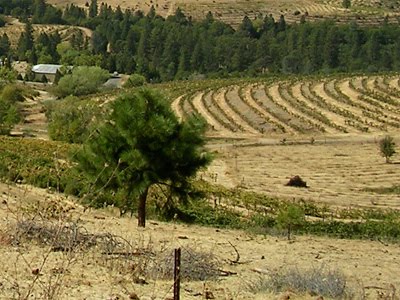
After eight years in Chicago*, I have moved to Oregon's Willamette Valley. Specifically, I live in Corvallis, which is about 50 miles south of this state's most storied vineyards. If appellations such as the Dundee Hills are quite accessible, my new site-uation gives me the ability to visit more isolated vineyards, some of which are quite small and tucked into folds of the Coast Range foothills, quite removed from the state's primary media center.
Up close, it's good to ask questions such as, What does it mean to be a grape planted at 45 degrees north in this part of the world? If Jory soils are less common than in the northern valley, what does that mean to the winemakers, and what is their conception of terroir? Why is the regional identity what it is? Who are the iconoclasts who are questioning the way things are done?
As I travel up and down the valley, I find that baseline quality is high. It's tough to find confected, fat-fruited wine; it's rare to find an overoaked wine of either color. If I pull over and visit a small producer whom I've never heard of, I'm practically assured of finding a pinot noir that was raised according to the "recipe" of reasonable brix and roughly 25% new barrels. If producers were focused on making big, dark pinots just a few years back, it's my perception that this is less the case – and if my comparison of 2009 to 2006 is accurate, it does seem that producers are dealing better with the hot vintages, with the resulting wines showing more freshness and elegance.
And yet, beyond a happy few, I've yet to find much pinot noir (or pinot gris, etc) that is terroir-expressive. Clone-expressive, yes, but too often not terroir-expressive. I wonder why this is. Is it the relative youth of many of the vines here? How strongly is it related to dry farming? Do most producers inoculate with the same "neutral" packaged yeast? How much is a question of focus? (It's been interesting to ask people about their soils. Too many get a glazed look and say "Jory," which sure makes it seem like they're making it up, or say they just don't know. I find this fascinating.)
Where are the iconoclasts and the mad scientists? A couple of guys are planting tempranillo and syrah in this cool climate. There is the guy who just harvested pinot at 17 degrees brix and who will make an undoubtedly interesting wine from it (I tasted the unfermented grapes and they are bright, alive, delicious, with brown seeds you can crunch through). Beyond these few, and beyond the deep thinkers, I wonder. Winemakers here have learned lot of tough lessons over the years and, as I understand it, the sharing of that knowledge has been invaluable about raising overall quality. But there is a fine line between regional identity and groupthink, and it'll be interesting to find out what ideas hold sway, why they are held, and how they are applied.
I've babbled enough for now. Let me just sum up by saying that it's good to be back.
* Since I no longer live in the Wicker Park neighborhood, does that mean I have to change the blog name?
Sunday, November 13, 2011
Now Living in the Willamette Valley
Saturday, April 16, 2011
A Mosse and a Baudry from 2009

Bernard Baudry Chinon Les Granges 2009
I adore Baudry's wines and I was expecting full young fruit, easy drinking, and expressive typicité in equal measure, with a low 12.5% alcohol promising a snappy attack. In practice, this has all the classic, lovely aromas I love about Chinon, but although the wine is nicely proportioned, with the acidity and fruit and minerality seemingly in their right places, the palate is strangely muted; it just doesn't have the spark, the informal elegance, or the mid-palate depth that I associate with Les Granges at this age. I drank this over three days' time in the hopes it would blossom, but it never unfurled (and actually it just turned slightly medicinal by the third night). Curious. John Gilman reported a favorable experience; might this be undergoing a particularly sullen adolescence?
Mosse Anjou Blanc 2009
I'm really honing in on the structure and acidity of the 2009 Loire whites I try (and by "whites" I really mean Muscadet and chenin from its many appellations). I'm asking myself if they have the bones and the guts for aging, or if even hints of softness that apparently mark some wines obscure terroir and suggest a short life.
Agnès and Réné Mosse's basic Anjou Blanc suffers not the least from softness. Rather, I was overjoyed (as in, you would have told me to settle down) to find a marvelous and highly expressive wine with considerable focus and complexity. There's some passionfruit on the nose that's allied to cantaloupe and ginger aromas, but any tropical fruit characteristics are solely aromatic. It's the snappy, medium-bodied palate that really makes me happy; there's a spicy singularity here that obviates the need to list the many descriptors I could use, particularly as it's so complete and quite long. That the vines for this cuvée were planted within the last ten years make the complexity and singularity that much more impressive. The mere 7 grams of RS are not enough to render this a sec tendre; it tastes completely dry, and the alliance of austerity and voluptuousness that is a hallmark of top-notch Anjou sec is in full force here. People, can you feel the love? I sure can.
Thursday, February 17, 2011
Random Whites Roundup, February 2011

Ilarria Irouléguy Blanc 2009
This white Irouléguy, a 50/50 blend of organically grown petit manseng and petit courbu, is one reason why I'll be posting more soon-ish on the wines of Southwestern France. It starts with tropical fruit on the nose (guava, passion fruit) and then, intriguingly, it goes all orchardy on the palate, showing crisp white fleshed fruit and grass/straw/herb characteristics. Bee sting acidity is nicely intertwined with minerals and a fleshy yet tightly coiled body that's very dry, even austere. This has superb length and self-confidence, but it's somehow unshowy to boot. I should have bought more! Fun fact: petit courbu is the same grape as Txakoli's hondarribi zuri.
Stéphane Tissot Savagnin Arbois 2004
Hmmm, not entirely sure about this Tissot. I get full fathom five brine, acidity that lashes the tongue like a cat o' nine tails, nuts clattering across the counter, lemon pith — yes, this is forceful rather than delicate, and it showed better on the second night, as it has relaxed somewhat. Still, it's awfully aggressive. I'm not your go-to guy on all things Jura but I like Montbourgeau's more delicate expressions of oxidized whites more, although perhaps this just needed more time (or less, not sure).
Brick House Chardonnay Ribbon Ridge 2008
Oaked New World chardonnays rarely thrill me, but this Puligny-esque effort from Oregon's Brick House almost does due to its bright acidity, well-structured flesh, creamy yet firm texture, and — the most important thing to me — its strong mineral signature, which really brings home the complexity on the finish. I wouldn't say this is lightly oaked, and for my personal tastes (and because it limits food pairing choices considerably) I would like to see less, but on a more objective level this is really very good. Also, it's far from drowning in popcorn butter. I would guess that the oak-derived flavors of nut and vanillin will be still more well-integrated in the coming years, as this has the balance for some aging.
Tuesday, February 15, 2011
Random Reds Roundup, February 2011
Here are a few really cool reds I've had in the past two months. Different countries, different regions, different grape varieties, but each have strong, noble personalities that suggest great and long lives lived on their terms. If you don't like tasting notes, move along.
Vieux Télégraphe Châteauneuf-du-Pape La Crau 1998
I drank this elegant, beautifully poised VT in the heart of winter, just as one should. It showed no baby fat on night one, no exuberant fruit, yet it still drank very young and lacked secondary characteristics. It was also very clean, with no hint of brett or funk. It advanced significantly on night two – lots of tobacco and earth came to the fore, the umami was cranking, with soy and mushroom notes entangling the fresh purple berry fruit, and the tannins turned leathery. I won't pretend to understand this wine based on just one bottle but I get the sense this wine will have a lot to say over the next 10+ years as its tannins resolve and its fruit fades. If I had to do it all over again, I'd decant two to four hours ahead of time and make sure it was all gone by night's end.
Renaissance selects grapes from their best, rockiest soils for their VdT bottlings. As with their cabernets, their syrahs are living — and long-lived — wines that emerge on their own terms. Some go through more than one adolescent period before emerging into early maturity at, say, five to ten years. I tracked this seven year old over three days (with no preserving gas or whatever, just a dark place and a cork) and even at day three this was remarkably youthful. It showed lively and spicy tannins, robust acidity, primary fruit, and serious, refined minerality. It actually started off middleweight, then with air gained heft without ever losing its freshness, proportion, and balance. Despite its 14.5% alcohol this shows not heat but rather cooling mint tones on the palate. Otherwise, the wine is characterized by Provencal herbs, black pepper, blackcurrant (this is not a fruity syrah), and rocks. This rough-elbowed youngster is evolving into something very promising, indeed, and in many ways already evokes a very good Cornas, and it certainly will have the life span of one.
Giacomo Conterno Barbera d'Alba Cascina Francia 2005
Even five years in the acidity is very strong willed and I waited, on its terms, for it to decide when it wanted to be drunk. Even 24 hours later ('twas left in bottle with only one glass consumed) it was a very firm if exotically scented barbera, all cedar and huckleberry laced with meatiness and spice, and the tannins delivered a swift slap to the cheeks. It's concentrated, yet almost weightless, and very fresh and pure, and really it needed quite a bit more time. Given its tannins I thought this would go well with steak but the fruit was too bright - pasta bolognese, maybe?
Sunday, February 13, 2011
2009 Beaujolais, Or At Least Four of Them

So I applied a jaundiced eye toward 2009 Beaujolais, and at first my skepticism seemed appropriate given one rather ho-hum bottle I had and another that showed California weight allied with simplistic overripe flavors, and which was almost bad. But these were feints, as I found some from reliable producers that are not just fresh and lovely and drinkable right now (I find that cru Beaujolais typically needs at least 2 full years from harvest, if not more, to show well), but which are even deeper and and more complete than usual, and which therefore seem to justify much of what I've read. Sure, time will tell, but sometimes the time to ask is right now.
Pierre Chermette Beaujolais 2009
Certainly I would expect this bottle to be lighter and more now-ish than any of the below cru wines, but I was pretty surprised by just how ethereal this was, and just how engaging I found it. It's sappy and long and stony, but not complicated. It's fermented in concrete and stainless steel solely with indigenous yeasts and it's a joyful wine for drinking right now — heck, right this minute, if you have a bottle handy.
Christian Ducroux Régnié 2009
This is a terrific expression of granitic Beaujolais, unsulfured and very clean. Initially the semi-carbonic fruitiness struck me as a bit rote, but the wine blossomed over a few nights and in the end it seemed lively yet contemplative. It's a wine that enunciates. It's nicely structured (the acidity is prominent without being sharp), stony and a bit peppery, with lovely raspberry fruit.
Marcel Lapierre Morgon 2009
When I touched this bottle at a local shop, I thought, "Wow, it's hot. I'd better buy this certainly-ruined wine so that people are not misled into thinking Lapierre makes crap." Perversely, I later thought, "I can't open this, it's too young to show well." I opened it anyway, and found I was wrong on two counts. This was not merely sound, approachable, and tasty, it was subtle, impeccable, multidimensional, complex, and harmonious. The stuff was cranking. Sour cherry, chorizo, mushroom, and rhubarb aromas carried over to the palate and were joined by granite-derived black pepper and coriander spice, a subtly tannic structure, and juicy boysenberry fruit. So fresh. So pure. So long. How so young a wine can be both complete now and also ageworthy is a notion I cannot address. RIP M. Lapierre.
Coudert Fleurie Clos de la Roilette Cuvée Tardive 2009
Katherine Hepburn as a wine. The 2009 Cuvée Tardive (which is not a late harvest wine, but rather a wine made from old, even 80 year old, vines) is firm and structured right out of the gate, with an upright, formal bearing that keeps you at arm's length; you have to admire it from afar at first. Soon enough it turns more inviting, whereupon you can banter with its complex beauty. Strawberries and crushed raspberries, polished stones, savory spices, black pepper, red floral elements, and a touch of smoke, all delivered with suave sophistication. It's concentrated, with fine and structured tannins, but shows little weight. This is gonna last a loooong time.
Thursday, February 10, 2011
A Roussanne From Jean-Paul Brun

Although the label advises one should drink up quickly due to the very low sulphur additions, this held up well over two days. Full pear and apple flavors are delivered in the context of a creamy texture enhanced by minerals, savory hazelnut tones, a top note of chalk and smoke — as if nuts had been lightly toasted — and a slight bitterness that's very nice to experience. There's a lot going on here, but it all seems effortlessly complete and together, and not overly intellectual.
The grapes spring from Brun's yellow limestone (terres dorées), not unlike the limestone soils in (warm) western Paso Robles and the (cool) Chignin cru of Savoie where roussanne can also excel. That said, roussanne can also perform very well in a variety of soils, including granitic and volcanic soils. The grape is a bitch from the farmer's perspective but if mesoclimactic conditions are favorable then a roussanne can be a particularly interesting wine from mineral-giving soils, and a rebuke to anyone who thinks that whites are inherently less interesting and serious than reds. To winemakers in such sites I say: more, please.


 Posts
Posts


