Showing posts with label g - Grenache. Show all posts

Tuesday, February 15, 2011

Random Reds Roundup, February 2011

Here are a few really cool reds I've had in the past two months. Different countries, different regions, different grape varieties, but each have strong, noble personalities that suggest great and long lives lived on their terms. If you don't like tasting notes, move along.

Vieux Télégraphe Châteauneuf-du-Pape La Crau 1998
I drank this elegant, beautifully poised VT in the heart of winter, just as one should. It showed no baby fat on night one, no exuberant fruit, yet it still drank very young and lacked secondary characteristics. It was also very clean, with no hint of brett or funk. It advanced significantly on night two – lots of tobacco and earth came to the fore, the umami was cranking, with soy and mushroom notes entangling the fresh purple berry fruit, and the tannins turned leathery. I won't pretend to understand this wine based on just one bottle but I get the sense this wine will have a lot to say over the next 10+ years as its tannins resolve and its fruit fades. If I had to do it all over again, I'd decant two to four hours ahead of time and make sure it was all gone by night's end.
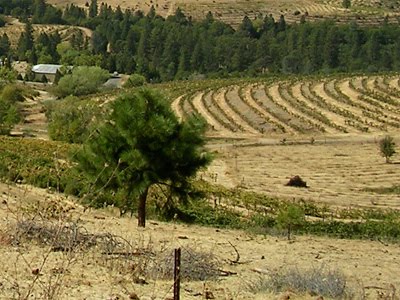
Renaissance Syrah Vin de Terroir North Yuba (Sierra Foothills) 2003
Renaissance selects grapes from their best, rockiest soils for their VdT bottlings. As with their cabernets, their syrahs are living — and long-lived — wines that emerge on their own terms. Some go through more than one adolescent period before emerging into early maturity at, say, five to ten years. I tracked this seven year old over three days (with no preserving gas or whatever, just a dark place and a cork) and even at day three this was remarkably youthful. It showed lively and spicy tannins, robust acidity, primary fruit, and serious, refined minerality. It actually started off middleweight, then with air gained heft without ever losing its freshness, proportion, and balance. Despite its 14.5% alcohol this shows not heat but rather cooling mint tones on the palate. Otherwise, the wine is characterized by Provencal herbs, black pepper, blackcurrant (this is not a fruity syrah), and rocks. This rough-elbowed youngster is evolving into something very promising, indeed, and in many ways already evokes a very good Cornas, and it certainly will have the life span of one.

Giacomo Conterno Barbera d'Alba Cascina Francia 2005
Even five years in the acidity is very strong willed and I waited, on its terms, for it to decide when it wanted to be drunk. Even 24 hours later ('twas left in bottle with only one glass consumed) it was a very firm if exotically scented barbera, all cedar and huckleberry laced with meatiness and spice, and the tannins delivered a swift slap to the cheeks. It's concentrated, yet almost weightless, and very fresh and pure, and really it needed quite a bit more time. Given its tannins I thought this would go well with steak but the fruit was too bright - pasta bolognese, maybe?

Monday, January 4, 2010

This Was Not Supposed To Be the New World

Those of us who love balanced, complex, traditionally-proportioned, terroir-focused, affordable wines tend to flock to the Old World. This makes sense to a large degree. The history of wine production "over there" spans centuries and more, whereas winemaking in the New World goes back but a single century, and then usually not even that. So many of the most conscientious of winemakers here are still figuring out what works where.

Then there are the factors such as warmer climates, UC Davis's heat summation scale, critics' 100 point scales, a culture that frequently equates wine with wealth, and the influence of corporate agribusiness which set up a dynamic in the New World that favored — and usually still favors — the production of simple, manipulated, and/or ridiculously opulent and alcoholic wines. Heck, Randall Grahm goes so far as to say that "the manifest non-expression of terroir in our wines is the greatest source of anguish in my winemaking life."

On top of that, importers of European wine such as Dressner, Rosenthal, Theise, Chadderdon, De Maison, Headrick, et al offer us reliable portals to some of the most interesting wines on the planet, but to my knowledge, domestic producers have no such portals. So those who do make reasonably-scaled, subtle, complex, specific wines are at a disadvantage, as they are less likely to find their natural audience. This sets up a vicious circle: people like me reflexively seek out Old World traditionalists because — excepting producers such as Edmunds St. John, Renaissance, and The Eyrie Vineyards, to name a fistful — I find it difficult to find worthy New World traditionalists and I'm well skeptical of those who market their wines as balanced and terroir-specific. (Your "cool climate" pinot flirts with 15% alcohol? No thanks! Not even if your wine were $40 less than it is...)

All this was made more apparent to me over the holiday period, as I drank two New World wines that if not as specific and terroir-driven as I'd like still delivered far more than I expected.

Of course, I doubt that few of you would blame me for assuming that a 1996 sangiovese from Napa Valley — particularly one that my parents stored for years in a closet at room temperature — would be DOA in 2009, a swampy hot mess. Yet the 1996 Villa Helena Sangiovese Napa Valley was as fresh as a daisy, very well proportioned, and most remarkably, varietally correct. That is, it was quite light-colored, showed aromas of violets, and the cherry flavors had really nice lift. I'm not sure where its peppery spice came from, but in any case it went very well with a sausage and tomato-festooned pasta. What it lacked in complexity it made up for in elegance. Unfortunately, this winery is no longer, so I guess that's that.

The 2006 Yalumba Barossa Bush Vine Grenache was perhaps an even bigger surprise. It was fine and decent on the first night, obviously nicely made but not terribly interesting, yet it really improved on the second night, showing bright and dense cherry flavors, unconfected acidity, and long undercurrents of thyme, black pepper, fennel, and umami. I never thought I'd tell anyone that they could hold a four year old, $15 Barossa grenache — not even one made from 30 to 70 year old vines — for another five years so it shows even greater interest and complexity, but that's exactly what I'm telling you now.

One of my new year's resolutions is to more proactively research, track down, and drink well-proportioned New World wines. I want to break the vicious circle. Sure, it won't always be easy to find the good stuff at prices I can afford, but isn't that part of the fun?

Wednesday, December 23, 2009

Another Cannonau From Sardinia

Ambito 2007 Cannonau di SardegnaPinot noir is frequently described as a "difficult" grape. That makes sense — it's literally thin-skinned, fussy in the vineyard, and requires the right conditions (and guiding hand) to yield a wine that's simultaneously deep and graceful. Grenache is never described as difficult, but in its own way it strikes me as just that. Grenache may grow easily and be found at a variety of latitudes in warm climates around the world, but it too requires the right conditions (and guiding hand) to yield a wine that's simultaneously deep, graceful, and transparent. I mean, not everyone in the Rhône is Château Rayas, right?

Grenache — called garnacha in Spain and cannonau in Sardinia — is typically a juicy grape, and a lot of times this means the fruit will be very forward, plush, simple, and often blowsy. So it's often blended with other grapes to provide acidity, lift, depth, and additional interest. But as Rayas proves, grenache can have all these things on its own if all the conditions are right.

I'm not going to tell you that the $17 2007 Ambito Cannonau di Sardegna produced by the Cantina Sociale della Vernaccia has the depth or grace of a $100+ bottle of Rayas Chateauneuf-du-Pape, but I will tell you that this wine, as with the (only) other Sardinian cannonau I have tried, is plenty more transparent than your typical bottle of varietal grenache. Heck, I reckon that even noted grenache-hater Lyle Fass would appreciate this. Yep, it's juicy and imbued with dark, slightly-baked fruit, but it's neither plush nor blowsy. Instead, it's restrained by a strong undertow of juicy anise, bitter pith, wild herbs, and firm, dry earth. It'd be great if it was more structured, but it definitely features a nice slap of acidity.

My attempts to learn more about this wine have been frustrated. The producer's web site mentions nothing about the Ambito and US importer Selected Estates has zip on any of the producer's wines. So I've no idea how the grapes were raised or if this was aged in tank, concrete, and/or oak (although obviously not much of the latter, if any). What I can tell you is that it was terrific with a cashew and herb-laden pasta and I'm pretty sure it would be even better with lamb.

Wednesday, May 7, 2008

A Good, Cheap Red From Nîmes

les galets rougesI can't tell you how pleased I am with the 2004 reds I've had from southern France at all price points. Freshness and vitality seem to characterize the vintage, and this $10 wine continues the run. I'm talking about the 2004 Chateau Mourgues du Gres Les Galets Rouges from the Costières de Nîmes. This appellation comprises the far southwestern arm of the Rhône region and, as the very name of this wine suggests, the same large, rolled pebbles that are found in Châteauneuf-du-Pape can be found here. The picture at right comes from the winery's web site.

The Galets Rouges is predominantly young-vine Syrah, complimented by at least 25% Grenache and 20% Mourvèdre (per Costières de Nîmes appellation rules) and a bit of old vine Carignan. It's aged in epoxy-lined concrete tanks (no oak!) for 12 months.

Coffee and blackberry notes dominate the nose, but the mouth action is what's particularly impressive: this is a completely balanced wine. The acidity and tannins are in harmony and the wine shows good length and depth. It's a large-bodied wine, and meat and pepper quietly nuzzle the ample fruit, but it's never heavy, thanks to the refreshing acidity. All for $10! OK, no one is expecting bedazzling complexity or nuance at this price and you won't find it here, but I've had enough very good cheap wine to demand balance and interest at every price point. This one delivers.

Oh, and I'm starting to wonder if 2004 is more my kind of vintage from the Rhône than the much-heralded 2005, which produced bigger, heavier wines. Being the Rhône boy that I am, I'm not about to shy away from further investigation!

Saturday, November 17, 2007

Move Over, Bacon!

Serre de Catin
Now this wine is just silly. I'm talking about the 2005 Clos du Mont-Olivet Serre de Catin Côtes du Rhône, which is 100% tank-aged Grenache from 35 year old vines. My friendly local retailer, who has excellent taste (i.e. his agrees with mine), wrote a blurb saying it put many a Châteauneuf to shame (!), and it seemed a great opportunity to taste the unblended, unadulterated essence of Rhône Grenache from a terrific producer.

The nose does exhibit pretty black pepper, bacon fat, and thyme aromas, but over two days of tasting all I get in the mouth is bacon fat and, to a lesser degree, raspberry ganache. There's lots of glycerin here. The acidity is modest and there are no tannins to speak of. More disappointingly, it's a bit flat at the midpalate and the finish is both short and a bit hot, although a faint saltiness sticks around and adds interest. All of this would be fine at $12 — it's a perfectly fine drink — but I shelled out $23.

God bless the Sabons, but I'm not taking this little piggy to town again.

Photo by Flickr user el_monstritro used under a Creative Commons license

Saturday, September 29, 2007

I Am a Grenache Lover

With Lyle Fass proclaiming himself a Grenache hater, what better way to kick off this blog than with a defense of Grenache?

Granted, Lyle says that "there are certain wines I am thinking about as a Grenache hater," specifically overcooked Robert Parkerized tete de cuvees from Chateauneuf, but I love the Rhône Grenache blends in part because the majority of them are not like this.

The basic 2005 CDR from Domaine Chaume-Arnaud that I brought to Shawn and Kyle's last night will serve as Exhibit A. This vibrant, fresh, medium bodied red jogs easily past the finish line, with pepper and wild herbs rooster-tailing in its wake (Cinsault (10%) and Syrah (30%) join Grenache in the blend). The raspberry fruit had just the right touch, neither sweet nor fat.

It was, in short, a vigorous wine, an alive wine, a balanced wine, but one modest enough to be simply enjoyable.

The Chaume-Arnaud family raised this wine in organic soils, harvested the grapes by hand, and let the juice spend 8 months in stainless steel and cement — no oak. And bad dollar and all, we got to experience this love for a mere $15 retail.

An organically grown, lovingly raised, very affordable wine of character... What's not to love?